
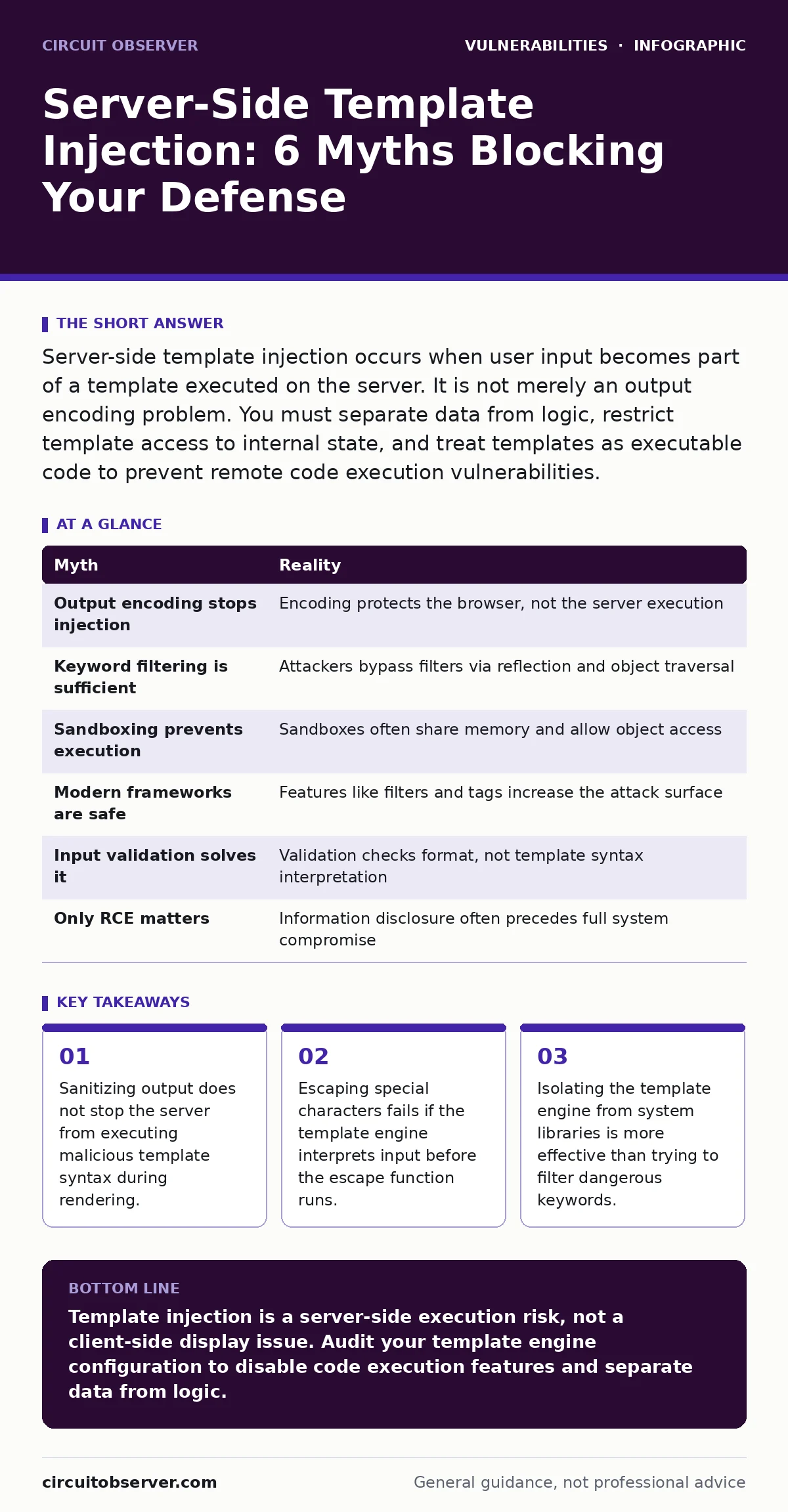
Server-side template injection occurs when user input becomes part of a template executed on the server. It is not merely an output encoding problem. You must separate data from logic, restrict template access to internal state, and treat templates as executable code to prevent remote code execution vulnerabilities.
Myth: Output Encoding Stops Template Injection
Reality: Encoding characters for HTML display does not prevent the template engine from parsing and executing logic. When you escape a string like <script>, you change how it looks in a browser. You do not change how the server processes the template file. The engine reads the raw input, interprets the syntax, and executes the logic before it ever sends data to the client.
Imagine a template variable {{ user_name }}. If an attacker inputs {{ 7 * 7 }}, the engine calculates 49. Encoding this result to <49> protects the browser from cross-site scripting. It does nothing to stop the server from performing the calculation. The damage occurs during the rendering phase on the server, not the display phase on the client.
This distinction matters because many security tools focus on output encoding. They assume that if the output is safe, the input was handled correctly. For template injection, this assumption is false. The execution happens before the output exists. You must treat the template language as a programming language, not just a markup format.
Myth: Filtering Dangerous Keywords Is Enough
Reality: Blacklisting specific keywords like exec, system, or import is easily bypassed. Template engines often have multiple ways to achieve the same result. An attacker can use reflection, object property access, or chained method calls to reach dangerous functions without using the forbidden words directly.
Suppose you block the word import. An attacker might access the import function through a global object or a class method that does not contain the word itself. They can traverse the object graph to find executable code. This is similar to how mass assignment vulnerabilities allow attackers to modify hidden fields by exploiting the framework's binding logic. The filter sees safe words, but the engine executes dangerous actions.
Keyword filtering also creates a maintenance burden. As the template engine updates, new methods appear. Your filter must update instantly. If it lags, the application is exposed. This approach assumes you know every possible attack vector. You do not. The attack surface is defined by the engine's capabilities, not your list of banned words.
Myth: Sandboxing Automatically Prevents Code Execution
Reality: Sandboxes often fail because the template engine shares the same runtime environment as the application. A sandbox restricts certain actions, but it rarely isolates the memory space. If the attacker can access any object in the application memory, they can often find a path to system commands.
Many developers believe that setting a "safe" mode in the template engine is sufficient. This mode usually restricts direct access to system functions. It does not restrict access to application objects. An attacker can inject code that reads sensitive configuration files, extracts database credentials, or modifies application state. This is a form of broken access control where the template engine grants access it should not have.
The illusion of safety comes from the lack of immediate visible damage. The server does not crash. The script does not fail. But the attacker has gained a foothold. From there, they can escalate privileges. The sandbox prevented the obvious attack, but not the subtle one. You must assume the sandbox can be bypassed and design your defense accordingly.
Myth: Using Modern Frameworks Eliminates the Risk
Reality: Modern frameworks often use powerful template engines that allow complex logic. Features like filters, modifiers, and custom tags increase the attack surface. Just because a framework is popular does not mean its default template configuration is secure.
Imagine a framework that allows you to define custom filters. An attacker might inject a filter name that triggers a server-side function. If the framework does not validate the filter name, it executes the code. This is not a bug in the framework; it is a feature being misused. The framework expects developers to know which features are dangerous.
Many teams enable all features by default for convenience. This includes features that allow server-side execution. You must audit the template engine configuration. Disable any feature that allows code execution or access to external resources. Do not assume the framework protects you. It provides the tools; you must secure them. This requires understanding how static application security testing (SAST) tools might miss logic flaws that only appear at runtime.
Myth: Input Validation Solves the Problem
Reality: Validating input type or length does not stop template syntax from being interpreted. An attacker can inject template code within a valid string. For example, a username can be a valid string that contains template instructions.
Suppose you validate that a user input is a string of less than 50 characters. The input {{ config.secret }} is a valid string. It is short. It contains no special characters that would break a standard input validator. But when the template engine processes it, it reveals the secret key. Input validation checks the format, not the semantics. It does not understand template syntax.
This myth persists because input validation is the standard defense for many vulnerabilities. It works for SQL injection if parameterized queries are used. It works for path traversal if paths are canonicalized. It does not work for template injection because the vulnerability is in the interpretation layer, not the data layer. You must separate the data from the interpretation logic.
See also: OAuth Misconfigurations Explained: Stop Identity Leaks
Myth: It Is Only a Remote Code Execution Issue
Reality: While remote code execution vulnerabilities are the worst outcome, template injection often starts with information disclosure. Attackers use template injection to read files, access environment variables, and map the application structure. This reconnaissance is often the first step in a larger attack.
Imagine an attacker injecting code to read the etc/passwd file. They do not execute a command. They just read a file. This might seem harmless. But it reveals user accounts, system versions, and other sensitive data. This information helps them craft more targeted attacks. It is a precursor to full control.
Focusing only on code execution misses the earlier stages of the attack. You might detect the file read, but if you think it is harmless, you leave the door open. You must monitor for any unauthorized data access via templates. This includes accessing internal objects that should not be exposed. Coordinated vulnerability disclosure processes often highlight these lower-severity issues that lead to higher-severity compromises.
| Myth | Reality |
|---|---|
| Output encoding stops injection | Encoding protects the browser, not the server execution |
| Keyword filtering is sufficient | Attackers bypass filters via reflection and object traversal |
| Sandboxing prevents execution | Sandboxes often share memory and allow object access |
| Modern frameworks are safe | Features like filters and tags increase the attack surface |
| Input validation solves it | Validation checks format, not template syntax interpretation |
| Only RCE matters | Information disclosure often precedes full system compromise |
Key takeaways
- Sanitizing output does not stop the server from executing malicious template syntax during rendering.
- Escaping special characters fails if the template engine interprets input before the escape function runs.
- Isolating the template engine from system libraries is more effective than trying to filter dangerous keywords.
Template injection is a server-side execution risk, not a client-side display issue. Audit your template engine configuration to disable code execution features and separate data from logic.
Frequently asked questions
Does using parameterized queries prevent template injection?
No. Parameterized queries protect against SQL injection. Template injection occurs in the rendering engine, which processes strings as code before any database query happens.
Can I use a whitelist to secure template inputs?
A whitelist of allowed characters is difficult to maintain because template syntax often uses standard alphanumeric characters. It is better to restrict the template engine's access to system objects.
How do I detect template injection in production?
Monitor for unexpected file reads, environment variable access, or calls to system functions. Look for errors that indicate the template engine is trying to execute code rather than just display data.
Is client-side template injection the same risk?
No. Client-side injection affects the user's browser. Server-side injection affects the server's memory and processes. Server-side risks are generally higher because they can lead to full server compromise.
How this guide was produced: written by the Circuit Observer editorial team with AI assistance, checked against the public references listed below, and reviewed when the facts change. See our editorial policy or report an error.