
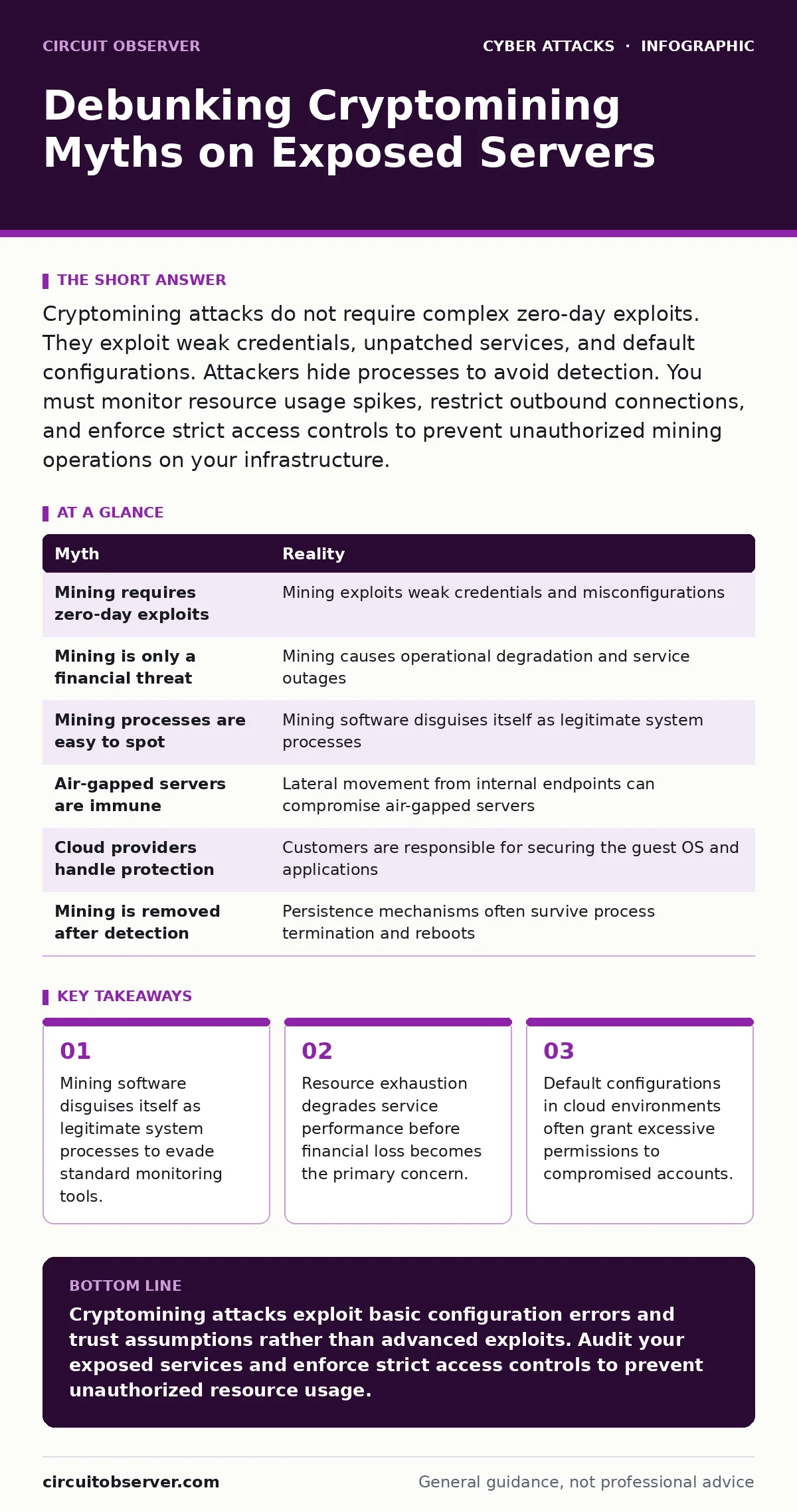
Cryptomining attacks do not require complex zero-day exploits. They exploit weak credentials, unpatched services, and default configurations. Attackers hide processes to avoid detection. You must monitor resource usage spikes, restrict outbound connections, and enforce strict access controls to prevent unauthorized mining operations on your infrastructure.
Myth: Mining malware requires a zero-day exploit
Reality: Most cryptomining infections occur through trivial entry points that administrators overlook during routine deployments. Attackers rarely spend time developing new vulnerabilities when existing weaknesses provide immediate access. They scan for servers with exposed management interfaces, outdated software versions, or accounts using common passwords. The infection vector is often a misconfigured firewall rule that allows inbound traffic to a service that should remain internal.
Suppose you deploy a web application server with the default administrative password intact. An automated scanner identifies this weakness within minutes of the server becoming reachable on the public internet. The attacker logs in, downloads a mining binary, and executes it with the privileges of the web service account. This method requires no novel exploit code. It relies entirely on the failure to change defaults or restrict network access.
Myth: Mining is only a financial threat
Reality: The immediate impact of cryptomining is operational degradation rather than direct theft of funds. The malware consumes CPU, GPU, or memory resources to perform complex hash calculations. This resource drain increases latency, causes timeouts, and reduces the throughput of legitimate applications. For a production server, this performance drop can trigger service level agreement violations or cause cascading failures in dependent systems.
Imagine a database server that suddenly experiences high disk I/O wait times and slow query responses. The administrator suspects a bad query or hardware failure. In reality, a mining process is saturating the CPU cores and memory bandwidth. The financial cost comes from the increased electricity bill and the lost revenue due to service unavailability. The data itself remains intact, but the business continuity is severely compromised by the resource exhaustion.
Myth: Mining processes are easy to spot
Reality: Modern cryptominers are designed to blend in with legitimate system activity to avoid detection by standard monitoring tools. They often rename their executables to match common system utilities, such as svchost or java, making them difficult to distinguish from genuine processes. Some miners also employ "polite mining" techniques, which throttle their resource usage when the server is under load, causing them to disappear from high-alert thresholds.
You must look for anomalies in process behavior rather than just resource consumption. A process that runs with unusual command-line arguments, connects to known mining pool domains, or persists across reboots via scheduled tasks is suspicious.
Myth: Air-gapped servers are immune to mining
Reality: Servers that are not directly connected to the internet can still be compromised through lateral movement from infected internal systems. If an endpoint within the network is infected with malware, the attacker can use that foothold to scan for vulnerable services on internal servers. This technique bypasses the perimeter defenses that rely on blocking inbound connections from the internet.
Suppose an employee clicks on a link in a malicious email attachment. The malware installs on their workstation and begins scanning the internal network for open ports. It finds a file server with an unpatched vulnerability and exploits it to deploy a cryptominer. The file server never communicated with the outside world, yet it is now mining cryptocurrency. This highlights the need for internal network segmentation and strict access controls between different zones.
Myth: Cloud providers handle all mining protection
Reality: Cloud infrastructure providers secure the underlying hardware and hypervisor, but they do not secure the guest operating system or the applications running within it. The responsibility for patching, configuring firewalls, and monitoring for malicious processes falls entirely on the customer. Many administrators assume that the cloud provider’s security features automatically detect and block mining activity, which is a dangerous misconception.
You must treat cloud instances as if they are on-premises servers in terms of security hygiene. This includes applying security updates promptly, disabling unused services, and monitoring for unusual outbound traffic. Mining malware often communicates with command and control servers over standard HTTPS ports, which may not be blocked by default cloud firewall rules.
See also: Malicious Email Attachments: Risks and Protection for Small Teams · Hardware Security Keys: 6 Misconceptions That Weaken Your Defense
Myth: Mining malware is always removed after detection
Reality: Cryptominers often install persistence mechanisms that survive process termination and system reboots. They may create scheduled tasks, modify startup scripts, or inject code into legitimate system processes. Simply killing the mining process does not remove the infection. The malware will restart automatically, often within seconds or minutes, continuing to consume resources.
Imagine you identify a suspicious process and terminate it. The CPU usage drops temporarily, but then spikes again. The miner has reinstalled itself via a scheduled task that runs every minute. To fully remediate the infection, you must identify and remove all persistence mechanisms. This often requires a thorough audit of system logs, startup items, and scheduled tasks. In severe cases, rebuilding the server from a known-good image is the only reliable way to ensure complete removal.
Myth: Mining attacks target only large organizations
Reality: Automated scanning tools target any server with an exposed IP address, regardless of the organization’s size. Small businesses and individual developers often have fewer security resources and weaker defenses, making them attractive targets. The low cost of launching a scanning attack means that attackers can cast a wide net, compromising hundreds of servers with minimal effort.
You should assume that your servers are constantly being scanned for vulnerabilities. Implementing basic security measures, such as disabling password authentication for SSH and using hardware security keys for administrative access, significantly reduces the risk of compromise. These measures are effective for organizations of all sizes and are often overlooked by smaller teams.
| Myth | Reality |
|---|---|
| Mining requires zero-day exploits | Mining exploits weak credentials and misconfigurations |
| Mining is only a financial threat | Mining causes operational degradation and service outages |
| Mining processes are easy to spot | Mining software disguises itself as legitimate system processes |
| Air-gapped servers are immune | Lateral movement from internal endpoints can compromise air-gapped servers |
| Cloud providers handle protection | Customers are responsible for securing the guest OS and applications |
| Mining is removed after detection | Persistence mechanisms often survive process termination and reboots |
Key takeaways
- Mining software disguises itself as legitimate system processes to evade standard monitoring tools.
- Resource exhaustion degrades service performance before financial loss becomes the primary concern.
- Default configurations in cloud environments often grant excessive permissions to compromised accounts.
Cryptomining attacks exploit basic configuration errors and trust assumptions rather than advanced exploits. Audit your exposed services and enforce strict access controls to prevent unauthorized resource usage.
Frequently asked questions
How can I detect if my server is mining cryptocurrency?
Monitor for unusual spikes in CPU or GPU usage, high outbound network traffic to known mining pools, and processes with suspicious names or command-line arguments.
Does multi-factor authentication prevent cryptomining attacks?
Multi-factor authentication significantly reduces the risk of initial compromise via stolen credentials, but it does not protect against unpatched software vulnerabilities or misconfigurations.
Can I use a firewall to block cryptomining?
A firewall can block known mining pool domains and ports, but miners often use standard HTTPS traffic that is difficult to distinguish from legitimate web browsing without deep packet inspection.
Should I rebuild my server after a mining infection?
Rebuilding from a known-good image is the most reliable way to ensure all persistence mechanisms and hidden backdoors are removed, especially if the infection has been present for an extended period.
How this guide was produced: written by the Circuit Observer editorial team with AI assistance, checked against the public references listed below, and reviewed when the facts change. See our editorial policy or report an error.