
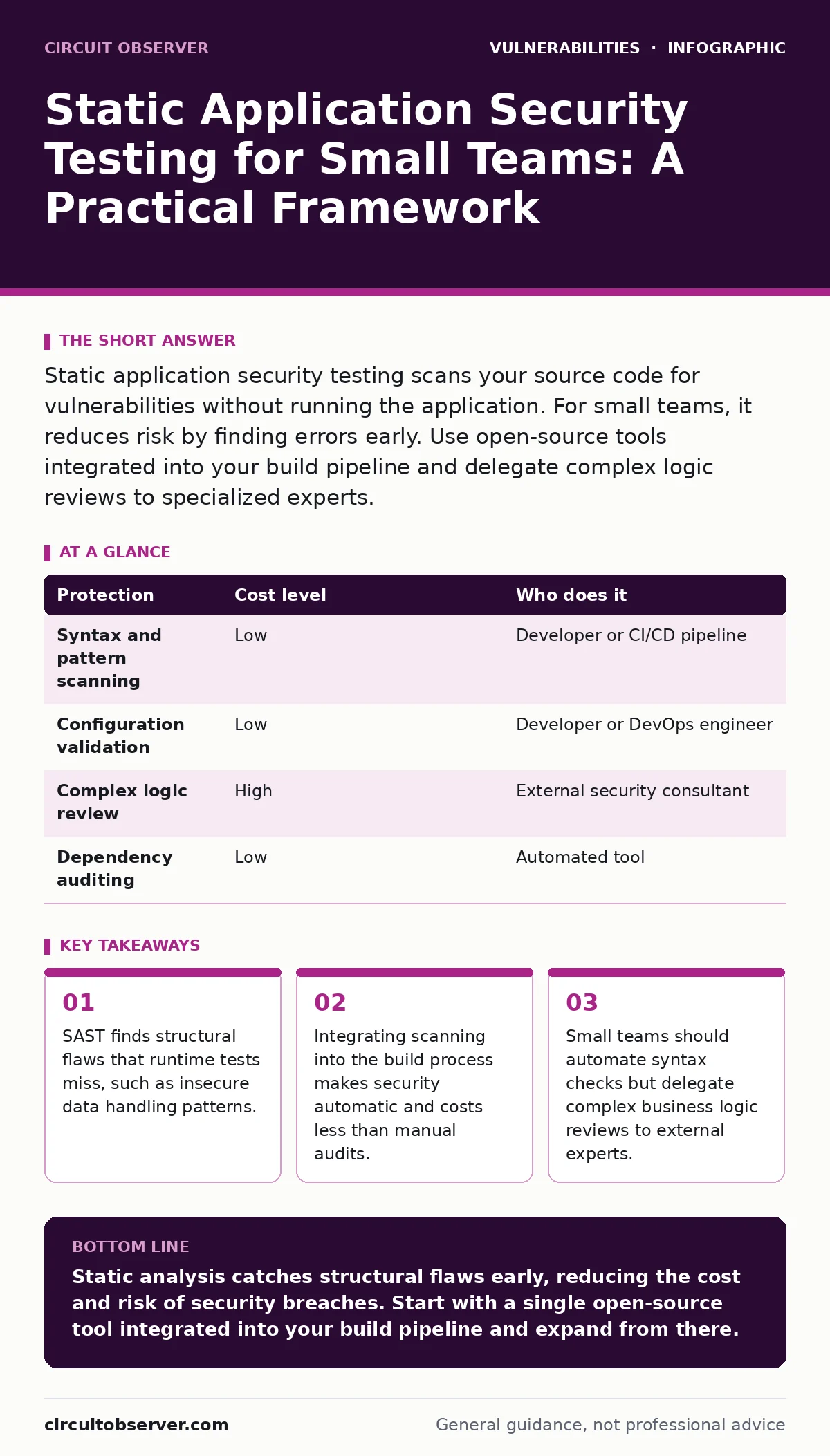
Static application security testing scans your source code for vulnerabilities without running the application. For small teams, it reduces risk by finding errors early. Use open-source tools integrated into your build pipeline and delegate complex logic reviews to specialized experts.
The Structural Advantage of Code Analysis
Static application security testing examines your source code for security flaws without executing the program. It looks for patterns that match known vulnerability signatures. This approach differs from testing a running application, which can only observe behavior. By reading the code, you see the intent and the structure. You identify where data enters the system and how it is processed before it reaches sensitive resources.
This method catches errors that other techniques miss. For instance, it can detect a missing validation check on an input field that is never triggered during normal testing. It reveals dead code paths that might contain backdoors or insecure dependencies. You gain visibility into the entire codebase, not just the parts your test scripts touch. This breadth is critical for maintaining a clean foundation as your software grows.
Why Small Teams Benefit Most
Small organizations often lack dedicated security staff. They rely on developers to write secure code while meeting tight deadlines. Static testing fits this reality by automating the inspection process. It runs in the background, providing immediate feedback to the developer. This shifts security left, meaning you find issues when they are cheapest to fix. You avoid the high cost of patching a live system after a breach.
The scale of your operation makes automation a necessity, not a luxury. You cannot afford manual code reviews for every commit. A tool that scans automatically ensures consistency. It applies the same rules to every line of code, every day. This reduces human error and fatigue. It also creates an audit trail of security checks, which helps with compliance requirements. You build a culture where security is part of the workflow, not an afterthought.
| Protection | Cost level | Who does it |
|---|---|---|
| Syntax and pattern scanning | Low | Developer or CI/CD pipeline |
| Configuration validation | Low | Developer or DevOps engineer |
| Complex logic review | High | External security consultant |
| Dependency auditing | Low | Automated tool |
Affordable Implementation Strategies
You do not need expensive enterprise suites to start. Many open-source static analysis tools are powerful and free. These tools scan for common weaknesses like injection flaws and buffer overflows. Integrate them into your continuous integration pipeline. This ensures every code change is checked before it is merged. The cost is primarily the time spent configuring the tool and reducing false positives.
Start with a narrow scope. Configure the tool to check for the most dangerous vulnerabilities first. This prevents alert fatigue, where developers ignore warnings because there are too many. As your team becomes comfortable, expand the scope. Include checks for coding standards and security best practices. This gradual approach builds competence without overwhelming your limited resources. You get high-value insights for a minimal financial investment.
What to Delegate to Experts
Not all security problems are solvable with automated tools. Static analysis struggles with complex business logic. It cannot easily understand the intent behind a series of database queries. If your application handles sensitive financial data or personal health information, the logic must be flawless. Here, you need human expertise. Delegate these reviews to external security consultants. They bring a fresh perspective and deep knowledge of attack techniques.
You should also delegate the tuning of your static analysis tools. Configuring a scanner to ignore false positives requires experience. An expert can set up profiles that match your specific technology stack. This saves your developers hours of manual filtering. It ensures that the alerts you receive are actionable. Outsourcing this maintenance allows your internal team to focus on writing code, not managing security tools.
Integrating Without Slowing Development
Security checks must not block your release cycle. If a scan takes too long, developers will bypass it. Optimize your pipeline to run lightweight checks on every commit. Reserve deeper, more comprehensive scans for nightly builds or pre-release stages. This balance keeps your workflow smooth while maintaining security. Use caching to speed up repeated scans of unchanged files.
Communicate the results clearly. Developers need to know exactly where the issue is and how to fix it. Provide links to documentation or examples of correct code. Make the path to resolution obvious. This turns security from a blocker into a helper. Your team learns to write better code over time. The tool becomes a teacher, not just a gatekeeper.
Common Pitfalls to Avoid
One major mistake is ignoring false positives. These are alerts that look like vulnerabilities but are not. If you do not review and suppress them, your team will lose trust in the tool. They will stop looking at the results. Regularly audit your alerts to ensure accuracy. Another pitfall is relying solely on static analysis. It cannot detect runtime issues or logic flaws that depend on external inputs. You must combine it with other methods for full coverage.
Complementing with Other Techniques
Static analysis is one part of a broader strategy. You should also use dynamic application security testing (DAST) to check your running application. DAST finds issues that only appear during execution, such as session management flaws. Combining both methods gives you a complete picture. You see the code structure and the runtime behavior. This dual approach covers more ground than either method alone.
Consider the principle of least privilege access when designing your architecture. Ensure that each component only has the permissions it needs. This limits the damage if a vulnerability is exploited. Review your configurations for open redirect vulnerabilities, which can lead to phishing attacks. Check for server-side request forgery (SSRF) risks, where your server makes unintended requests. Address server-side template injection by validating all user inputs. These specific checks strengthen your overall posture.
The Role of Disclosure and Access
If you find a vulnerability, you need a process for handling it. Coordinated vulnerability disclosure allows you to report issues privately and responsibly. This builds trust with your users and the security community. It also helps you prioritize fixes based on severity. Broken access control is a common issue that static tools might miss if the logic is complex. Regularly review your access controls to ensure they align with your business rules. This manual check complements the automated scans.
Next Steps for Your Team
Start by selecting one open-source static analysis tool. Install it and configure it to scan your most critical module. Run it and review the results with your development team. Discuss the findings and fix the high-severity issues. This hands-on experience builds familiarity. Gradually expand the scope to include more modules and more checks. Over time, this becomes a standard part of your development process. You build a more secure application without disrupting your workflow.
Key takeaways
- SAST finds structural flaws that runtime tests miss, such as insecure data handling patterns.
- Integrating scanning into the build process makes security automatic and costs less than manual audits.
- Small teams should automate syntax checks but delegate complex business logic reviews to external experts.
Static analysis catches structural flaws early, reducing the cost and risk of security breaches. Start with a single open-source tool integrated into your build pipeline and expand from there.
Frequently asked questions
Can static analysis replace manual code reviews?
No, it complements them. Static tools find pattern-based errors, but humans are needed to understand complex logic and business context.
How do I handle false positives in static analysis?
Review each alert to determine if it is a real issue. Suppress known false positives in the tool configuration to keep the alert list actionable.
Is static analysis suitable for legacy code?
Yes, but expect many initial alerts. Start with a baseline scan and focus on high-severity issues first. Gradually clean up the codebase over time.
How this guide was produced: written by the Circuit Observer editorial team with AI assistance, checked against the public references listed below, and reviewed when the facts change. See our editorial policy or report an error.