
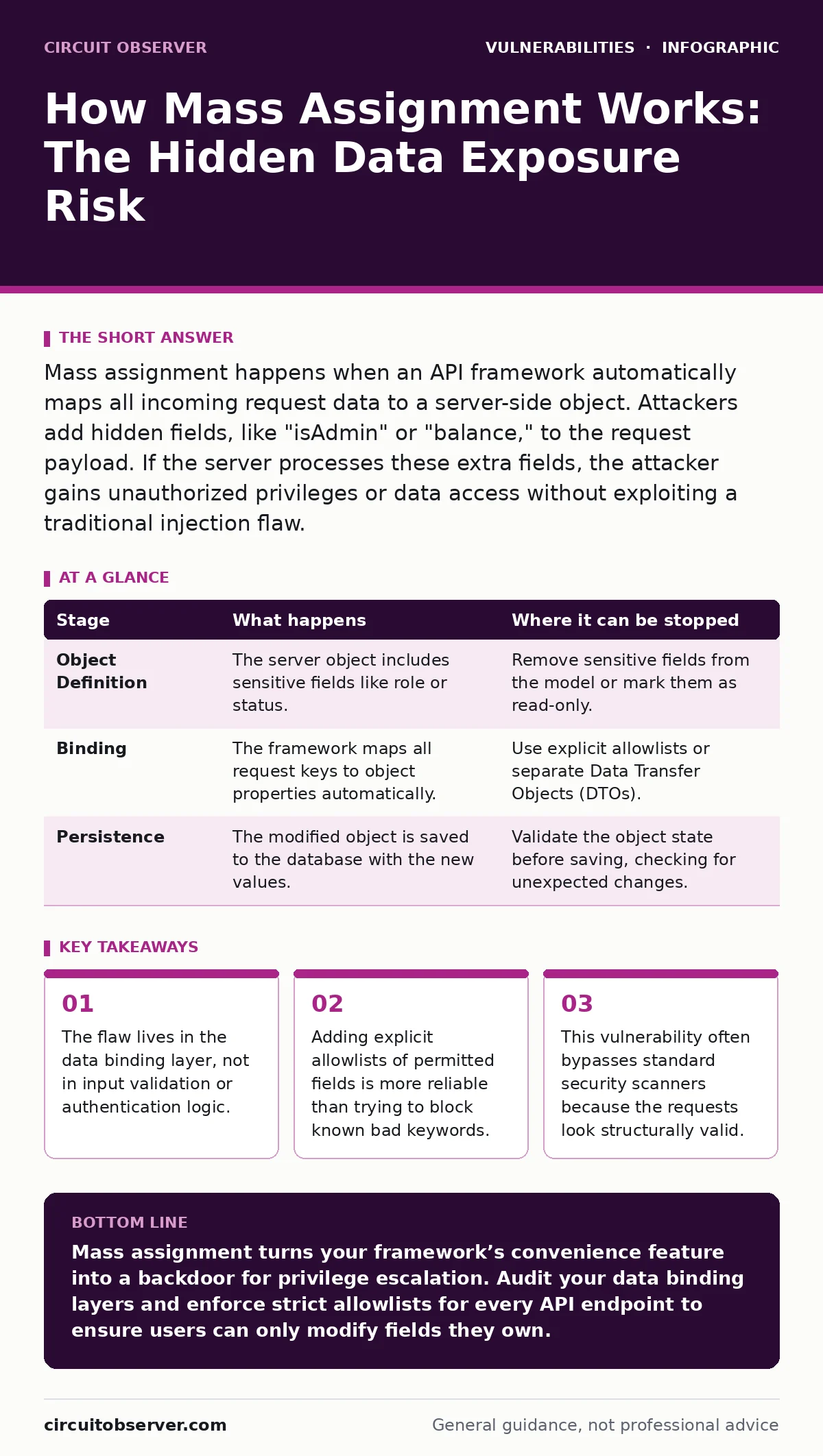
Mass assignment happens when an API framework automatically maps all incoming request data to a server-side object. Attackers add hidden fields, like "isAdmin" or "balance," to the request payload. If the server processes these extra fields, the attacker gains unauthorized privileges or data access without exploiting a traditional injection flaw.
The Illusion of Safe Input Handling
You build an API to update user profiles. You expect a name and an email address. You write the code to accept a JSON payload, parse it, and save it to the database. It feels secure because you validate the email format and sanitize the name for special characters. You assume the server only touches what you explicitly tell it to touch.
This assumption is where the gap opens. Modern web frameworks are designed for developer productivity, not security by default. They often include automatic binding features. These features take the raw input from the HTTP request and map it directly to the properties of a server-side object. If the object has a field named "role," and the request contains a key named "role," the framework assigns that value. It does not ask if you intended for the user to set that value.
Stage 1: The Object Model Definition
The vulnerability begins before any code runs in production. It starts with how you define your data models. Suppose you have a User class. This class contains public properties for "firstName," "lastName," and "isActive." It might also contain internal properties like "permissions," "accountBalance," or "lastLoginTimestamp."
In many languages, these properties are accessible. If you pass the entire User object to an update function, the function sees all those fields as valid targets for modification. The framework does not distinguish between data that belongs to the user and data that belongs to the system. It sees a structure with slots, and it wants to fill them.
Stage 2: The Framework Binding Process
When a request arrives, the framework deserializes the JSON or form data. It creates an instance of your User object. Then, it iterates through the incoming keys. For each key, it looks for a matching property on the object. If it finds one, it sets the value.
This is the core mechanism. The framework trusts the shape of the input. It does not check your business logic. It does not check if the current user has permission to change their own role. It simply performs the assignment. This step is invisible to most logging systems because the request format is correct. The JSON is well-formed. The HTTP method is POST or PUT. Nothing looks malicious to a perimeter firewall.
| Stage | What happens | Where it can be stopped |
|---|---|---|
| Object Definition | The server object includes sensitive fields like role or status. | Remove sensitive fields from the model or mark them as read-only. |
| Binding | The framework maps all request keys to object properties automatically. | Use explicit allowlists or separate Data Transfer Objects (DTOs). |
| Persistence | The modified object is saved to the database with the new values. | Validate the object state before saving, checking for unexpected changes. |
Stage 3: The Attack Payload Construction
The attacker does not need to break encryption or guess passwords. They only need to know the structure of your object. This information is often available through API documentation, Swagger files, or simple observation. If the API returns a user profile with a "role" field in the response, the attacker knows the key exists.
They craft a new request. They keep the legitimate fields like "email" intact. Then they add a new field: "role": "admin". They might also add "accountBalance": 999999. The request looks like this: {"email": "[email protected]", "role": "admin"}.
This is not a injection attack. There is no SQL query being appended. There is no script tag. It is a legitimate update request with extra data. The attacker relies on your framework’s eagerness to be helpful.
Stage 4: The Silent Persistence
The server receives the payload. The binding engine assigns the values. The "isAdmin" property changes from false to true. The code then calls the save function. The database record is updated. The next time the user logs in, they have administrative privileges.
This stage is dangerous because it leaves no trace of an attack vector. The logs show a standard update. There is no error. There is no warning. The application behaved exactly as the framework was designed to behave. The flaw is in the design of the data flow, not in a bug in the code.
Interrupting the Flow with Allowlists
You can stop this at the binding stage. The most effective method is to use explicit allowlists. Instead of allowing the framework to bind all fields, you define exactly which fields are acceptable for a specific endpoint.
Create a separate object, often called a Data Transfer Object (DTO), for each operation. If the endpoint is "Update Profile," the DTO only contains "firstName," "lastName," and "email." It does not contain "role" or "isAdmin." When the framework binds the request, it discards any keys that do not match the DTO. The extra fields in the attacker’s request are ignored. They never touch the server-side object.
The Hidden Cost of Blacklisting
A common mistake is to try to block specific keys. You might write a filter that drops any request containing "role" or "password." This approach fails because it is reactive. If you miss a field, or if an attacker uses a slightly different casing like "Role" or "role_," the filter misses it.
Blacklisting is also brittle. As your application grows, new fields are added. You must remember to update the blacklist every time. It is easier to maintain a list of what is allowed than a list of what is forbidden. This principle applies to many security contexts. For example, dealing with broken access control requires knowing what a user can do, not just guessing what they cannot. Similarly, preventing remote code execution vulnerabilities often involves restricting input rather than trying to catch every possible malicious string.
Beyond Basic Validation
Input validation helps, but it is not enough. You might validate that "role" is a string. The attacker sends the string "admin." It passes validation. The problem is not the data type; it is the permission to set the field.
This is why dynamic application security testing (DAST) tools are useful. They can send mutated requests to your live application and check for unexpected changes in response codes or data. However, they cannot catch everything. You need to think about the data model itself.
Consider the interaction with server-side template injection. While different, both flaws arise from trusting user input too much. In template injection, you trust input in a rendering engine. In mass assignment, you trust input in a binding engine. Both require strict boundaries between user data and system logic.
Integrating into Your Security Process
You should treat mass assignment as a design issue, not a code fix. Review your API contracts. Ensure that every endpoint uses a specific DTO. Do not pass raw request bodies directly to service methods.
If you are managing a large codebase, this is a good candidate for coordinated vulnerability disclosure. If a researcher finds this flaw, it is not a zero-day exploit that crashes your server. It is a logic error. You can fix it by adjusting the binding rules. It does not require a full rewrite.
Finally, consider the principle of least privilege access. Even if mass assignment occurs, the damage is limited if the application itself enforces checks before saving. For example, the "Save" function could verify that the user is actually an admin before allowing the role change. This defense-in-depth approach ensures that a single layer failure does not lead to total compromise.
Key takeaways
- The flaw lives in the data binding layer, not in input validation or authentication logic.
- Adding explicit allowlists of permitted fields is more reliable than trying to block known bad keywords.
- This vulnerability often bypasses standard security scanners because the requests look structurally valid.
Mass assignment turns your framework’s convenience feature into a backdoor for privilege escalation. Audit your data binding layers and enforce strict allowlists for every API endpoint to ensure users can only modify fields they own.
Frequently asked questions
Does HTTPS prevent mass assignment?
No, HTTPS encrypts the data in transit but does not change how the server processes the fields once received.
Can I fix this with input sanitization?
Sanitization cleans data content, but mass assignment is about field presence, not content safety.
Do all frameworks have this issue?
Most modern frameworks have auto-binding features that can be misconfigured, though some default to stricter settings. Q
How this guide was produced: written by the Circuit Observer editorial team with AI assistance, checked against the public references listed below, and reviewed when the facts change. See our editorial policy or report an error.