
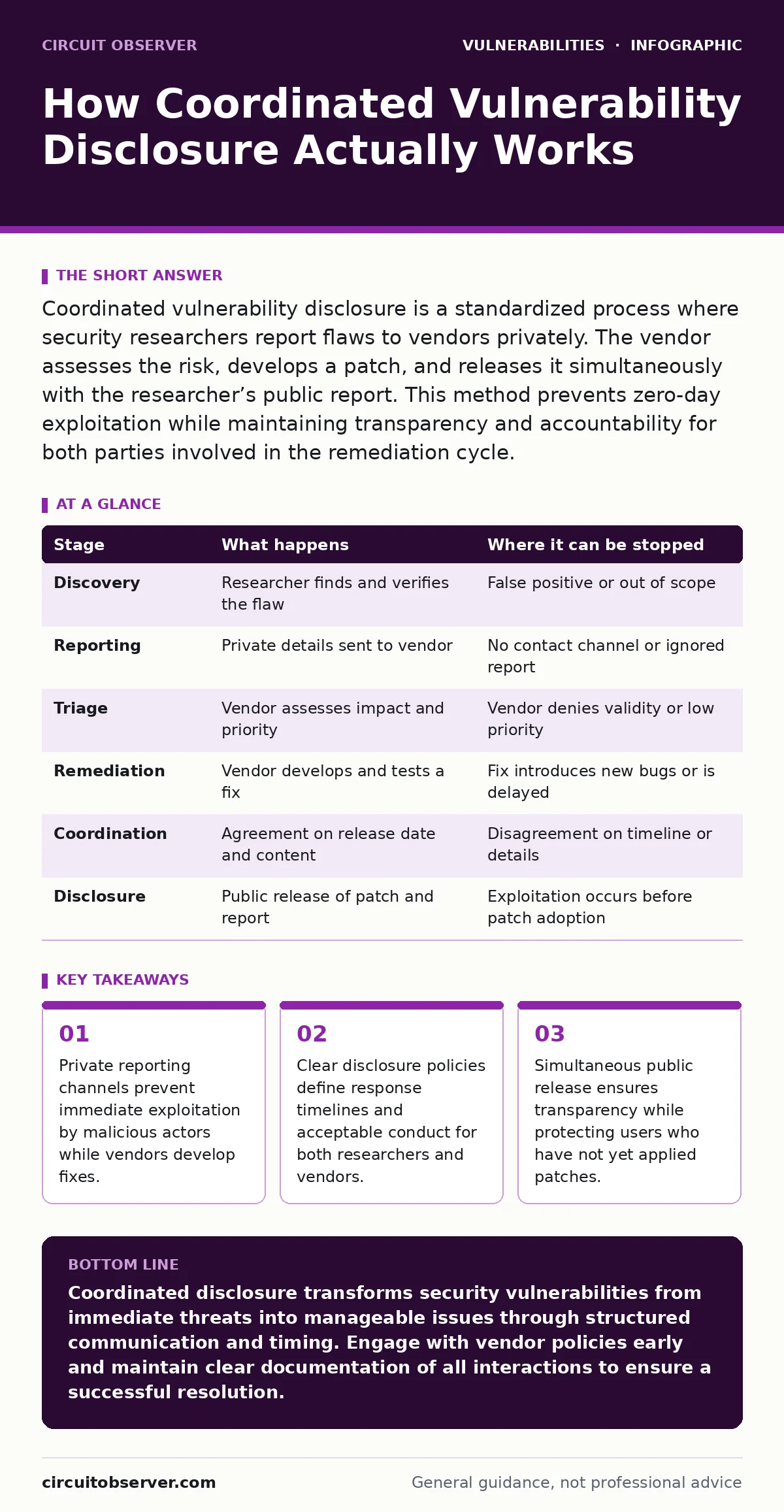
Coordinated vulnerability disclosure is a standardized process where security researchers report flaws to vendors privately. The vendor assesses the risk, develops a patch, and releases it simultaneously with the researcher’s public report. This method prevents zero-day exploitation while maintaining transparency and accountability for both parties involved in the remediation cycle.
The Mechanics of Responsible Disclosure
Security software rarely launches without defects. The question is who finds them first and what they do next. Coordinated vulnerability disclosure creates a bridge between independent researchers and the organizations that build the software. It replaces chaos with a predictable workflow. This process protects users by ensuring patches are available before the details of the flaw become public knowledge.
You must understand that this is not merely a reporting line. It is a negotiation of trust and timing. The researcher holds the leverage of the technical detail, while the vendor holds the leverage of the distribution channel. Both parties must align their incentives to achieve a safe outcome for the end user.
Stage One: Discovery and Validation
The process begins when a researcher identifies a potential flaw. This could be a logic error in authentication or a buffer overflow in a parser. Before any communication occurs, the researcher must verify the finding. False positives waste vendor resources and damage the researcher’s reputation.
Imagine a researcher finds a way to bypass login checks. They must reproduce the issue multiple times to confirm it is consistent. They also determine the impact. Does it allow reading data, or does it allow executing code? This distinction dictates the urgency. A finding related to remote code execution vulnerabilities demands immediate attention, whereas a minor configuration error might wait.
Stage Two: Private Reporting
Once validated, the researcher contacts the vendor through a designated channel. Most organizations provide a dedicated email address or a web form. Some use automated platforms that track the ticket status. The initial report must be clear and concise. It should include the affected version, the steps to reproduce the issue, and the severity assessment.
The vendor receives this report in confidence. They assign it to a security team or a developer. This step isolates the knowledge. By keeping the details private, the vendor buys time to investigate without the pressure of a public outcry. The researcher waits for acknowledgment. Silence here is a common friction point, often leading to premature public disclosure.
Stage Three: Assessment and Triage
The vendor reviews the report to determine its validity and scope. They check if the issue exists in other products or versions. This phase often reveals that the bug is more widespread than initially thought. The vendor must also assess the exploitability. How difficult is it for an attacker to trigger the flaw?
Consider a scenario involving broken access control. The researcher might have found a way to view another user’s profile. The vendor checks if this applies to all users or only those with specific roles. They also check if mass assignment vulnerabilities are present, which could allow attackers to overwrite user attributes entirely. This triage determines the priority of the fix.
Stage Four: Remediation and Patching
The vendor develops a fix. This might involve code changes, configuration updates, or architectural adjustments. Developers work to close the loophole without introducing new issues. They test the fix in a staging environment. This stage is often the longest. Complex systems require careful refactoring to ensure stability.
During this time, the researcher and vendor may exchange messages. The vendor might ask for additional technical details. The researcher might provide proof-of-concept code to help developers understand the root cause. This collaboration is vital for a high-quality fix. The vendor aims to release a patch that is both secure and stable.
Stage Five: Coordination of Release
As the patch nears completion, the vendor and researcher agree on a disclosure date. This date allows time for users to apply the update. The vendor prepares release notes and advisory documents. The researcher prepares their public report, ensuring it does not include sensitive details that could aid attackers before the patch is widely deployed.
This coordination prevents a race condition where attackers exploit the flaw immediately after the report goes public. A standard window is often agreed upon, allowing large organizations time to schedule maintenance windows. The simultaneous release ensures that when the world knows about the flaw, a solution is also available.
Stage Six: Public Disclosure and Aftermath
The patch is released, and the report becomes public. The community analyzes the fix. Other researchers might check for similar issues in related products. This public scrutiny helps identify any remaining weaknesses. The vendor monitors for any signs of exploitation that may have occurred before the patch was applied.
The cycle closes with a post-mortem. The vendor reviews why the flaw existed. Was it a coding standard issue? A lack of testing? Lessons learned here feed into future development practices. For instance, integrating dynamic application security testing (DAST) into the build pipeline might catch similar issues early. This continuous improvement is the true value of coordinated disclosure.
Navigating the Policy Landscape
Not all vendors follow the same rules. Some have strict non-disclosure agreements. Others encourage rapid public pressure. You must read the disclosure policy carefully before reporting. It will outline the expected response times and the consequences of early disclosure.
If a vendor fails to respond, you have ethical choices. You can escalate the issue through industry bodies or legal channels. You can also set a public deadline for disclosure. This keeps the pressure on without violating the spirit of coordination. Understanding these nuances is key to effective vulnerability management.
| Stage | What happens | Where it can be stopped |
|---|---|---|
| Discovery | Researcher finds and verifies the flaw | False positive or out of scope |
| Reporting | Private details sent to vendor | No contact channel or ignored report |
| Triage | Vendor assesses impact and priority | Vendor denies validity or low priority |
| Remediation | Vendor develops and tests a fix | Fix introduces new bugs or is delayed |
| Coordination | Agreement on release date and content | Disagreement on timeline or details |
| Disclosure | Public release of patch and report | Exploitation occurs before patch adoption |
Hidden Costs and Edge Cases
Coordinated disclosure is not without its challenges. Researchers may face legal threats if they are perceived as hackers. Vendors may fear reputational damage and delay fixes. This tension can stall the process. Additionally, some flaws are inherent to the design, not just the code. These architectural issues are harder to patch and may require significant refactoring.
Consider server-side template injection. Fixing this might require changing how the application renders content, which can break existing features. The vendor must balance security with functionality. Researchers must understand these trade-offs to set realistic expectations. The goal is not just a patch, but a sustainable security posture.
Another edge case involves third-party components. If the flaw is in a library, the vendor might wait for the library maintainer to fix it. This dependency chain can delay remediation significantly. You must track these dependencies closely. Ignoring them leaves your systems vulnerable even if your own code is secure.
Key takeaways
- Private reporting channels prevent immediate exploitation by malicious actors while vendors develop fixes.
- Clear disclosure policies define response timelines and acceptable conduct for both researchers and vendors.
- Simultaneous public release ensures transparency while protecting users who have not yet applied patches.
Coordinated disclosure transforms security vulnerabilities from immediate threats into manageable issues through structured communication and timing. Engage with vendor policies early and maintain clear documentation of all interactions to ensure a successful resolution.
Frequently asked questions
What if the vendor ignores my report?
Document your attempts to contact them. Escalate through industry security groups or legal advisors if necessary. Set a public disclosure deadline to maintain accountability.
Can I disclose a vulnerability if the vendor refuses to fix it?
Yes, but ensure you have allowed reasonable time for a response. Public disclosure can pressure the vendor to act, but it also exposes users to risk if no patch is available.
How do I know if a vulnerability is in scope?
Check the vendor’s disclosure policy. It usually lists supported products and versions. If unsure, ask for clarification before proceeding with detailed testing.
What is the difference between coordinated and full disclosure?
Coordinated disclosure involves private reporting and a joint release. Full disclosure makes the details public immediately, often to pressure vendors, but risks immediate exploitation by attackers.
How this guide was produced: written by the Circuit Observer editorial team with AI assistance, checked against the public references listed below, and reviewed when the facts change. See our editorial policy or report an error.