
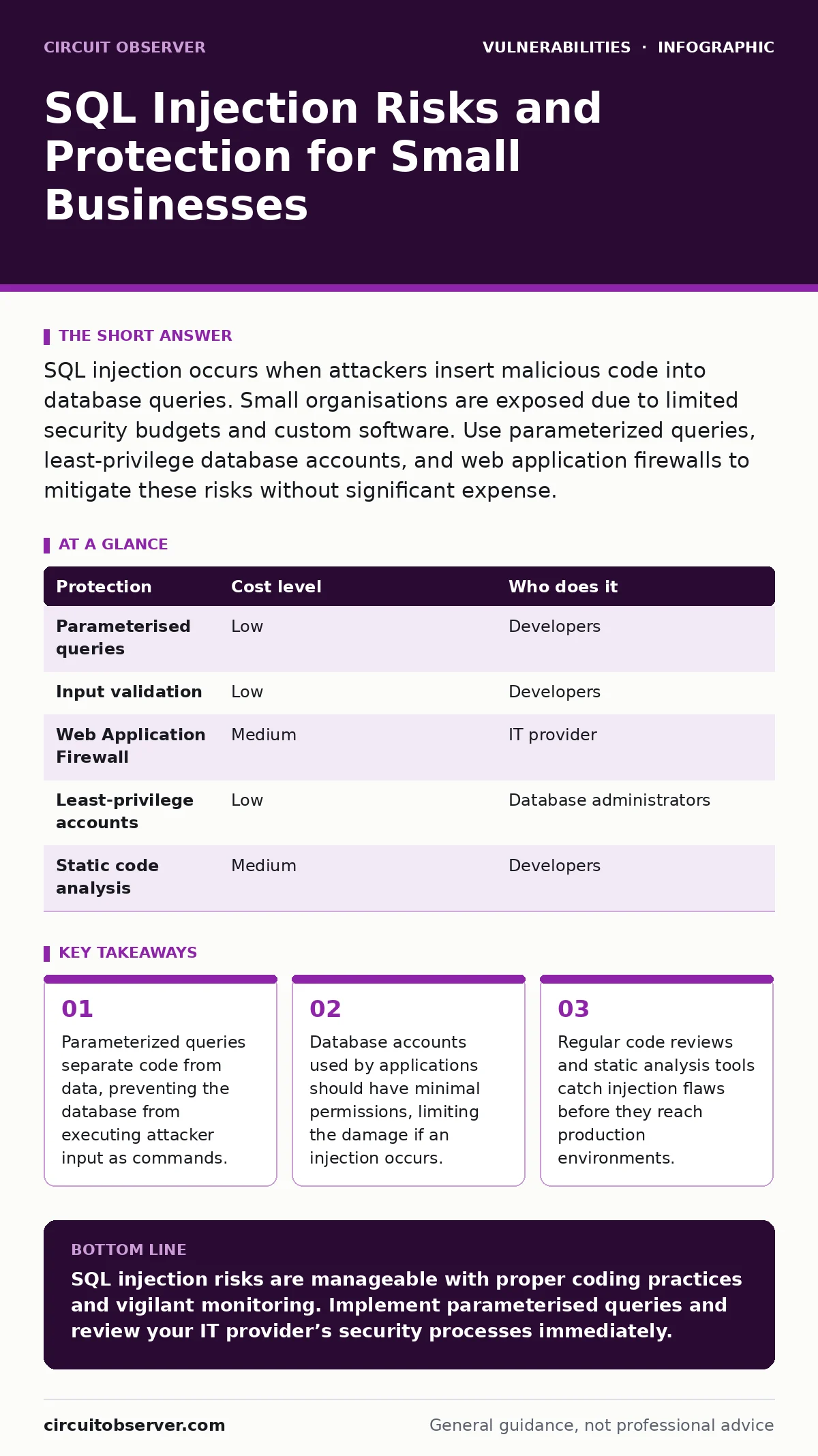
SQL injection occurs when attackers insert malicious code into database queries. Small organisations are exposed due to limited security budgets and custom software. Use parameterized queries, least-privilege database accounts, and web application firewalls to mitigate these risks without significant expense.
Why Small Organisations Face Higher Exposure
Small organisations often rely on custom-built applications to meet specific business needs. These applications rarely undergo the same rigorous security testing as commercial software. Developers may prioritise functionality over security, leaving gaps in input validation. Attackers target these gaps because small businesses often have weaker defensive postures.
The lack of dedicated security staff means vulnerabilities remain undiscovered for long periods. When an SQL injection occurs, the attacker can read, modify, or delete data. This exposure is not limited to large databases. Even a small contact list can be valuable to criminals. The cost of remediation often exceeds the cost of prevention.
The Mechanics of SQL Injection Attacks
SQL injection exploits the way applications interact with databases. Applications construct queries by combining fixed code with user-supplied data. If the application does not properly escape or parameterise this data, the database interprets it as executable code. This allows attackers to alter the query’s intent.
An attacker might add a condition that always evaluates to true, bypassing login screens. They might append a command to delete records or extract sensitive information. The database executes these commands because it cannot distinguish between legitimate query structure and injected code. This fundamental flaw exists in many programming languages and database systems.
Low-Cost Protections for Limited Budgets
You do not need expensive security tools to mitigate SQL injection. The most effective protection is proper coding practice. Parameterised queries, also known as prepared statements, separate the SQL code from the data. The database treats the data strictly as values, not as commands. This approach is supported by most modern programming frameworks.
Input validation is another low-cost measure. Validate all user input against expected formats. Reject data that does not match the expected pattern. For example, if a field expects a number, reject any alphabetic characters. This defence in depth reduces the attack surface. Combine these methods for stronger protection.
| Protection | Cost level | Who does it |
|---|---|---|
| Parameterised queries | Low | Developers |
| Input validation | Low | Developers |
| Web Application Firewall | Medium | IT provider |
| Least-privilege accounts | Low | Database administrators |
| Static code analysis | Medium | Developers |
The Hidden Cost of Custom Software
Custom software offers flexibility but introduces unique security challenges. Commercial products often have large teams dedicated to security research and patching. Custom applications rely on the original developers for updates. If the developer leaves or the company grows, maintenance may fall behind.
This lag creates a window of opportunity for attackers. Vulnerabilities in custom code are not publicly known, which can create a false sense of security. However, automated scanning tools can still detect common patterns. Regular code reviews are necessary to catch logic errors that automated tools miss. The cost of hiring a security consultant for periodic reviews is often lower than the cost of a data breach.
What to Ask Your IT Provider
Your IT provider plays a critical role in maintaining your application security. Ask specific questions to ensure they understand SQL injection risks. Do not accept vague assurances about security. Request details on their development and maintenance processes. Clear communication ensures both parties align on security expectations.
- How do you ensure all database queries use parameterised statements?
- What process do you follow for reviewing code before deployment?
- How do you manage database user permissions and access controls?
- Do you perform regular static code analysis for security vulnerabilities?
- What is your incident response plan if an injection is detected?
See also: Web Cache Poisoning: How to Trace and Stop the Attack
Edge Cases and Non-Obvious Risks
SQL injection is not limited to obvious input fields. Attackers can inject code through HTTP headers, cookies, or URL parameters. These hidden vectors are often overlooked by developers who focus only on form inputs. Comprehensive input validation must cover all data sources.
Blind SQL injection is another subtle threat. The application does not return error messages or data directly. Instead, the attacker infers information based on the application’s behaviour or response time. This technique makes detection difficult. Monitoring application performance and error logs can help identify these slow, stealthy attacks.
Integrating with Broader Security Efforts
SQL injection protection should be part of a broader security strategy. Similar input validation techniques help prevent server-side template injection, where attackers manipulate server-side templates. Understanding these related threats helps you build a more resilient application.
Consider mass assignment vulnerabilities, where attackers manipulate object properties to gain unauthorized access. Proper input handling mitigates both risks. You should also be aware of remote code execution vulnerabilities, which can result from unpatched software components. Regular updates and patch management are vital for reducing these overlapping risks.
The Role of Web Application Firewalls
Web application firewalls can provide an additional layer of defence. They inspect incoming traffic for known attack signatures. While they cannot replace secure coding, they can block many common SQL injection attempts. This buys you time to patch vulnerabilities in your application code.
Choose a firewall that allows custom rule creation. Default rules may not cover your specific application logic. Test the firewall thoroughly to ensure it does not block legitimate traffic. Balance security with usability. A firewall that blocks valid users is as harmful as one that allows attackers.
Conclusion and Next Steps
Protecting against SQL injection requires a combination of secure coding, proper configuration, and ongoing monitoring. Small businesses can achieve strong protection without significant investment. Focus on parameterised queries, input validation, and least-privilege access. Engage your IT provider in regular security discussions.
The effort to secure your applications pays off in reduced risk and increased customer trust. Do not wait for a breach to act. Implement these measures now. Regular reviews and updates keep your defences current. Stay proactive in your security posture.
Key takeaways
- Parameterized queries separate code from data, preventing the database from executing attacker input as commands.
- Database accounts used by applications should have minimal permissions, limiting the damage if an injection occurs.
- Regular code reviews and static analysis tools catch injection flaws before they reach production environments.
SQL injection risks are manageable with proper coding practices and vigilant monitoring. Implement parameterised queries and review your IT provider’s security processes immediately.
Frequently asked questions
What is the difference between SQL injection and other web vulnerabilities?
SQL injection specifically targets the database layer by inserting malicious SQL commands. Other vulnerabilities may target the application logic or network layer. Each requires different mitigation strategies.
Can a web application firewall stop all SQL injection attacks?
No, a web application firewall can block many known attacks but may miss novel or complex injections. Secure coding practices are necessary for complete protection. Firewalls are a supplementary defence.
How often should I review my code for SQL injection?
You should review code every time you make changes to database interactions. Regular static code analysis and manual reviews during development help catch issues early. Continuous monitoring is best practice.
Do open-source applications have SQL injection vulnerabilities?
Yes, open-source applications can have vulnerabilities if not properly maintained. Use reputable sources and keep your software updated. Review community security advisories for known issues.
How this guide was produced: written by the Circuit Observer editorial team with AI assistance, checked against the public references listed below, and reviewed when the facts change. See our editorial policy or report an error.