
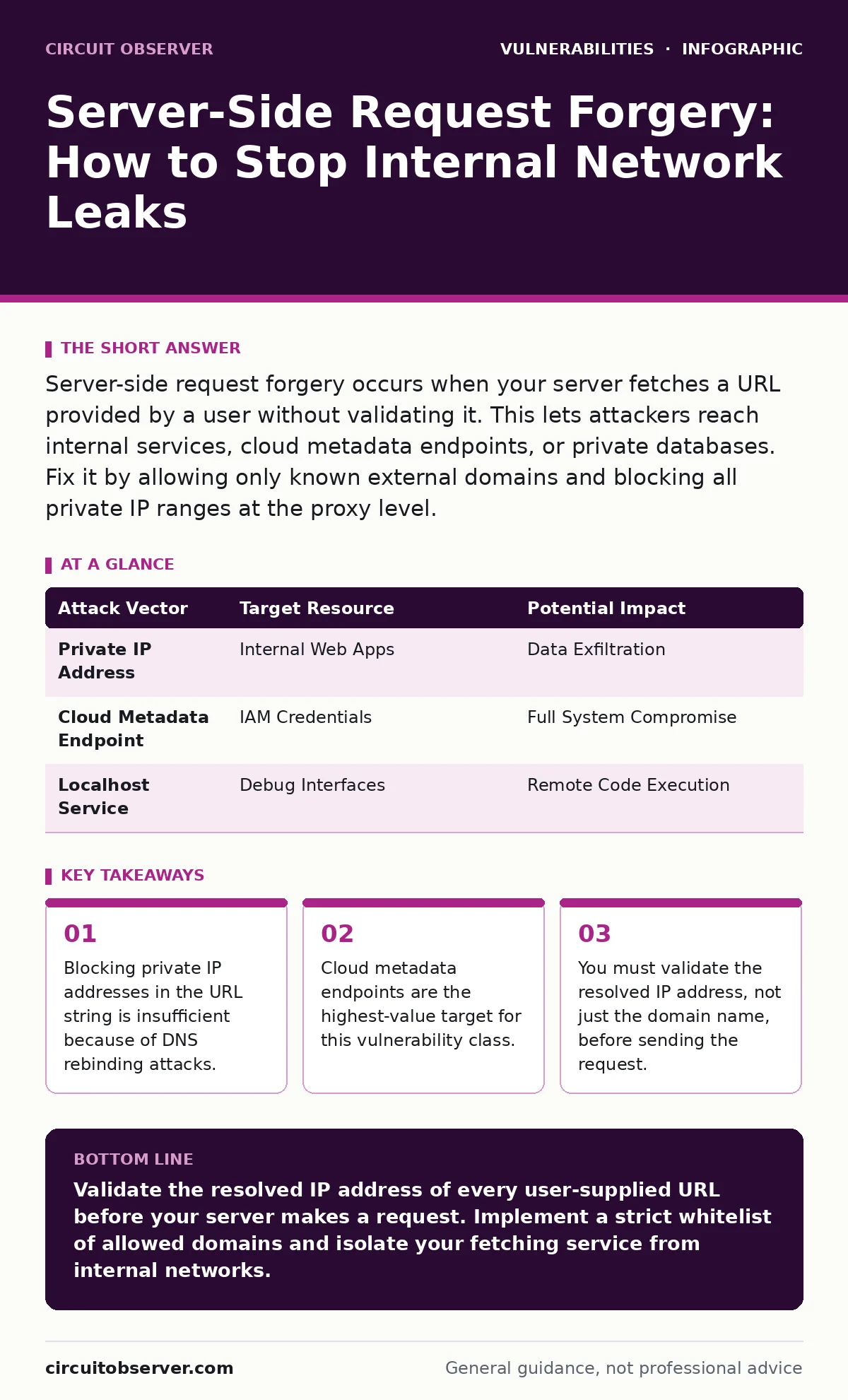
Server-side request forgery occurs when your server fetches a URL provided by a user without validating it. This lets attackers reach internal services, cloud metadata endpoints, or private databases. Fix it by allowing only known external domains and blocking all private IP ranges at the proxy level.
What exactly is server-side request forgery?
Server-side request forgery is a vulnerability where an attacker forces a server to make HTTP requests to an unintended destination. The server acts as a proxy, fetching resources on behalf of the user. This happens when the application accepts a user-supplied URL and processes it without strict validation.
Why does this matter more than client-side redirects?
A client-side redirect sends the user’s browser to a new location, which the browser restricts via same-origin policies. Server-side request forgery bypasses these browser restrictions because the request originates from your server. Your server has access to internal networks, private APIs, and cloud metadata services that the user’s browser cannot touch.
How do attackers exploit this to access internal services?
Attackers supply a URL pointing to an internal IP address or a private hostname. The server resolves this address and fetches the content. If the target is an internal database or a legacy application, the server may return sensitive data to the attacker. This turns your public-facing application into a tool for internal network reconnaissance.
| Attack Vector | Target Resource | Potential Impact |
|---|---|---|
| Private IP Address | Internal Web Apps | Data Exfiltration |
| Cloud Metadata Endpoint | IAM Credentials | Full System Compromise |
| Localhost Service | Debug Interfaces | Remote Code Execution |
Why does simple IP filtering fail to stop attacks?
Many developers block requests to private IP ranges like 10.0.0.0/8 or 127.0.0.1. This seems secure until an attacker uses DNS rebinding. The attacker registers a domain that initially resolves to a public IP, passing your filter. Before your server connects, the DNS record changes to a private IP. Your server connects to the internal resource using the trusted domain context.
What are the most dangerous targets in cloud environments?
Cloud metadata services are the primary target for modern attackers. These services run on local addresses like 169.254.169.254 and provide authentication tokens. If your server can reach this endpoint, an attacker can steal temporary credentials. These credentials often have high privileges, allowing the attacker to control the entire cloud account.
See also: Web Cache Poisoning: How to Trace and Stop the Attack · SQL Injection Risks and Protection for Small Businesses
How do you defend against DNS rebinding attacks?
You must verify the IP address at the moment of connection, not just during initial parsing. Use a function that resolves the hostname and checks the resulting IP against a deny list of private ranges. If the IP is private, reject the request immediately. Some libraries allow you to bind the request to a specific network interface, which adds another layer of control.
Can input validation completely prevent this vulnerability?
Input validation is your first line of defense, but it is not foolproof. You should maintain a whitelist of allowed domains if possible. If you must allow arbitrary URLs, enforce strict parsing that rejects any URL with a private IP, localhost, or internal domain suffix. This reduces the attack surface significantly but requires constant updating as new private ranges or internal domains emerge.
How does this relate to other injection flaws?
Server-side request forgery often appears alongside server-side template injection. In template injection, an attacker injects code that executes on the server. They might use that execution to trigger an SSRF payload. Both vulnerabilities share the root cause of trusting user input to determine system behavior. Fixing one often requires reviewing the logic for the other.
What testing methods reveal these hidden risks?
Static application security testing (SAST) can find code patterns that fetch user-controlled URLs. However, it often misses logical flaws where the URL is constructed indirectly. Dynamic application security testing (DAST) is more effective because it interacts with the live application. It can attempt to trigger internal requests and check for responses that indicate successful access to private resources.
Why is breaking out to the local file system dangerous?
Some server libraries allow fetching local files using the file:// protocol. An attacker can use SSRF to read sensitive configuration files, private keys, or source code. This expands the attack from network access to direct file system access. The result is often a complete compromise of the server, as the attacker gains the information needed to pivot further.
How do you handle URL encoding tricks?
Attackers use double-encoding, Unicode normalization, or mixed-case hostnames to bypass simple filters. For example, a URL might contain hex-encoded characters that decode to a private IP address. Your validation logic must normalize the URL to its canonical form before checking it. This ensures that obfuscated attempts to reach internal hosts are caught by your standard IP filtering rules.
What is the long-term strategy for mitigation?
The most reliable fix is to remove the functionality that allows arbitrary URL fetching. If users need to link to external content, use a service that handles the fetching on a separate, isolated network. This limits the blast radius if a vulnerability is found. You should also review your architecture for open redirect vulnerabilities, which can sometimes be chained with SSRF to trick users or bypass filters.
How does this impact coordinated vulnerability disclosure?
When you find this flaw in third-party components, you must report it responsibly. Server-side request forgery can expose critical infrastructure, making it a high-priority issue. Following a process for coordinated vulnerability disclosure ensures that vendors have time to patch the issue before attackers exploit it. This protects your organization and the broader ecosystem from widespread damage.
Key takeaways
- Blocking private IP addresses in the URL string is insufficient because of DNS rebinding attacks.
- Cloud metadata endpoints are the highest-value target for this vulnerability class.
- You must validate the resolved IP address, not just the domain name, before sending the request.
Validate the resolved IP address of every user-supplied URL before your server makes a request. Implement a strict whitelist of allowed domains and isolate your fetching service from internal networks.
Frequently asked questions
Can a firewall stop server-side request forgery?
No, because the request originates from inside your network. The firewall sees it as legitimate traffic from your server, not an external attack.
Is using a proxy server enough to prevent this?
A proxy can help if it is configured to block private IPs and internal domains. However, if the proxy itself is vulnerable or misconfigured, the attack can still succeed.
Do HTTPS connections protect against SSRF?
No, HTTPS only encrypts the data in transit. It does not validate whether the destination is authorized or safe. The server still connects to the attacker-controlled destination.
How is this different from an open redirect?
An open redirect sends the user’s browser to a malicious site. SSRF makes the server itself connect to a malicious or internal site, bypassing browser security controls.
How this guide was produced: written by the Circuit Observer editorial team with AI assistance, checked against the public references listed below, and reviewed when the facts change. See our editorial policy or report an error.