
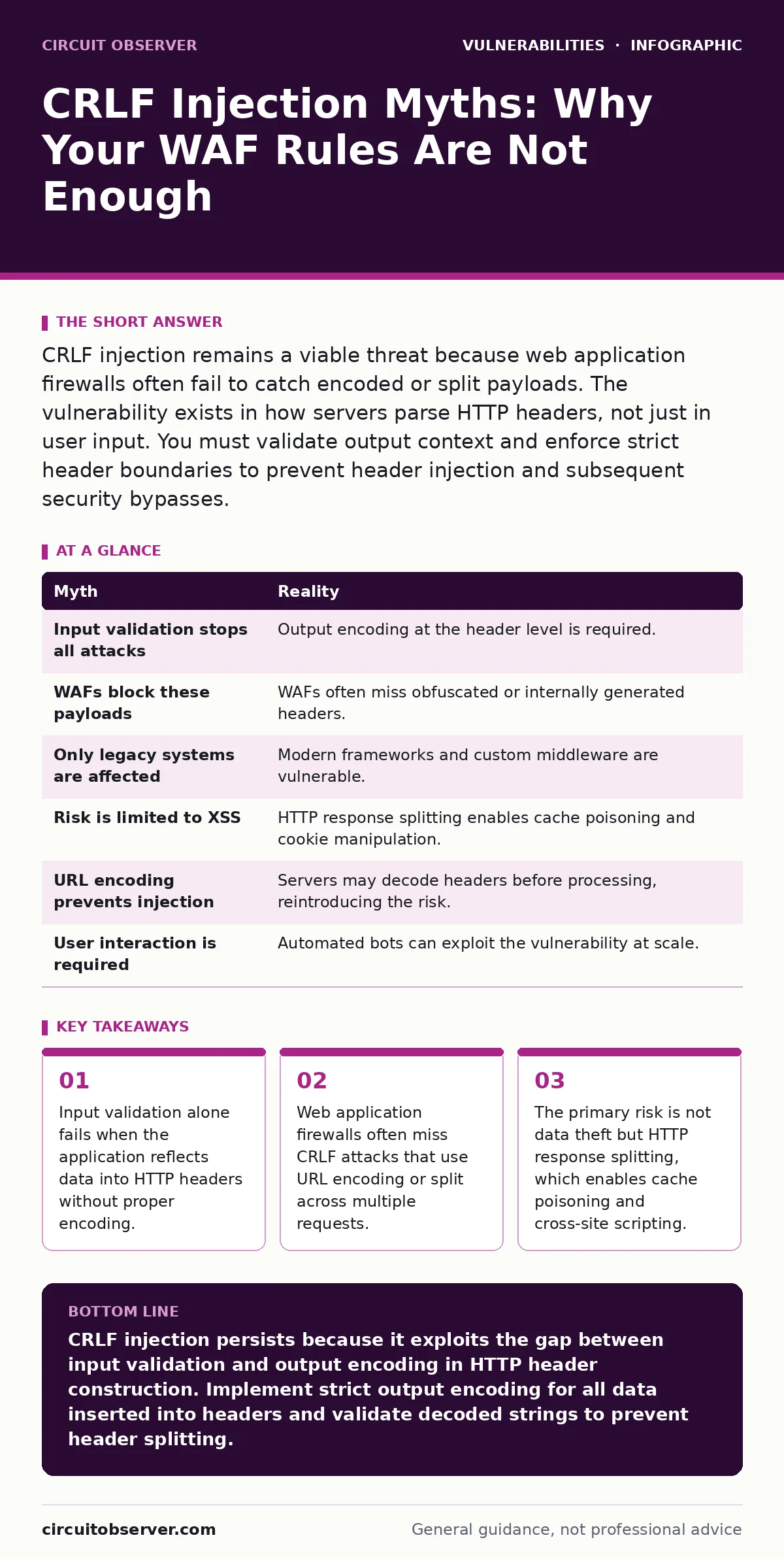
CRLF injection remains a viable threat because web application firewalls often fail to catch encoded or split payloads. The vulnerability exists in how servers parse HTTP headers, not just in user input. You must validate output context and enforce strict header boundaries to prevent header injection and subsequent security bypasses.
Myth: Input Validation Stops All CRLF Attacks
Reality: Validating user input for carriage return and line feed characters is insufficient if the application later uses that input to construct HTTP headers. The vulnerability lies in the output phase, not the input phase. When an application takes user-supplied data and inserts it into a response header without encoding, it creates a header injection vector.
Imagine a search function that adds the query term to a Location header for redirection. If the input is not sanitized at the point of use, an attacker can inject new headers. Standard input filters often allow benign-looking strings that become malicious when placed in a header context. You must treat all data destined for headers as untrusted until it is encoded.
Myth: Web Application Firewalls Block These Payloads
Reality: Web application firewalls operate on pattern matching and often miss CRLF injection attempts that are obfuscated or split. Many WAFs inspect the request body but do not fully reconstruct the HTTP response before it leaves the server. If the application constructs a malicious header internally, the WAF may never see the final payload.
This creates a blind spot in your defense perimeter. The firewall sees a clean request, but the application generates a polluted response. This disconnect allows header splitting to occur behind the firewall. You cannot assume that perimeter tools protect against logic flaws in your application code. The application must enforce its own header integrity.
Myth: CRLF Injection Only Affects Legacy Systems
Reality: Modern frameworks and languages still struggle with proper header handling when developers manually construct HTTP responses. While high-level libraries often handle encoding automatically, custom middleware and third-party plugins frequently introduce vulnerabilities. Any system that allows user input to influence HTTP headers is at risk, regardless of its age.
Newer technologies often prioritize flexibility over security by default. Developers may bypass built-in security features to optimize performance or meet specific requirements. This leads to custom header manipulation code that lacks proper validation. The shift to microservices increases the attack surface, as many internal services may not have the same security rigor as public-facing endpoints.
Myth: The Risk Is Limited to Cross-Site Scripting
Reality: CRLF injection enables HTTP response splitting, which is a broader threat than just cross-site scripting. By injecting new headers, an attacker can set cookies, redirect users, or poison the server cache. Cache poisoning is particularly dangerous because it affects all users who receive the cached response, not just the initial attacker.
Imagine a scenario where an attacker injects a script into a cached response. Every subsequent user who requests that resource executes the script. This amplifies the impact of the vulnerability significantly. The attacker does not need to target specific users; they can compromise the entire user base through a single poisoned cache entry. This makes CRLF injection a high-impact vector for lateral movement.
Myth: URL Encoding Prevents Header Injection
Reality: URL encoding is not a silver bullet because servers often decode headers before processing them. If the application decodes the input and then uses it in a header, the encoded CRLF characters become active. Many frameworks automatically decode URL-encoded strings, which can reintroduce the vulnerability even if the input was initially safe.
This double-decoding issue is a common source of confusion. Developers assume that encoding the input is sufficient, but the server’s parsing logic may strip the encoding. You must understand the decoding behavior of your specific framework and server software. If the server decodes headers before validation, you must validate the decoded string, not the encoded one.
See also: SQL Injection Risks and Protection for Small Businesses · File Upload Vulnerabilities Prevention Checklist
Myth: CRLF Injection Requires User Interaction
Reality: CRLF injection can be exploited through automated tools and bots, requiring no direct user interaction. Attackers can send crafted requests to trigger header splitting and cache poisoning automatically. This makes the vulnerability exploitable at scale, allowing attackers to compromise large numbers of users without them clicking a link or visiting a specific page.
This characteristic aligns with the behavior of zero-click exploits, where the victim is unaware of the attack. The automation potential means that even low-traffic sites can be targeted effectively. Bots can continuously probe for vulnerable endpoints and inject payloads into caches. The lack of required user interaction lowers the barrier for exploitation and increases the likelihood of successful attacks.
Summary of CRLF Injection Myths
| Myth | Reality |
|---|---|
| Input validation stops all attacks | Output encoding at the header level is required. |
| WAFs block these payloads | WAFs often miss obfuscated or internally generated headers. |
| Only legacy systems are affected | Modern frameworks and custom middleware are vulnerable. |
| Risk is limited to XSS | HTTP response splitting enables cache poisoning and cookie manipulation. |
| URL encoding prevents injection | Servers may decode headers before processing, reintroducing the risk. |
| User interaction is required | Automated bots can exploit the vulnerability at scale. |
Key takeaways
- Input validation alone fails when the application reflects data into HTTP headers without proper encoding.
- Web application firewalls often miss CRLF attacks that use URL encoding or split across multiple requests.
- The primary risk is not data theft but HTTP response splitting, which enables cache poisoning and cross-site scripting.
CRLF injection persists because it exploits the gap between input validation and output encoding in HTTP header construction. Implement strict output encoding for all data inserted into headers and validate decoded strings to prevent header splitting.
Frequently asked questions
How do I test for CRLF injection in my application?
Send requests containing URL-encoded carriage return and line feed characters to parameters that influence HTTP headers. Check the response headers to see if your injected characters appear as new headers or break the header structure.
What is the difference between CRLF injection and open redirect vulnerabilities?
Open redirect vulnerabilities allow attackers to redirect users to external sites, while CRLF injection allows attackers to inject arbitrary HTTP headers. CRLF injection can be used to create open redirects, but it also enables more severe attacks like cache poisoning and session hijacking.
Does HTTPS prevent CRLF injection?
No, HTTPS encrypts data in transit but does not prevent the server from processing malicious headers. CRLF injection is a server-side logic flaw that occurs before encryption or after decryption. HTTPS does not validate the content of HTTP headers.
How this guide was produced: written by the Circuit Observer editorial team with AI assistance, checked against the public references listed below, and reviewed when the facts change. See our editorial policy or report an error.