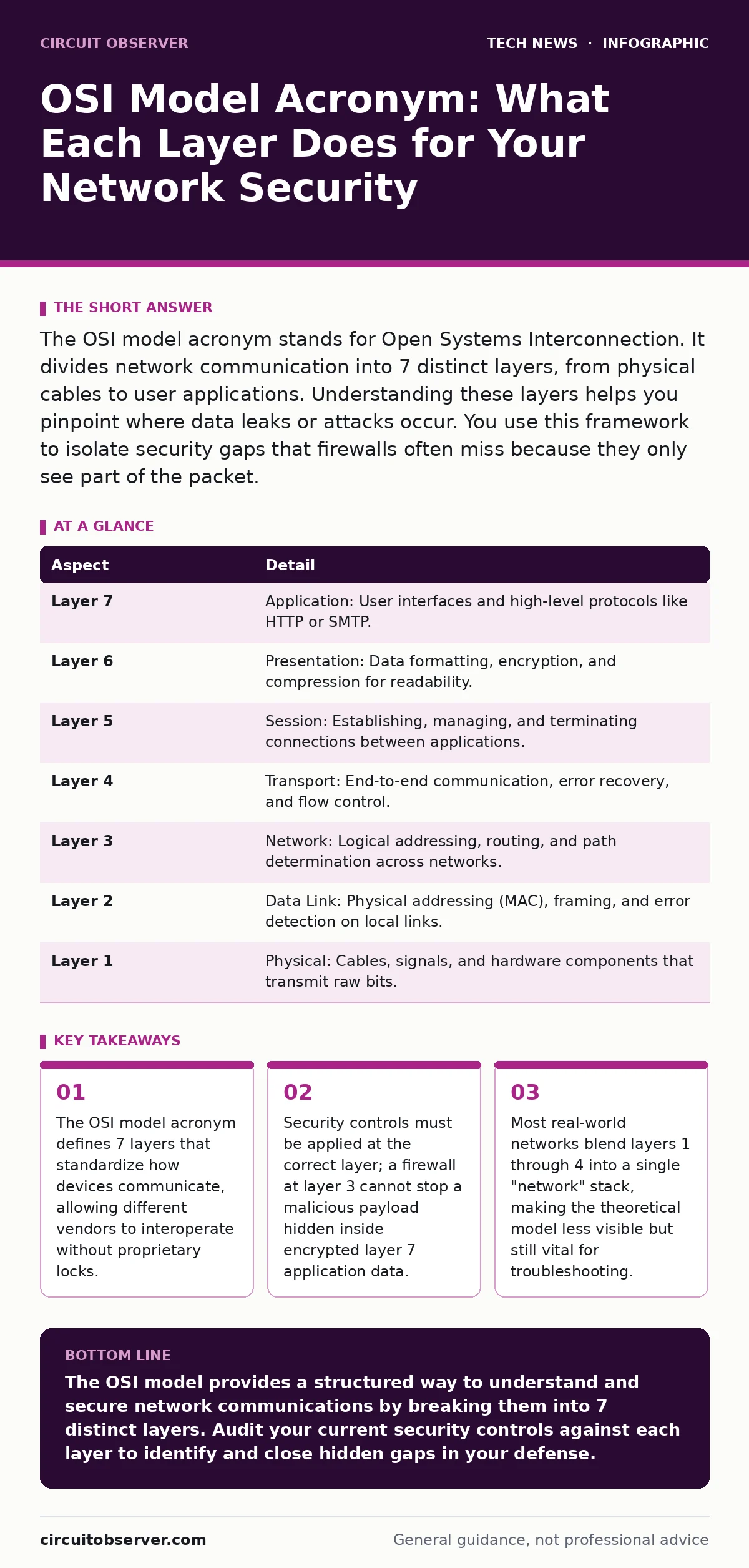
The OSI model acronym stands for Open Systems Interconnection. It divides network communication into 7 distinct layers, from physical cables to user applications. Understanding these layers helps you pinpoint where data leaks or attacks occur. You use this framework to isolate security gaps that firewalls often miss because they only see part of the packet.
The OSI Model Acronym Defined
Imagine you are sending a sealed letter through the postal system. You write the message, put it in an envelope, write the address, hand it to a carrier, who drives it on roads to another city, where a local carrier delivers it to the recipient's mailbox. Each step handles a specific part of the journey. The OSI model acronym describes this same process for digital data. It stands for Open Systems Interconnection. This framework creates 7 abstract layers that standardize how computer systems communicate. Each layer performs specific functions and interacts only with the layer directly above and below it. This separation allows hardware from one manufacturer to work with software from another. You do not need to know how a router switches bits to send an email. The model ensures that changes in one layer do not break the entire system.
It provides a common language for engineers to discuss where a problem exists. When a connection fails, you can isolate the issue to a specific layer. This precision saves hours of troubleshooting time. The model is theoretical but remains the foundation of all modern networking standards. It helps you visualize the path data takes from your keyboard to a remote server. Understanding this path is the first step in securing it. Each layer adds its own header information to the data. This process is called encapsulation. The receiving system removes these headers in reverse order. This process is called decapsulation. The OSI model acronym reminds you that data is not just a blob. It is a structured package with multiple wrappers. Each wrapper serves a distinct purpose in the communication chain. You use this structure to design security controls that match the threat model.
| Aspect | Detail |
|---|---|
| Layer 7 | Application: User interfaces and high-level protocols like HTTP or SMTP. |
| Layer 6 | Presentation: Data formatting, encryption, and compression for readability. |
| Layer 5 | Session: Establishing, managing, and terminating connections between applications. |
| Layer 4 | Transport: End-to-end communication, error recovery, and flow control. |
| Layer 3 | Network: Logical addressing, routing, and path determination across networks. |
| Layer 2 | Data Link: Physical addressing (MAC), framing, and error detection on local links. |
| Layer 1 | Physical: Cables, signals, and hardware components that transmit raw bits. |
How the Layers Work Together
Data flows down the stack on the sender side and up the stack on the receiver side. At the application layer, a program generates data. This data moves to the presentation layer where it might be encrypted. Encryption here ensures that only the intended recipient can read the content. This is where you see the benefits of strong cryptographic standards. The session layer then establishes a dialogue between the two applications. It manages the timing and coordination of the exchange. Next, the transport layer breaks the data into smaller segments. It assigns port numbers to ensure the data reaches the correct program on the destination device. It also handles retransmission if packets are lost. The network layer then packages these segments into packets. It adds logical addresses, such as IP addresses, to route the data across different networks. Routers operate primarily at this layer. They decide the best path for the packet to travel.
The data link layer frames the packets for transmission over the local network segment. It uses physical addresses, like MAC addresses, to identify devices on the same network. Finally, the physical layer converts the frames into electrical, optical, or radio signals. These signals travel over cables or air to the next device. On the receiving end, the process reverses. Each layer strips off its corresponding header. It passes the remaining data up to the next layer. This strict separation of duties allows for modular upgrades. You can change the cable type without changing the application software. This flexibility is why the model remains relevant decades after its creation. It abstracts complexity into manageable units. You can focus on securing one layer without worrying about the others. However, this abstraction also creates blind spots. If you only look at one layer, you miss threats operating at another. A complete security strategy requires visibility across all 7 layers.
Who the Model Affects
Every device that connects to a network relies on this structure. System administrators use it to diagnose connectivity issues. Security engineers use it to design defense-in-depth strategies. Developers use it to ensure their applications communicate correctly with external services. The model affects how you configure firewalls, intrusion detection systems, and proxies. It determines where you place sensors to monitor traffic. If you place a sensor at layer 3, you see IP addresses but not web content. If you place it at layer 7, you see web content but may miss low-level protocol anomalies. The choice depends on your security goals. Organizations with strict compliance requirements often need to inspect traffic at multiple layers. This requirement drives the need for advanced security tools. These tools must be able to decrypt and inspect application data.
They must also handle the performance overhead of deep inspection. The model affects how you train new staff. It provides a common vocabulary for discussing network behavior. Without this shared understanding, teams waste time arguing about symptoms instead of causes. It also affects how you evaluate new technologies. When a new protocol emerges, you map it to the OSI layers. This mapping helps you understand its security implications. For example, a new IoT protocol might operate primarily at layers 2 and 3. This placement suggests different risks than a traditional web application. You must adapt your security controls to match the layer where the data resides. Ignoring this mapping leads to ineffective security postures. You might secure the perimeter while leaving the application layer exposed. The model forces you to think holistically about the entire communication path.
What People Usually Get Wrong
Many people confuse the OSI model with the TCP/IP model. The TCP/IP model is the practical implementation used on the internet. It condenses the 7 OSI layers into 4 layers. The OSI model is a theoretical reference, not a strict implementation guide. Real-world protocols often span multiple OSI layers. For instance, HTTPS operates at both the transport and application layers. Assuming a strict boundary between layers leads to misconfiguration. Another common mistake is assuming that higher layers are less important for security. Attackers frequently target layer 7 applications because they are complex and hard to secure. They exploit bugs in web applications rather than breaking encryption. Focusing only on network layer security leaves these vulnerabilities open.
You must secure the application code itself. Another error is ignoring the physical layer. Physical security is the foundation of all other security measures. If an attacker gains physical access to a device, they can bypass most software controls. They can plug in a device to intercept traffic or install hardware keyloggers. The model reminds you that security starts with the cable and ends with the user. Neglecting any layer creates a weak link in the chain. Attackers follow the path of least resistance. They will exploit the weakest layer they find. You must ensure that each layer has appropriate controls. This requires a balanced approach to security investment. Do not over-invest in layer 3 firewalls while neglecting layer 7 application security. Balance is key to a resilient network.
Practical Steps for Implementation
You can use the OSI model to audit your current security posture. Start by mapping your existing controls to each layer. Identify which layers have no active monitoring or protection. Prioritize gaps that expose sensitive data. For layer 1 and 2, ensure physical access is restricted. Use locked server rooms and secure cable management. For layer 3 and 4, configure firewalls to block unauthorized traffic. Use intrusion prevention systems to detect anomalies. For layer 5 and 6, manage session timeouts and enforce strong encryption standards. For layer 7, deploy web application firewalls and conduct regular code reviews. This layered approach ensures that if one control fails, another catches the threat. It also helps you justify security spending to management.
You can show exactly where each tool adds value. Do not rely on a single tool to protect all layers. No single product can effectively secure the entire stack. You need a combination of hardware, software, and policy controls. Regularly test your defenses at each layer. Penetration testing should simulate attacks at different levels. This testing reveals hidden weaknesses that automated scans miss. Update your documentation to reflect the current state of each layer. This documentation helps new team members understand the security architecture. It also serves as a baseline for future improvements. The OSI model is not just a textbook concept. It is a practical tool for building a secure network. Use it to structure your thinking and your defenses.
See also: List of Ports and Protocols: How to Map and Secure Your Network · Detect Eavesdropping: Log Signals and Network Anomalies
Related Security Considerations
Securing the application layer often involves managing how users authenticate. One-time passwords add a second factor to this process, reducing the risk of credential theft. This control operates at the application layer but impacts the session layer by validating identity. Remote work security introduces new challenges for layer 3 and 4. Employees connect from various networks, bypassing traditional perimeter defenses. You must extend your security controls to these remote endpoints. Data center security focuses heavily on layers 1 and 2. Physical access controls and network segmentation are critical here. Mobile device security requires attention to layers 1 through 7.
These devices connect via wireless signals and run complex applications. macOS security settings provide controls at the operating system level, affecting layers 5 through 7. Understanding the OSI model helps you place these controls correctly. It ensures that you are not leaving gaps in your defense. For example, USB security controls prevent data exfiltration at the physical layer. SHA-256 is a hashing algorithm used at the presentation layer to verify data integrity. Each of these topics connects back to the OSI framework. They represent specific controls for specific layers. By understanding the model, you can integrate these controls more effectively. You create a cohesive security strategy rather than a collection of disjointed tools. This integration is vital for protecting modern, complex networks.
Key takeaways
- The OSI model acronym defines 7 layers that standardize how devices communicate, allowing different vendors to interoperate without proprietary locks.
- Security controls must be applied at the correct layer; a firewall at layer 3 cannot stop a malicious payload hidden inside encrypted layer 7 application data.
- Most real-world networks blend layers 1 through 4 into a single "network" stack, making the theoretical model less visible but still vital for troubleshooting.
The OSI model provides a structured way to understand and secure network communications by breaking them into 7 distinct layers. Audit your current security controls against each layer to identify and close hidden gaps in your defense.
Frequently asked questions
What does the OSI model acronym stand for?
The OSI model acronym stands for Open Systems Interconnection. It is a conceptual framework that characterizes and standardizes the functions of a telecommunication or computing system into seven abstraction layers.
Is the OSI model still used today?
Yes, the OSI model remains a vital reference for networking education and troubleshooting. While modern networks use the TCP/IP model for implementation, the OSI layers provide a common language for discussing protocol functions and security controls.
Which layer is the most important for security?
No single layer is more important than the others. Security requires a defense-in-depth approach where each layer has appropriate controls. A weakness in any layer can be exploited by an attacker to compromise the entire system.
How does encryption fit into the OSI model?
Encryption typically operates at the presentation layer (layer 6) for data formatting and at the application layer (layer 7) for specific protocol security. It ensures that data remains confidential as it traverses the lower layers of the stack.
How this guide was produced: written by the Circuit Observer editorial team with AI assistance, checked against the public references listed below, and reviewed when the facts change. See our editorial policy or report an error.