
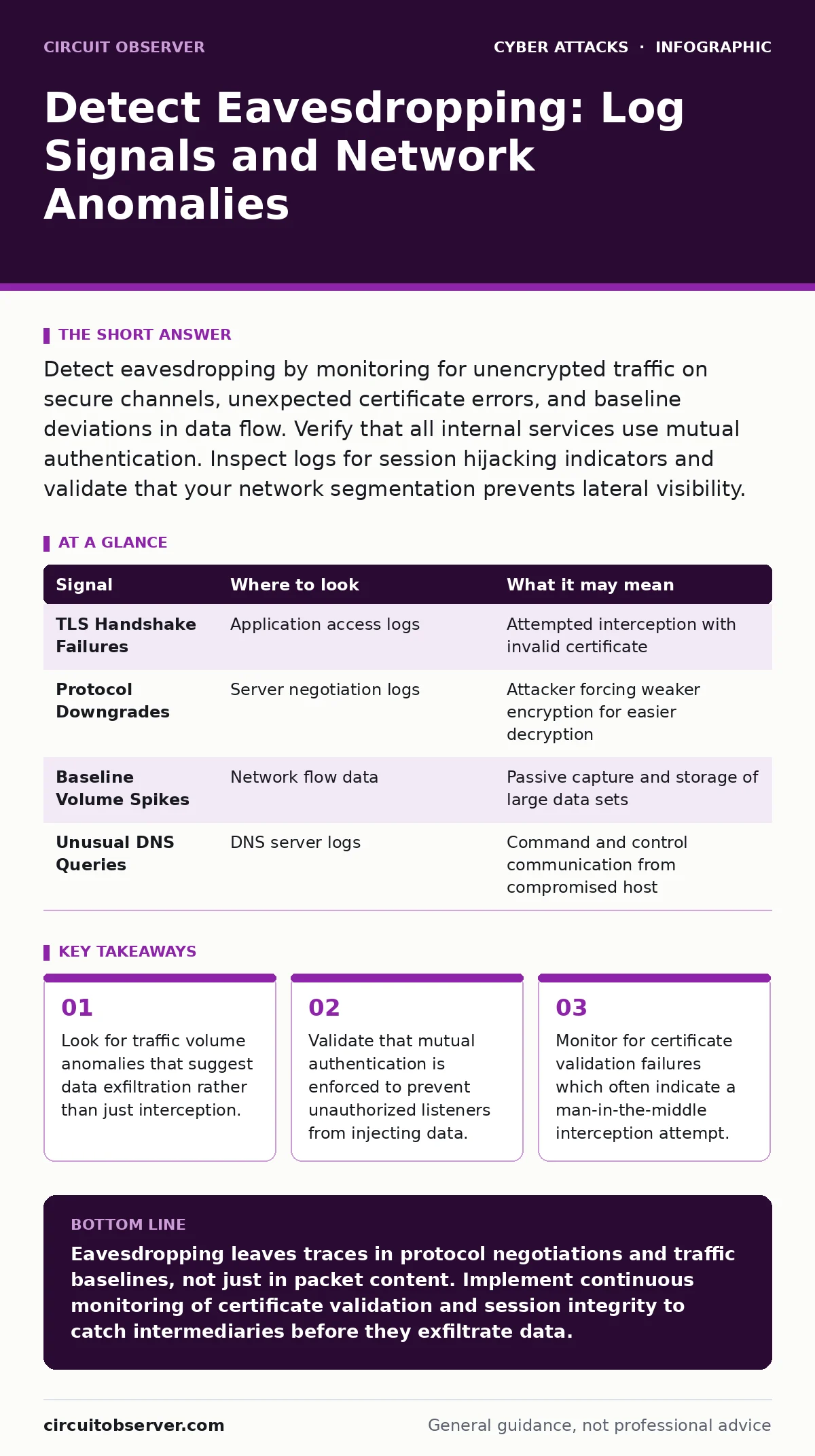
Detect eavesdropping by monitoring for unencrypted traffic on secure channels, unexpected certificate errors, and baseline deviations in data flow. Verify that all internal services use mutual authentication. Inspect logs for session hijacking indicators and validate that your network segmentation prevents lateral visibility.
Anomalies in Encrypted Channel Behavior
Encryption hides the content of your traffic, but it cannot hide the metadata. When an attacker inserts themselves into a communication stream, they often force a downgrade in security protocols or introduce latency. You must look for connections that fail to negotiate the highest available security standard. If a client suddenly accepts a lower encryption tier than it previously supported, an intermediary may be stripping stronger protections to decrypt the data.
Check your application logs for sudden increases in handshake failures. A man-in-the-middle attack often disrupts the initial negotiation phase. The attacker attempts to present a fraudulent certificate, and the client rejects it. This rejection generates a specific error code in your web server or application logs. Aggregating these errors across your infrastructure reveals patterns that single instances might miss.
Certificate Validation Failures
Mutual authentication requires both parties to verify each other’s identity using digital certificates. If an eavesdropper sits between two systems, they must present a certificate that matches the expected identity. Without the private key, they cannot generate a valid signature. This mismatch causes the receiving system to reject the connection.
You will see these failures in the access logs of your application servers. Look for HTTP status codes that indicate authentication errors or TLS handshake failures. A spike in these errors from specific IP ranges suggests active interference. Do not ignore sporadic failures. They often represent the initial probing phase before the attacker adjusts their tools to bypass detection.
Suppose your internal database server starts rejecting connections from your application tier. The logs show certificate validation errors. This indicates that something is intercepting the traffic and presenting a fake certificate. The application server correctly identifies the impostor and drops the connection. This failure is a feature, not a bug, but it requires you to monitor the error rate closely.
Traffic Volume and Baseline Deviations
Eavesdropping does not always involve active modification of data. Passive sniffing captures packets without altering them. However, the act of capturing and storing large volumes of traffic consumes resources. If an attacker is mirroring traffic to a local analysis tool, they may generate additional network noise.
Compare current traffic patterns against your established baseline. Look for unexplained increases in bandwidth usage on specific segments. If a quiet server suddenly sends large amounts of data to an unknown destination, it may be exfiltrating captured information. This is distinct from normal backup operations. Backup traffic follows a predictable schedule and size. Exfiltration traffic often occurs during off-hours and varies in size.
| Signal | Where to look | What it may mean |
|---|---|---|
| TLS Handshake Failures | Application access logs | Attempted interception with invalid certificate |
| Protocol Downgrades | Server negotiation logs | Attacker forcing weaker encryption for easier decryption |
| Baseline Volume Spikes | Network flow data | Passive capture and storage of large data sets |
| Unusual DNS Queries | DNS server logs | Command and control communication from compromised host |
Session Token Anomalies
Web applications rely on session tokens to maintain user state. If an attacker captures these tokens, they can impersonate the user. This is known as session hijacking. The original user and the attacker may appear to be in two places at once.
Monitor for concurrent sessions from geographically distant locations. If a user logs in from one city and immediately accesses resources from another, the system should flag this. Look for rapid succession of requests that exceed normal human interaction rates. Automated tools used by attackers often send requests faster than a human can click.
You should also check for token reuse across different endpoints. A valid session token should only be active on one device at a time. If the same token appears in logs from two different IP addresses within a short window, assume the token has been stolen. Invalidate the token immediately and force a re-authentication. This aligns with best practices for privileged access management to ensure that compromised credentials do not persist.
Blind Spots in Internal Trust
Most organizations focus heavily on perimeter defense. They assume that internal traffic is safe. This assumption is the largest blind spot in detecting eavesdropping. Attackers who breach the perimeter often pivot to internal networks where encryption is less common.
Internal services often communicate over plain text protocols for historical reasons. Database queries, internal API calls, and administrative interfaces may lack encryption. An attacker on the same network segment can capture this traffic without triggering external alerts. You must treat internal traffic with the same scrutiny as external traffic.
See also: List of Ports and Protocols: How to Map and Secure Your Network · OSI Model Acronym: What Each Layer Does for Your Network Security
The Cost of Inspection
To detect eavesdropping, you often need to inspect encrypted traffic. This requires terminating SSL/TLS at a proxy or firewall. This process exposes the plaintext data to the inspection device. If that device is compromised, the attacker gains access to all inspected traffic.
You face a trade-off between visibility and privacy. Decrypting traffic allows you to detect malicious payloads but introduces a single point of failure. You must secure the inspection device rigorously. Limit access to the private keys used for decryption. Rotate these keys regularly. This approach mirrors the principles found in cyber incident response team playbooks, where containment and preservation of evidence are balanced against operational continuity.
Correlating Signals Across Systems
No single log source provides a complete picture. You must correlate signals from network devices, application servers, and endpoint agents. A handshake failure in the web server log combined with a traffic spike on the network segment suggests active interception.
Automate this correlation. Manual review of logs is too slow to catch transient attacks. Use security information and event management systems to create rules that trigger alerts when multiple indicators appear simultaneously. For example, if a user’s session token is stolen and their login location changes, the system should block access and notify administrators.
This multi-layered approach reduces false positives. A single anomaly might be a configuration error. A cluster of anomalies is likely an attack. By connecting the dots, you move from reactive monitoring to proactive detection. This depth is necessary because attackers constantly adapt their tools to evade simple signature-based detection.
Key takeaways
- Look for traffic volume anomalies that suggest data exfiltration rather than just interception.
- Validate that mutual authentication is enforced to prevent unauthorized listeners from injecting data.
- Monitor for certificate validation failures which often indicate a man-in-the-middle interception attempt.
Eavesdropping leaves traces in protocol negotiations and traffic baselines, not just in packet content. Implement continuous monitoring of certificate validation and session integrity to catch intermediaries before they exfiltrate data.
Frequently asked questions
Can encryption prevent all eavesdropping?
Encryption protects data in transit but does not prevent attackers from capturing encrypted packets. If the attacker obtains the decryption keys or compromises an endpoint, they can still read the data.
How do I distinguish between a network glitch and an attack?
Look for patterns. Glitches are usually random and affect multiple services. Attacks are targeted, often affecting specific users or sessions, and may correlate with other suspicious activities like unusual login times.
Should I disable older encryption protocols?
Yes, unless you have specific legacy hardware that requires them. Older protocols have known vulnerabilities that attackers use to decrypt traffic. Disabling them forces connections to use stronger, modern standards.
What is the role of network segmentation in detection?
Segmentation limits the scope of an attack. If an attacker compromises one segment, they cannot easily eavesdrop on traffic in other segments. This reduces the amount of data they can capture and makes anomalies easier to spot.
How this guide was produced: written by the Circuit Observer editorial team with AI assistance, checked against the public references listed below, and reviewed when the facts change. See our editorial policy or report an error.