
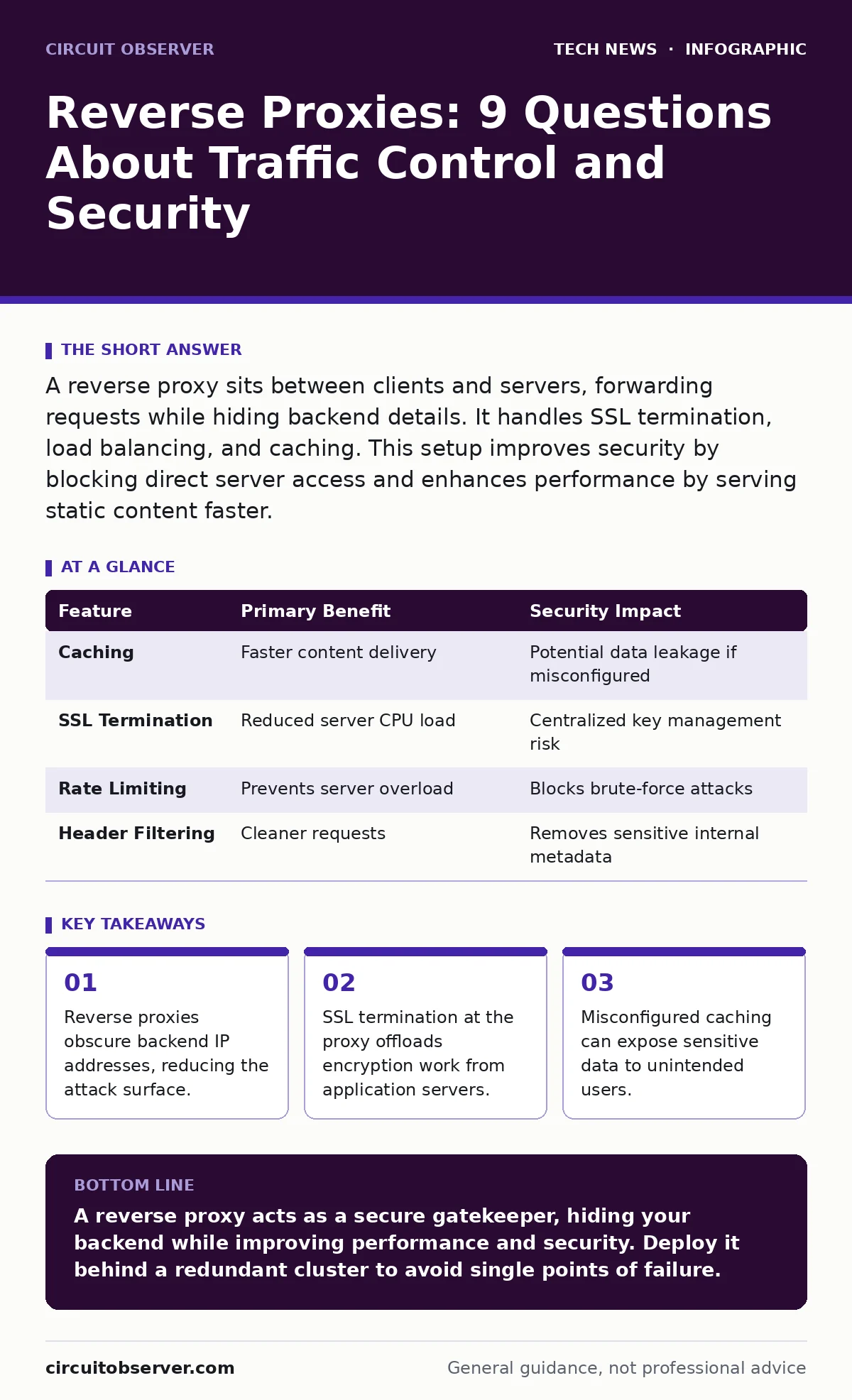
A reverse proxy sits between clients and servers, forwarding requests while hiding backend details. It handles SSL termination, load balancing, and caching. This setup improves security by blocking direct server access and enhances performance by serving static content faster.
What is a reverse proxy?
A reverse proxy is a server that sits in front of one or more web servers, intercepting client requests and forwarding them to the appropriate backend. Unlike a forward proxy, which acts on behalf of clients to access the internet, a reverse proxy represents the servers to the clients. You place it at the edge of your network to control how traffic enters your infrastructure. This positioning allows you to manage connections without exposing your application servers directly to the public.
How does it differ from a load balancer?
Load balancing is a specific function that distributes incoming traffic across multiple servers to prevent overload, while a reverse proxy is a broader architectural component. Many reverse proxies include load balancing capabilities, but they also handle security, caching, and SSL termination. A dedicated load balancer might focus solely on distributing packets efficiently, whereas a reverse proxy often processes HTTP headers and responses. You use a reverse proxy when you need control over content and security, not just traffic distribution.
Why should I use one for security?
It hides the true identity and configuration of your backend servers from external observers. Attackers scanning the internet see the proxy’s IP address and software signature, not your vulnerable application servers. This obscurity reduces the effectiveness of automated exploits targeting specific server versions. You can also enforce strict access controls and filter malicious payloads before they reach your application logic. For deeper context on server exposure, review our guide on data center security.
How does SSL termination work?
SSL termination decrypts incoming HTTPS traffic at the proxy layer, allowing the backend servers to process unencrypted HTTP requests. The proxy holds the private keys and performs the computationally expensive encryption and decryption tasks. This offloads the workload from your application servers, freeing up CPU cycles for business logic. The connection between the proxy and the backend is typically secured with internal certificates or trusted network segmentation.
Can a reverse proxy improve performance?
Yes, by caching static content and compressing responses before sending them to clients. When a user requests an image or stylesheet, the proxy can serve it from its local cache instead of querying the backend. This reduces latency and decreases the load on your origin servers. Compression algorithms like gzip or brotli shrink the size of text-based responses, speeding up page loads for users with slower connections.
| Feature | Primary Benefit | Security Impact |
|---|---|---|
| Caching | Faster content delivery | Potential data leakage if misconfigured |
| SSL Termination | Reduced server CPU load | Centralized key management risk |
| Rate Limiting | Prevents server overload | Blocks brute-force attacks |
| Header Filtering | Cleaner requests | Removes sensitive internal metadata |
See also: Web Cache Poisoning: How to Trace and Stop the Attack · SQL Injection Risks and Protection for Small Businesses
Does it protect against DDoS attacks?
It mitigates certain types of distributed denial-of-service attacks by absorbing traffic spikes and enforcing rate limits. The proxy can drop malformed packets or throttle requests from single IP addresses before they overwhelm your backend. However, it does not stop volumetric attacks that saturate your network bandwidth before traffic reaches the proxy. You need upstream filtering or a dedicated DDoS mitigation service for large-scale volumetric attacks.
What are the risks of misconfiguration?
Misconfigurations can expose your backend servers directly or leak sensitive information through error messages. If the proxy fails to strip internal headers, attackers may discover server software versions or internal IP addresses. Incorrect caching rules might serve private data to public users. You must regularly audit proxy rules and ensure that default configurations are hardened.
How do I handle internal traffic?
Traffic between the reverse proxy and backend servers should travel over a private, isolated network segment. This ensures that external attackers cannot intercept the decrypted traffic even if they compromise the proxy. Use mutual TLS or strict firewall rules to verify the identity of backend servers. This separation of duties prevents lateral movement if the edge proxy is breached.
Can it mask server fingerprints?
Yes, by rewriting or removing headers that reveal server software and versions. Many proxies allow you to customize the "Server" header to display a generic value or nothing at all. This prevents attackers from using fingerprinting tools to identify known vulnerabilities in your specific software version. You should also suppress error pages that might reveal stack traces or internal paths. For related header security practices, see our guide on email security.
What happens if the proxy fails?
If the reverse proxy goes offline, all external access to your backend services is interrupted. This creates a single point of failure unless you deploy multiple proxies in a high-availability cluster. You must design your architecture to handle proxy downtime without disrupting critical operations. Regular health checks and automated failover mechanisms are necessary to maintain service continuity.
How does it relate to DNS?
The reverse proxy’s public IP address is what you publish in your domain name system records. This decouples your backend infrastructure from your public identity, allowing you to change backend servers without updating DNS. You can also use DNS round-robin to distribute traffic among multiple proxy instances. For best practices on managing these records, refer to our guide on domain name security.
Key takeaways
- Reverse proxies obscure backend IP addresses, reducing the attack surface.
- SSL termination at the proxy offloads encryption work from application servers.
- Misconfigured caching can expose sensitive data to unintended users.
- Rate limiting at the proxy layer prevents application-layer exhaustion.
A reverse proxy acts as a secure gatekeeper, hiding your backend while improving performance and security. Deploy it behind a redundant cluster to avoid single points of failure.
Frequently asked questions
Do I need a reverse proxy for a small website?
Even small sites benefit from SSL termination and basic security headers provided by a reverse proxy. It simplifies certificate management and protects against common web exploits.
Can a reverse proxy replace a firewall?
No, a reverse proxy operates at the application layer, while a firewall operates at the network and transport layers. You need both to protect against different types of attacks.
How do I log traffic through a reverse proxy?
Configure the proxy to log request details, including source IPs, timestamps, and response codes. Analyze these logs to detect anomalies and audit access patterns.
Is a reverse proxy the same as a CDN?
A content delivery network uses reverse proxies at edge locations to cache content globally. A single reverse proxy is usually located closer to your origin servers, though the underlying technology is similar.
How this guide was produced: written by the Circuit Observer editorial team with AI assistance, checked against the public references listed below, and reviewed when the facts change. See our editorial policy or report an error.