
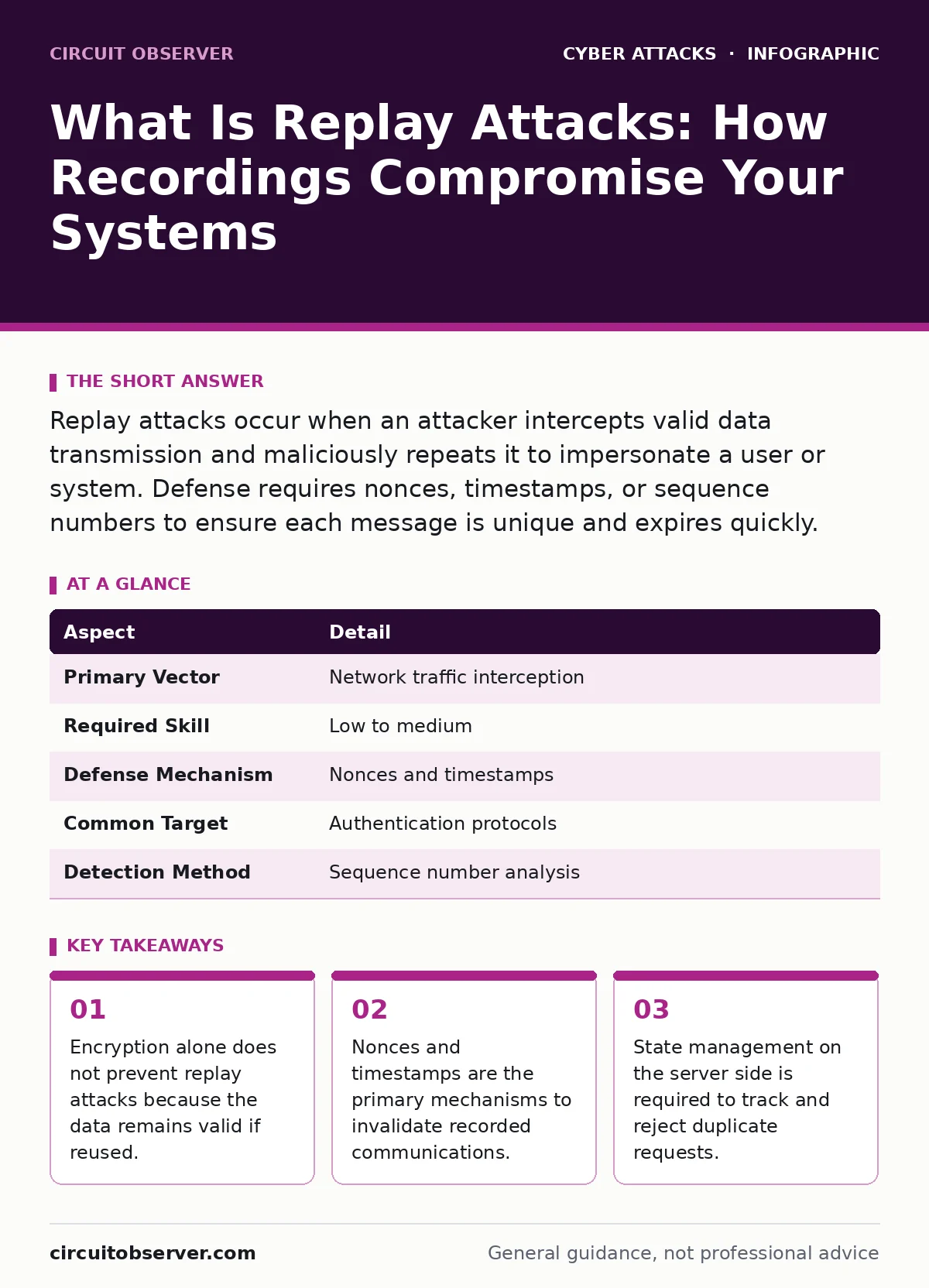
Replay attacks occur when an attacker intercepts valid data transmission and maliciously repeats it to impersonate a user or system. Defense requires nonces, timestamps, or sequence numbers to ensure each message is unique and expires quickly.
What Is Replay Attacks and Why It Matters
Replay attacks involve an attacker intercepting valid data transmission and maliciously repeating it to gain unauthorized access. The attacker does not need to decrypt the information. The attacker simply copies the packet and sends it again. The target system accepts the copy because it contains valid credentials or authentication tokens. This method bypasses many standard security controls that only verify the integrity of the data, not its freshness.
Imagine you send a signed letter to your bank authorizing a transfer. A thief steals the letter but cannot read it. The thief makes a perfect photocopy and delivers it to the bank. The bank sees your signature and accepts the copy. You have lost funds despite never giving away your password. This is the core mechanic of replay attacks. The security failure lies in the system accepting the same message twice.
| Aspect | Detail |
|---|---|
| Primary Vector | Network traffic interception |
| Required Skill | Low to medium |
| Defense Mechanism | Nonces and timestamps |
| Common Target | Authentication protocols |
| Detection Method | Sequence number analysis |
How the Attack Mechanism Operates
The attacker positions themselves on the network path between the client and the server. This is often called a man-in-the-middle position. The attacker records the handshake or the login request. The recorded data includes encrypted credentials or session tokens. The attacker waits for a convenient moment or sends the data immediately. The server receives the replayed data and processes it as a new, legitimate request.
The protocol must support this behavior for the attack to succeed. If the protocol allows the same credential to work multiple times within a window, the attack succeeds. The attacker gains access to the account or executes the command. This affects any system that relies on static tokens or challenge-response pairs without expiration. It impacts wireless networks, web logins, and internal service calls.
Who Is Affected by Replay Attacks
Any system using challenge-response authentication is vulnerable if it lacks freshness checks. Wireless networks using older security standards are frequent targets. These systems broadcast authentication challenges that can be captured and replayed. Web applications using session cookies are also at risk if the cookies do not expire or rotate. Internal microservices communicating over local networks often skip these checks for performance, creating internal attack surfaces.
You may assume that because your data is encrypted, it is safe from replay. This assumption is dangerous. The attack does not rely on breaking encryption. It relies on the protocol accepting valid data out of context. Systems that prioritize uptime over strict state tracking are particularly vulnerable. If the server cannot remember every previous request, it cannot detect a duplicate. This creates a trade-off between server memory usage and security posture.
What to Do About Replay Attacks
You must implement mechanisms that ensure each message is unique and time-sensitive. The most common solution is a nonce. A nonce is a number used only once. The server generates a unique value for each session or request. The client includes this value in its response. The server checks that the nonce has not been used before. If the nonce is repeated, the server rejects the request.
Timestamps provide another layer of defense. The client includes the current time in the request. The server checks if the time is within an acceptable window. If the request is too old, the server rejects it. This prevents attackers from storing data and playing it back later. You must synchronize clocks between client and server for this to work. Network time protocol helps maintain this synchronization.
Sequence numbers offer a third approach. Each message in a session gets a sequential number. The server expects the next number in the series. If a number is repeated or skipped, the server detects the anomaly. This method requires the server to maintain state for each active session. It increases server complexity but provides strong protection against replay.
What People Usually Get Wrong
Many administrators believe that strong encryption algorithms prevent replay attacks. This is incorrect. Encryption ensures confidentiality and integrity. It does not ensure freshness. A replayed encrypted message is still valid if the key remains secret. You must add protocol-level protections on top of encryption.
Another common mistake is relying solely on client-side timestamps. An attacker can manipulate the client clock if they have control over the device. Server-side validation is required. The server must define the acceptable time window and reject anything outside it. You cannot trust the client to tell the truth about time.
Some teams disable replay protection to improve performance. Tracking nonces or sequence numbers requires database lookups or memory usage. This adds latency to every request. Teams often accept this risk for internal services. This creates a hidden vulnerability that attackers can exploit to move laterally through your network.
See also: OSI Model Acronym: What Each Layer Does for Your Network Security · Detect Eavesdropping: Log Signals and Network Anomalies
Integration with Other Security Controls
Replay protection works best when combined with other measures. Multi-factor authentication adds a second layer that is harder to replay. If the second factor is time-based, it naturally expires. This reduces the window of opportunity for an attacker. However, you must ensure the second factor cannot be intercepted and replayed either.
Rate limiting can mitigate the impact of a replay attack. If the attacker tries to replay many requests, rate limiting slows them down. This gives you time to detect the anomaly. However, rate limiting does not stop a single successful replay. It only limits the volume of the attack.
Payment verification procedures often include unique transaction IDs. These IDs act like nonces. Each payment has a unique identifier that is checked against a ledger. This prevents the same payment authorization from being processed twice. This pattern applies to any financial or critical operation.
Bot protection systems can help identify automated replay attempts. If a request pattern looks like a script rather than a human, the system can block it. This is a heuristic defense. It is not a guarantee. You should use it as an additional alert mechanism, not a primary control.
Implementing Defenses in Your Environment
You need to audit your current authentication methods. Identify any protocol that allows repeated use of the same token. Implement nonces or timestamps in these protocols. Ensure your servers can track used nonces. This may require changes to your database schema or caching layer.
Test your defenses with simulated replay attacks. Capture legitimate traffic and attempt to replay it. Verify that your system rejects the duplicate requests. Monitor logs for rejected nonces or timestamps. This indicates an active attack attempt.
Keep your protocols updated. Older versions may lack replay protection features. Upgrade to versions that support modern security standards. This includes TLS configurations and authentication frameworks. Regular updates close known vulnerabilities and improve your security posture.
Key takeaways
- Encryption alone does not prevent replay attacks because the data remains valid if reused.
- Nonces and timestamps are the primary mechanisms to invalidate recorded communications.
- State management on the server side is required to track and reject duplicate requests.
Frequently asked questions
Does HTTPS prevent replay attacks?
HTTPS encrypts the data but does not inherently prevent replay. You must implement application-level checks like nonces or timestamps within the HTTPS connection.
Can I use a random number as a nonce?
Yes, but it must be cryptographically secure and unique. The server must store used nonces to detect duplicates, even if they are random.
How long should a timestamp window be?
The window depends on your network latency. A few seconds is typical. Longer windows increase the risk of successful replay attacks.
Do replay attacks work on offline systems?
No, replay attacks require network communication. They cannot affect systems that do not transmit data over a network.
How this guide was produced: written by the Circuit Observer editorial team with AI assistance, checked against the public references listed below, and reviewed when the facts change. See our editorial policy or report an error.