
Protected health information is not just medical records. It includes any data that can identify a patient, even if stored separately from clinical notes. Misreading the scope leads to silent exposure. You must map data flows, not just file locations, to understand true liability and compliance boundaries.
Misreading: Only Clinical Notes Are Protected
Correct reading: Protected health information extends far beyond diagnosis codes and treatment plans. Any information that can identify a patient and relates to their past, present, or future physical or mental health status becomes protected. This includes billing records, insurance claims, and even attendance logs at a health club if linked to a member ID.
Suppose a hospital stores patient gym usage data in a separate database from medical records. If a common identifier like a date of birth links the two, the gym data becomes protected. You must treat any dataset that can be joined with patient identifiers as sensitive. This prevents accidental re-identification through data correlation.
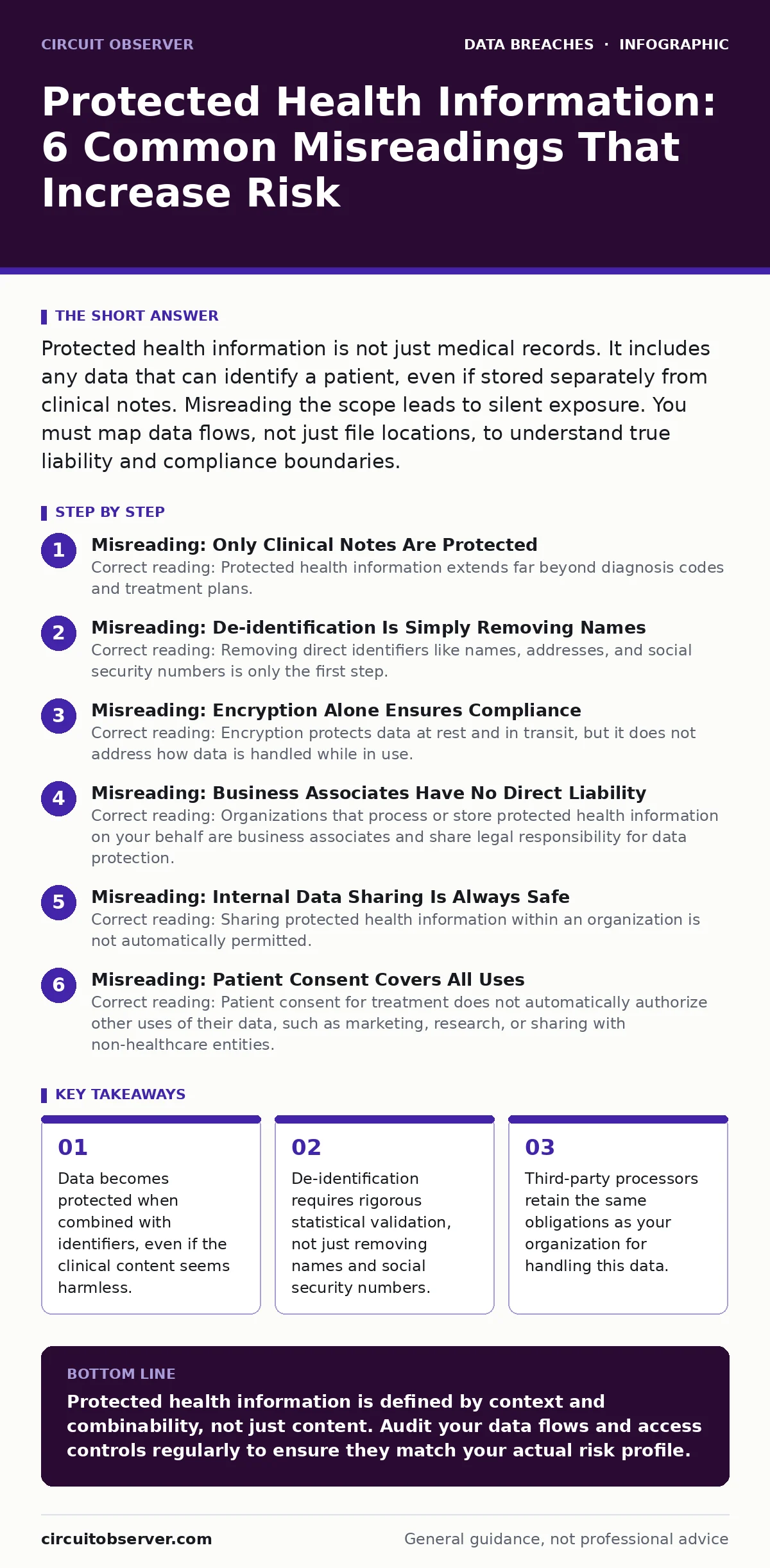
Misreading: De-identification Is Simply Removing Names
Correct reading: Removing direct identifiers like names, addresses, and social security numbers is only the first step. True de-identification requires ensuring that the remaining data cannot be used to identify an individual, either alone or when combined with other available information.
This often involves generalizing dates, removing geographic specifics smaller than a state, and applying statistical tests to confirm that the risk of re-identification is minimal. Imagine a dataset with rare medical conditions and exact birth dates. Even without names, the combination of rare disease and birth date can uniquely identify a person. You must validate de-identification methods against known re-identification techniques.
Misreading: Encryption Alone Ensures Compliance
Correct reading: Encryption protects data at rest and in transit, but it does not address how data is handled while in use. When applications decrypt data for processing, analysis, or display, that data is exposed in memory and on screens. If an attacker gains unauthorized access to a system during this window, encryption provides no protection.
You must implement strict access controls, session timeouts, and screen masking policies. Additionally, encryption keys must be managed securely. If keys are stored alongside the encrypted data or are easily accessible, the encryption is effectively broken. This is a common failure point in insider data theft scenarios where attackers already have system access.
Misreading: Business Associates Have No Direct Liability
Correct reading: Organizations that process or store protected health information on your behalf are business associates and share legal responsibility for data protection. You cannot outsource compliance. If a vendor suffers a breach due to poor security practices, your organization may face penalties and reputational damage.
You must conduct thorough vendor risk management to ensure partners meet security standards. Contracts must explicitly define security obligations, breach notification timelines, and audit rights. Suppose a cloud provider fails to segregate your data properly, leading to unauthorized access. You are still accountable for the failure to oversee that provider. Regular audits and security questionnaires are necessary checks.
Misreading: Internal Data Sharing Is Always Safe
Correct reading: Sharing protected health information within an organization is not automatically permitted. Access must be limited to the minimum necessary for the specific task. A marketing team does not need access to full medical histories to send appointment reminders. Over-provisioning access increases the risk of employee data breaches and accidental exposure.
You must implement role-based access controls and regularly review permissions. User access provisioning should be tied to job functions, not seniority. When employees change roles, their access must be updated immediately. Failure to revoke access is a leading cause of credential leaks and unauthorized data views. Monitor access logs to detect unusual patterns.
See also: Tokenization vs Encryption: How to Keep Data Safe Without the Keys
Misreading: Patient Consent Covers All Uses
Correct reading: Patient consent for treatment does not automatically authorize other uses of their data, such as marketing, research, or sharing with non-healthcare entities. Specific, written authorization is often required for these purposes. Assuming broad consent leads to violations and loss of trust. You must clearly distinguish between routine care operations and special uses. Suppose a hospital shares patient data with a wellness app partner without explicit opt-in consent. This violates privacy rules even if the data was de-identified poorly. Always verify the legal basis for each data use case. Documentation of consent must be precise and retrievable.
Misreading: Breach Notification Is Only for Large Incidents
Correct reading: Any unauthorized acquisition, access, or use of protected health information is a potential breach, regardless of size. Small incidents can indicate systemic weaknesses that lead to larger compromises. You must have a process to investigate and report all suspicious events. Delaying notification can worsen the impact and increase penalties. Even if data was encrypted, you must assess whether the encryption was compromised. If keys were exposed, the data is considered unprotected. Prompt assessment and communication are key to maintaining trust and compliance. Do not assume minor incidents are beneath reporting thresholds.
Misreading: Cloud Storage Is Inherently Secure
Correct reading: Cloud providers offer security tools, but configuring them correctly is your responsibility. Misconfigured storage buckets, databases, or access policies are common causes of data exposure. You must verify that encryption is enabled, access controls are strict, and logging is active. Regularly audit cloud configurations for drift. Suppose a team member uploads a sensitive file to a public cloud storage folder without realizing it is accessible to anyone. This is a frequent error in data exfiltration incidents. Implement automated scanning tools to detect misconfigurations. Train staff on secure cloud usage practices.
Misreading: Historical Data Is Less Risky
Correct reading: Old records remain protected health information and must be secured with the same rigor as current data. Historical data can still be used for identity theft, fraud, or re-identification. Archiving data does not remove compliance obligations. You must ensure that archived data is encrypted, access-controlled, and monitored. Suppose a hospital moves old records to cold storage but neglects to update access controls. An attacker gains access to these records and uses them for fraud. The age of the data does not diminish its value or the risk of exposure. Regularly review and purge unnecessary historical data to reduce the attack surface.
Key takeaways
- Data becomes protected when combined with identifiers, even if the clinical content seems harmless.
- De-identification requires rigorous statistical validation, not just removing names and social security numbers.
- Third-party processors retain the same obligations as your organization for handling this data.
- Encryption at rest does not protect data while it is being processed or displayed in memory.
Protected health information is defined by context and combinability, not just content. Audit your data flows and access controls regularly to ensure they match your actual risk profile.
Frequently asked questions
Does a patient's date of birth alone constitute protected health information?
No, a date of birth alone is not protected. It becomes protected when linked to other data that identifies the patient and relates to their health, such as a medical record number or diagnosis.
How do I know if a vendor is a business associate?
A vendor is a business associate if they create, receive, maintain, or transmit protected health information on your behalf to perform a service. Review your contracts to define this relationship clearly.
Can I share data with family members without consent?
You may share relevant information with family members involved in the patient's care if the patient agrees or does not object. If the patient is incapacitated, you may use professional judgment to share necessary information.
What is the minimum necessary standard?
The minimum necessary standard requires you to limit the use, disclosure, and request of protected health information to the amount needed to accomplish the intended purpose.
How this guide was produced: written by the Circuit Observer editorial team with AI assistance, checked against the public references listed below, and reviewed when the facts change. See our editorial policy or report an error.