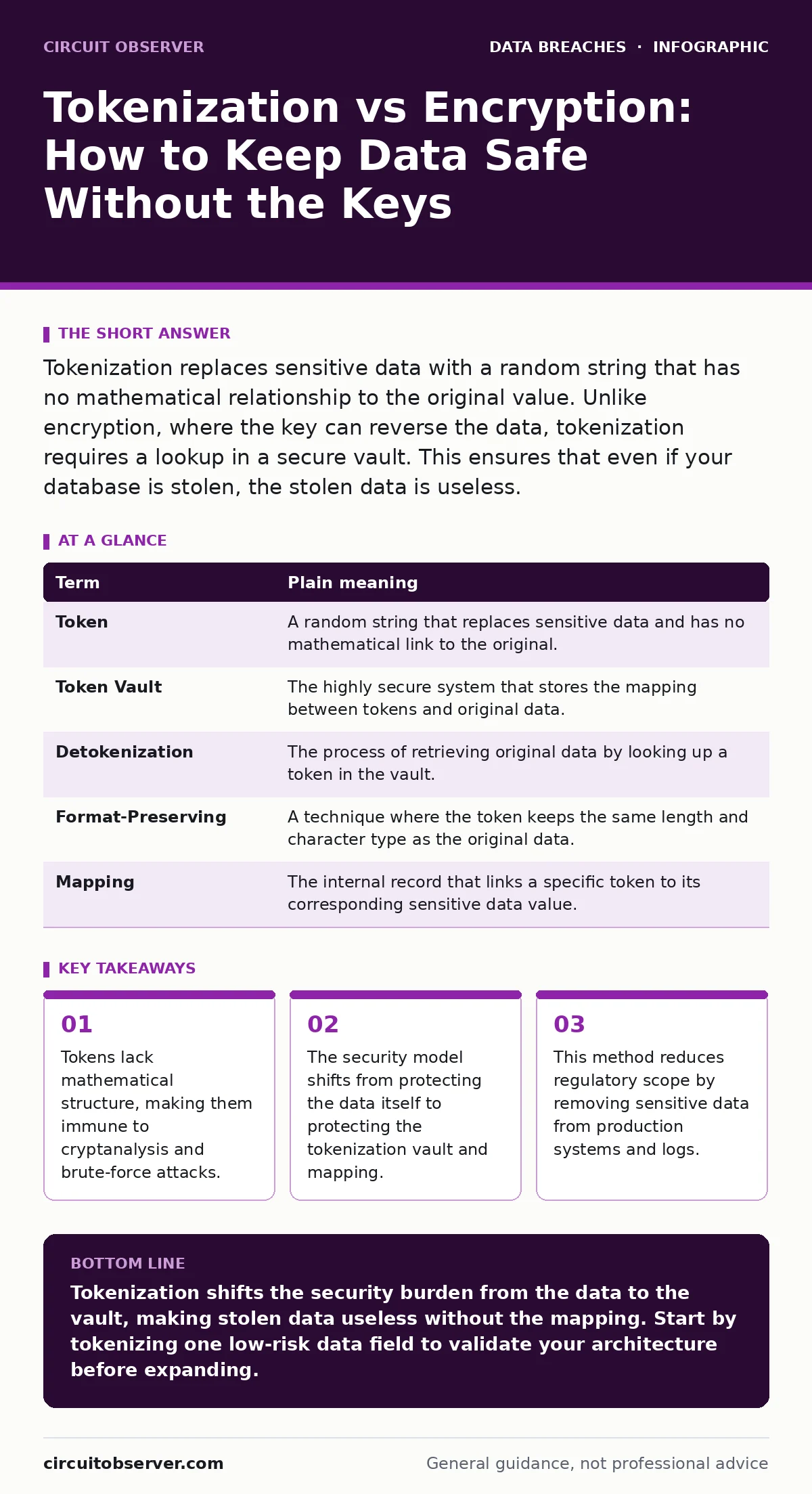
Tokenization replaces sensitive data with a random string that has no mathematical relationship to the original value. Unlike encryption, where the key can reverse the data, tokenization requires a lookup in a secure vault. This ensures that even if your database is stolen, the stolen data is useless.
The Library Book Exchange
Imagine you run a library where patrons check out books using their driver’s license numbers. You need to track who has which book, but you do not want to store those license numbers in your circulation database. Instead, you take each license number to a secure room. You write the number on a slip of paper and place it in a locked box labeled with a random code, like "XJ9-22." You give the code "XJ9-22" to the librarian. The librarian records "XJ9-22" against the book. If someone steals the circulation log, they see only random codes. They cannot guess the license numbers because the codes have no pattern. This is tokenization.
How Tokenization Differs from Encryption
Encryption transforms data using a mathematical formula and a key. If you have the key, you can reverse the process. Tokenization replaces data with a surrogate value called a token. There is no mathematical formula linking the token to the original data. To get the original data back, you must look up the token in a secure repository known as the token vault. This lookup process is called detokenization. Because there is no formula, an attacker who steals tokens cannot derive the original data, even if they know the tokenization algorithm.
| Term | Plain meaning |
|---|---|
| Token | A random string that replaces sensitive data and has no mathematical link to the original. |
| Token Vault | The highly secure system that stores the mapping between tokens and original data. |
| Detokenization | The process of retrieving original data by looking up a token in the vault. |
| Format-Preserving | A technique where the token keeps the same length and character type as the original data. |
| Mapping | The internal record that links a specific token to its corresponding sensitive data value. |
The Hidden Cost of Complexity
The security of tokenization relies entirely on the security of the vault. If the vault is compromised, the entire system fails. This creates a single point of failure that is often more valuable to attackers than a distributed database. You must protect the vault with stricter access controls than you use for the data itself. Imagine the library’s secure room is the only place where the real license numbers exist. If a thief breaks into that room, every book check-out becomes traceable to a real person. Your system architecture must reflect this heightened risk.
When Encryption Fails You
Encryption is vulnerable if the key is exposed. Attackers often target keys stored in configuration files or memory. Tokenization removes this risk because there is no key to steal. However, tokenization introduces latency. Every time you need to use the original data, your system must query the vault. This adds network overhead and potential points of failure. For high-volume transactions, this latency can degrade performance. You must balance the security benefit against the operational cost of every lookup.
Preserving Format for Legacy Systems
Many legacy applications expect specific data formats. A credit card number must be sixteen digits. An email address must contain an "@" symbol. Format-preserving tokenization ensures the token matches the structure of the original data. This allows you to replace sensitive fields in databases without breaking application logic. For example, a tokenized email can still be validated by standard regex checks. This is particularly useful when integrating with third-party services that require specific data formats but do not need access to the actual sensitive values.
See also: How Tokenization Works: Mapping Data to Unbreakable Tokens · Difference Between Unauthorized Access and Unauthorized Use Explained
Reducing Regulatory Scope
Regulations often define "sensitive data" by its ability to identify individuals. If your production database contains only tokens, it may no longer fall under strict compliance requirements. This is a significant operational advantage. You can perform user access provisioning with fewer restrictions because the data being accessed is not considered sensitive. However, the token vault remains in scope. You must document this distinction clearly for auditors. The reduction in scope applies only to the data at rest in your primary systems, not to the vault infrastructure.
Practical Implementation Steps
You cannot simply swap encryption for tokenization without planning. The transition requires changes to data flow, error handling, and monitoring. Start small. Identify a low-risk data element that is frequently accessed but rarely needs to be viewed in plain text. Implement tokenization for that field first. Monitor the performance impact and the success rate of detokenization requests. This allows you to refine your architecture before scaling to critical data.
- Identify data fields that are used for matching or reporting but do not require plain-text display in user interfaces.
- Select a tokenization solution that supports your required data formats and integrates with your existing authentication systems.
- Implement logging that records token usage without storing the original data, ensuring you can audit access without compromising privacy.
Managing the Vault Risk
The vault is the crown jewel of your tokenization strategy. It must be isolated from the production environment. Access should be granted only to specific services and personnel, with strict multi-factor authentication. Regular audits of vault access logs are necessary to detect unauthorized attempts. If you suspect a breach, you must consider digital forensics to determine if the vault was accessed. The cost of securing the vault is higher than securing encrypted data, but the payoff is a system that remains secure even if the primary database is compromised.
Key takeaways
- Tokens lack mathematical structure, making them immune to cryptanalysis and brute-force attacks.
- The security model shifts from protecting the data itself to protecting the tokenization vault and mapping.
- This method reduces regulatory scope by removing sensitive data from production systems and logs.
Tokenization shifts the security burden from the data to the vault, making stolen data useless without the mapping. Start by tokenizing one low-risk data field to validate your architecture before expanding.
Frequently asked questions
Is tokenization better than encryption?
It depends on your threat model. Tokenization is better for preventing data misuse from database breaches, but encryption is better for protecting data in transit and at rest without external dependencies.
Can tokens be reversed without the vault?
No. Tokens are random strings with no mathematical relationship to the original data. Without access to the token vault, reversing them is computationally impossible.
Does tokenization help with GDPR compliance?
Yes, by reducing the amount of personal data stored in processing systems, it can lower regulatory scope. However, the vault itself must still comply with data protection laws.
What happens if the token vault goes down?
Your applications will fail to detokenize data. You must design your system to handle vault unavailability gracefully, perhaps by caching recent tokens or falling back to read-only modes.
How this guide was produced: written by the Circuit Observer editorial team with AI assistance, checked against the public references listed below, and reviewed when the facts change. See our editorial policy or report an error.