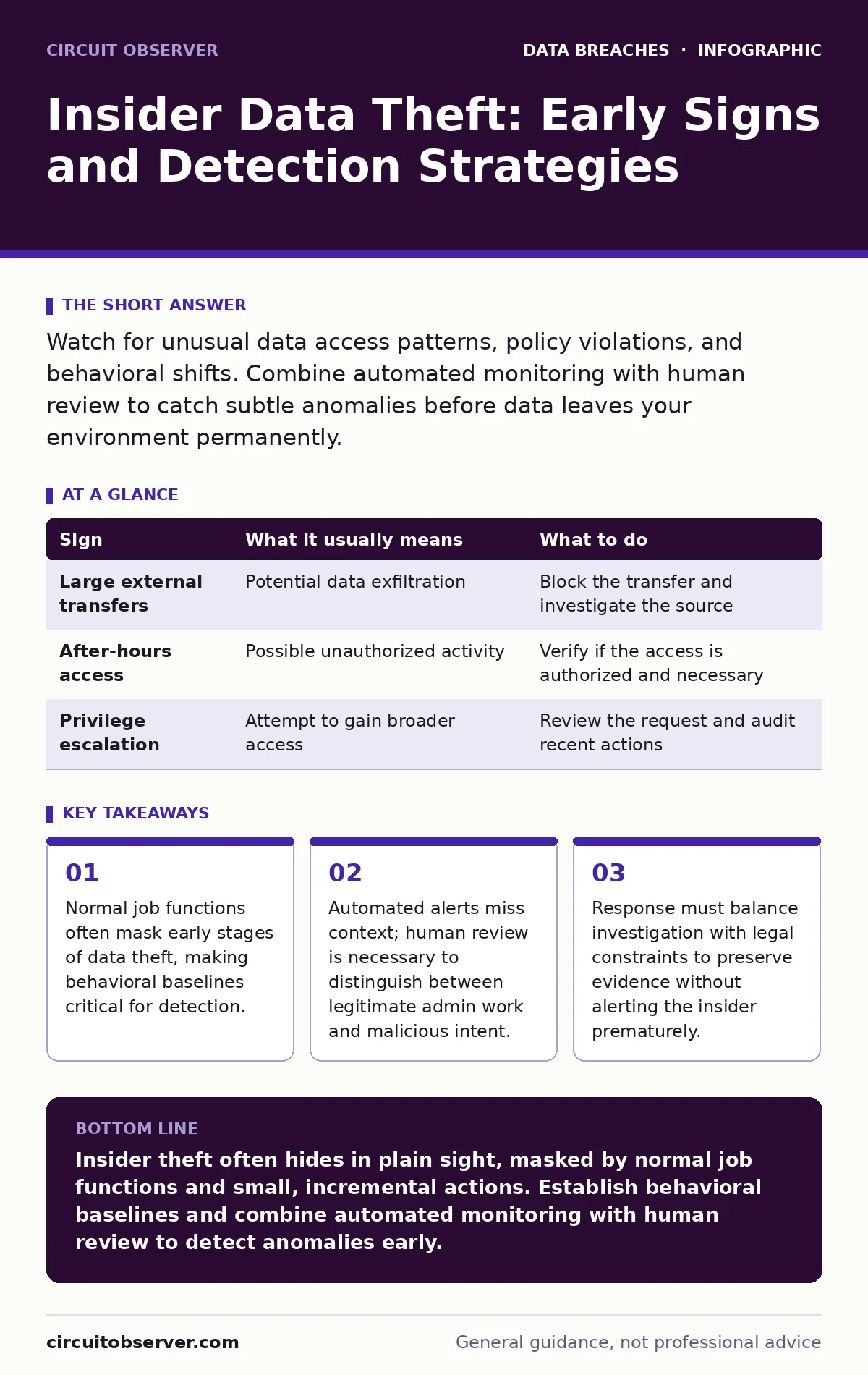
Watch for unusual data access patterns, policy violations, and behavioral shifts. Combine automated monitoring with human review to catch subtle anomalies before data leaves your environment permanently.
Immediate Indicators of Insider Threats
Immediate indicators often involve obvious policy violations or technical anomalies that trigger standard security alerts. These signs appear when an insider attempts to move large volumes of data quickly or bypasses standard controls. You will see these first because automated systems are designed to catch them.
- Large file transfers to external drives or cloud storage services.
- Accessing sensitive files outside of normal business hours.
- Repeated failed login attempts followed by successful access from unusual locations.
These events are loud. They stand out against the background noise of daily operations. Security information and event management tools flag them immediately. The challenge is not detection but interpretation. A legitimate system administrator might need to move large files during maintenance. Distinguishing between necessary work and theft requires understanding the context of the action.
Subtle Signs That Escape Automated Detection
Subtle signs are far more dangerous because they mimic normal behavior. An insider who understands your systems can hide their activities within legitimate workflows. These signs require human analysis to identify. They often involve small, incremental actions that accumulate over time.
- Accessing files unrelated to the user’s job role, even if the volume is small.
- Disabling or modifying logging tools on specific workstations or servers.
- Creating new accounts or elevating privileges without proper authorization.
These actions do not trigger alarms because they fall within accepted parameters. A developer might access a database they do not usually query. A manager might request additional permissions for a project. The anomaly lies in the pattern, not the individual event. You must look for deviations from the user’s historical baseline.
Behavioral Red Flags in the Workplace
Behavioral changes often precede technical anomalies. An insider planning to steal data may exhibit stress, defensiveness, or sudden disengagement. These signs are difficult to quantify but are critical for early warning. They require observation by colleagues and managers who interact with the insider daily.
- Sudden resistance to sharing work or collaborating with peers.
- Unexplained changes in work habits, such as staying late or working on weekends.
- Increased secrecy around computer screens or devices.
These behaviors are not proof of theft. They are indicators that warrant further investigation. A person might be dealing with personal issues or preparing for a resignation. Context matters. You should combine behavioral observations with technical data to form a complete picture.
Technical Anomalies in Data Access Patterns
Data access patterns reveal intent. An insider who wants to steal information will often gather data methodically. This creates distinct patterns in access logs. You can detect these patterns by analyzing who accesses what, when, and how often.
- Accessing multiple sensitive files in a short period.
- Downloading or printing large volumes of data.
- Accessing data from unusual devices or networks.
These patterns become visible when you establish a baseline for normal user behavior. Deviations from this baseline indicate potential risk. Automated tools can help identify these deviations, but they require tuning to reduce false positives. You must define what normal looks like for each role in your organization.
Response Protocol When Signs Appear
When you detect potential insider theft, your response must be careful and deliberate. Rushing to confront the insider can destroy evidence or allow them to escalate their activities. You need a structured approach to investigation and containment.
- Verify the alert by cross-referencing multiple data sources.
- Preserve logs and evidence without altering the original data.
- Consult legal counsel before taking action against the individual.
This process ensures that you act within legal boundaries and maintain the integrity of the evidence. It also prevents panic and ensures that you have a clear plan for containment.
| Sign | What it usually means | What to do |
|---|---|---|
| Large external transfers | Potential data exfiltration | Block the transfer and investigate the source |
| After-hours access | Possible unauthorized activity | Verify if the access is authorized and necessary |
| Privilege escalation | Attempt to gain broader access | Review the request and audit recent actions |
See also: Small Business Digital Forensics: Preserve Evidence and Limit Liability · Employee Data Breach Prevention Checklist for Internal Threats
Balancing Monitoring and Privacy
Monitoring insider activity raises privacy concerns. You must balance security needs with employee rights. Over-monitoring can create a culture of distrust and reduce morale. Under-monitoring leaves you vulnerable to theft.
- Define clear policies on what data is monitored and why.
- Communicate these policies to all employees.
- Limit access to monitoring data to authorized personnel only.
This balance is difficult to maintain. You must regularly review your monitoring practices to ensure they remain effective and compliant. Transparency helps build trust while maintaining security.
Long-Term Prevention Strategies
Preventing insider theft requires more than detection. You need to reduce the opportunity and motivation for theft. This involves technical controls, policy enforcement, and cultural changes.
- Implement least privilege access controls.
- Regularly review user permissions and access rights.
- Provide training on data handling and security policies.
These measures reduce the risk of insider threats. They also create a culture of security awareness. You should integrate these strategies into your overall security program.
Key takeaways
- Normal job functions often mask early stages of data theft, making behavioral baselines critical for detection.
- Automated alerts miss context; human review is necessary to distinguish between legitimate admin work and malicious intent.
- Response must balance investigation with legal constraints to preserve evidence without alerting the insider prematurely.
Insider theft often hides in plain sight, masked by normal job functions and small, incremental actions. Establish behavioral baselines and combine automated monitoring with human review to detect anomalies early.
Frequently asked questions
How do I distinguish between a curious employee and a malicious insider?
Look for patterns of access that deviate from the user’s historical baseline and job role. Curiosity is usually sporadic; malicious intent is methodical and persistent.
Should I confront an employee if I suspect insider theft?
No. Confrontation can alert the insider to destroy evidence or escalate their activities. Consult legal counsel and follow a structured investigation protocol first.
Can automated tools detect all insider threats?
No. Automated tools detect technical anomalies but miss context and behavioral nuances. Human review is necessary to interpret alerts and identify subtle signs.
How often should I review user access permissions?
Regularly. Access reviews should occur at least quarterly or whenever an employee changes roles. This ensures that permissions align with current job responsibilities.
How this guide was produced: written by the Circuit Observer editorial team with AI assistance, checked against the public references listed below, and reviewed when the facts change. See our editorial policy or report an error.