
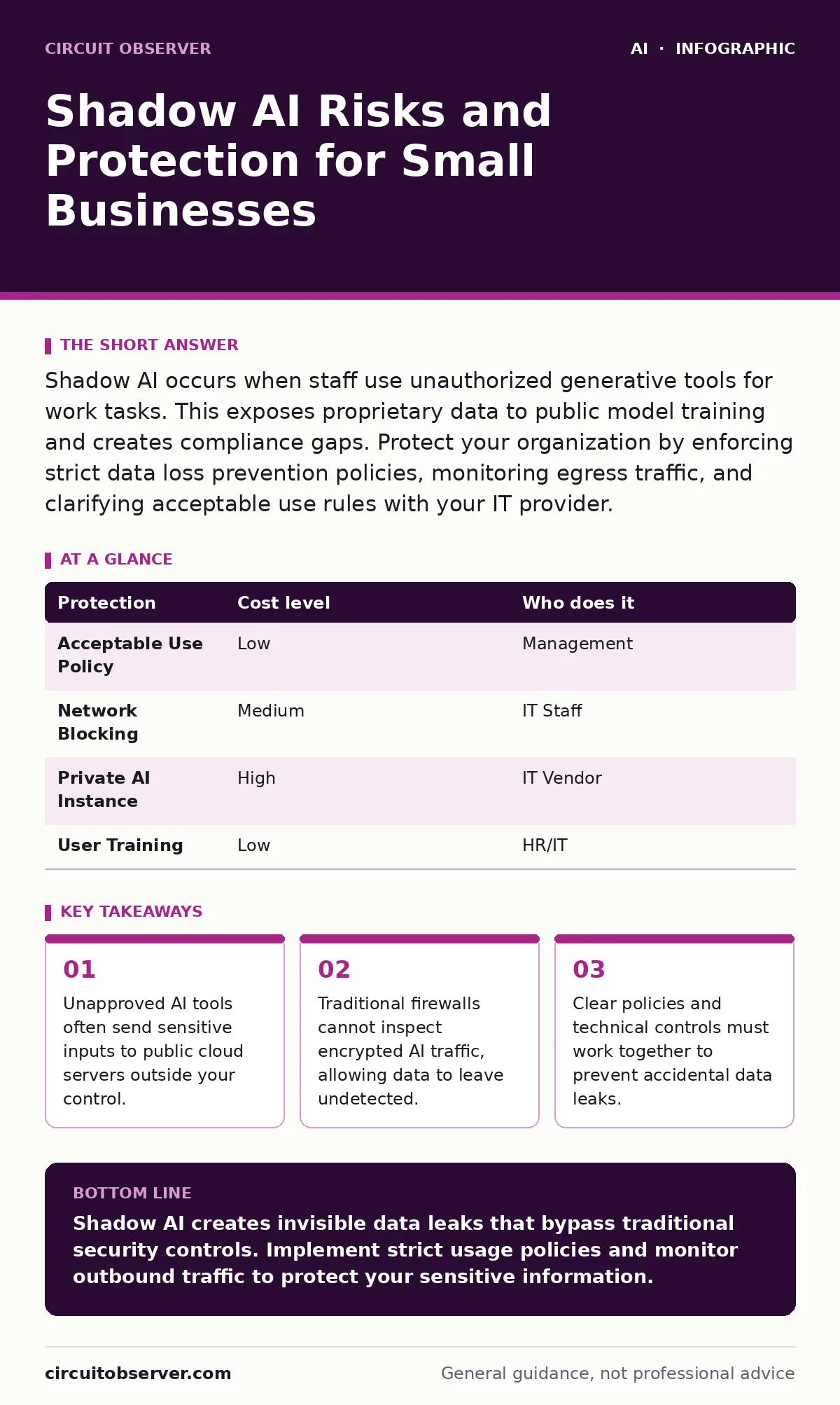
Shadow AI occurs when staff use unauthorized generative tools for work tasks. This exposes proprietary data to public model training and creates compliance gaps. Protect your organization by enforcing strict data loss prevention policies, monitoring egress traffic, and clarifying acceptable use rules with your IT provider.
The Hidden Cost of Convenience
Shadow AI refers to the use of artificial intelligence tools by employees without the knowledge or approval of the organization's IT department. This happens because these tools are easy to access and often faster than internal systems. You might see staff using public chatbots to summarize emails, write code, or analyze spreadsheets. The immediate benefit is speed, but the hidden cost is data exposure.
When an employee inputs company data into a public AI service, that data leaves your secure environment. Most free or low-cost AI services do not guarantee data privacy. They may store inputs to improve their models or share them with third parties. You lose control over where that information goes and who can access it. This creates a significant risk for small organizations that lack the resources to recover from a breach.
Why Small Organizations Are Exposed
Small businesses are particularly vulnerable to shadow AI because they often lack dedicated security teams. IT staff may be stretched thin, focusing on keeping systems online rather than monitoring user behavior. Employees feel pressure to work efficiently and turn to the easiest tool available. This cultural factor drives adoption faster than security policies can adapt.
Additionally, small organizations often rely on standard internet connections without deep packet inspection. This means they cannot see what data is leaving the network. If an employee uses a browser-based AI tool, the traffic looks like normal web browsing. Your firewall sees HTTPS traffic but cannot determine if that traffic contains sensitive financial records or customer lists. This blind spot allows shadow AI to thrive undetected.
Data Leakage Mechanisms
The primary risk of shadow AI is sensitive data leaks through AI chatbots. When you type a query into a public model, you are sending raw text to a remote server. That server processes the text and returns a response. The provider may retain logs of this interaction for debugging or training purposes. This means your internal documents could end up in a dataset used to train future versions of the model.
Consider the mechanism of prompt injection. If an employee pastes code into a public AI tool to fix a bug, that code is now visible to the service provider. If the code contains API keys or connection strings, those secrets are compromised. Even if the provider promises not to use data for training, you have no way to verify this claim. The risk remains because you cannot audit the provider’s internal processes.
Low-Cost Protection Strategies
You can mitigate shadow AI risks without expensive enterprise software. Start by implementing a clear acceptable use policy. Define which AI tools are approved for business use and which are prohibited. Specify what types of data can be entered into approved tools. For example, allow public data summaries but ban the input of customer names or financial figures.
Next, enforce data loss prevention controls. Configure your network to block access to known unauthorized AI services. This requires maintaining a list of blocked domains and updating it regularly. Since new AI tools emerge frequently, this is an ongoing process. You can also use browser extensions that warn users when they attempt to access blocked sites. These tools provide a layer of friction that encourages compliance.
Another effective measure is to provide approved alternatives. If your staff needs AI assistance, offer a secure, private instance of a model. This allows them to use AI benefits while keeping data within your environment. Private models do not send data to public servers, eliminating the leakage risk. This approach addresses the root cause of shadow AI: the need for efficiency.
Protection Matrix
| Protection | Cost level | Who does it |
|---|---|---|
| Acceptable Use Policy | Low | Management |
| Network Blocking | Medium | IT Staff |
| Private AI Instance | High | IT Vendor |
| User Training | Low | HR/IT |
See also: Small Business Digital Forensics: Preserve Evidence and Limit Liability
What to Ask Your IT Provider
If you rely on an external IT provider, you must verify their capabilities regarding AI security. Do not assume they are monitoring for these threats. Ask specific questions to uncover gaps in their service. You need to know how they detect and respond to unauthorized tool usage.
- How do you monitor outbound traffic for signs of AI tool usage?
- Do you maintain a blocklist of unauthorized AI domains, and how often is it updated?
- Can you provide logs of blocked attempts to access shadow AI services?
- What is your process for investigating potential data leaks caused by AI tools?
- Do you offer or manage private AI instances for secure internal use?
These questions force a concrete discussion about technical controls. They move the conversation beyond vague promises of security. If your provider cannot answer these questions, you may need to enhance your internal monitoring or switch vendors.
The Role of Training and Culture
Technical controls alone cannot stop shadow AI. You must address the human element through training. Teach your staff why unauthorized AI tools are risky. Explain the concept of model training and how their inputs contribute to it. Use hypothetical scenarios to illustrate the consequences of data leakage.
For instance, imagine an employee using an AI tool to rewrite a confidential contract. The tool generates a polished version, but the original text is now stored on a public server. If that server is compromised, your contract terms are exposed. This scenario helps staff understand that convenience comes with a price. Regular refreshers keep this awareness high as new tools emerge.
Monitoring and Continuous Improvement
Security is not a one-time setup. You must continuously monitor for new threats and adjust your controls. Review your acceptable use policy regularly to ensure it reflects current business needs. Update your blocklists as new AI services launch. Encourage staff to report new tools they encounter so you can evaluate them for approval.
Consider the insights from AI model monitoring to understand how providers handle data. While you cannot monitor external models directly, you can monitor your own usage patterns. Look for spikes in outbound data traffic that might indicate heavy AI usage. Investigate these anomalies to determine if they are authorized. This proactive approach helps you stay ahead of emerging risks.
Key takeaways
- Unapproved AI tools often send sensitive inputs to public cloud servers outside your control.
- Traditional firewalls cannot inspect encrypted AI traffic, allowing data to leave undetected.
- Clear policies and technical controls must work together to prevent accidental data leaks.
Shadow AI creates invisible data leaks that bypass traditional security controls. Implement strict usage policies and monitor outbound traffic to protect your sensitive information.
Frequently asked questions
Can I use free AI tools for non-sensitive tasks?
Yes, but you must define what constitutes sensitive data in your policy. Ensure staff understand that even non-sensitive data can reveal business processes or strategies if aggregated.
How do I block all AI tools on my network?
You can block known AI domains using your firewall or DNS settings. However, new tools emerge frequently, so you must update your blocklist regularly. Consider using a proxy service that categorizes and blocks AI traffic.
Is private AI worth the cost for a small business?
It depends on your data sensitivity. If you handle confidential client data or intellectual property, private AI provides a secure environment. For general tasks, strict policies and network blocking may suffice.
What if an employee accidentally leaks data via AI?
Have an incident response plan in place. Immediately revoke access to the leaked data, notify affected parties, and assess the impact. Use this incident to reinforce training and update your controls.
How this guide was produced: written by the Circuit Observer editorial team with AI assistance, checked against the public references listed below, and reviewed when the facts change. See our editorial policy or report an error.