
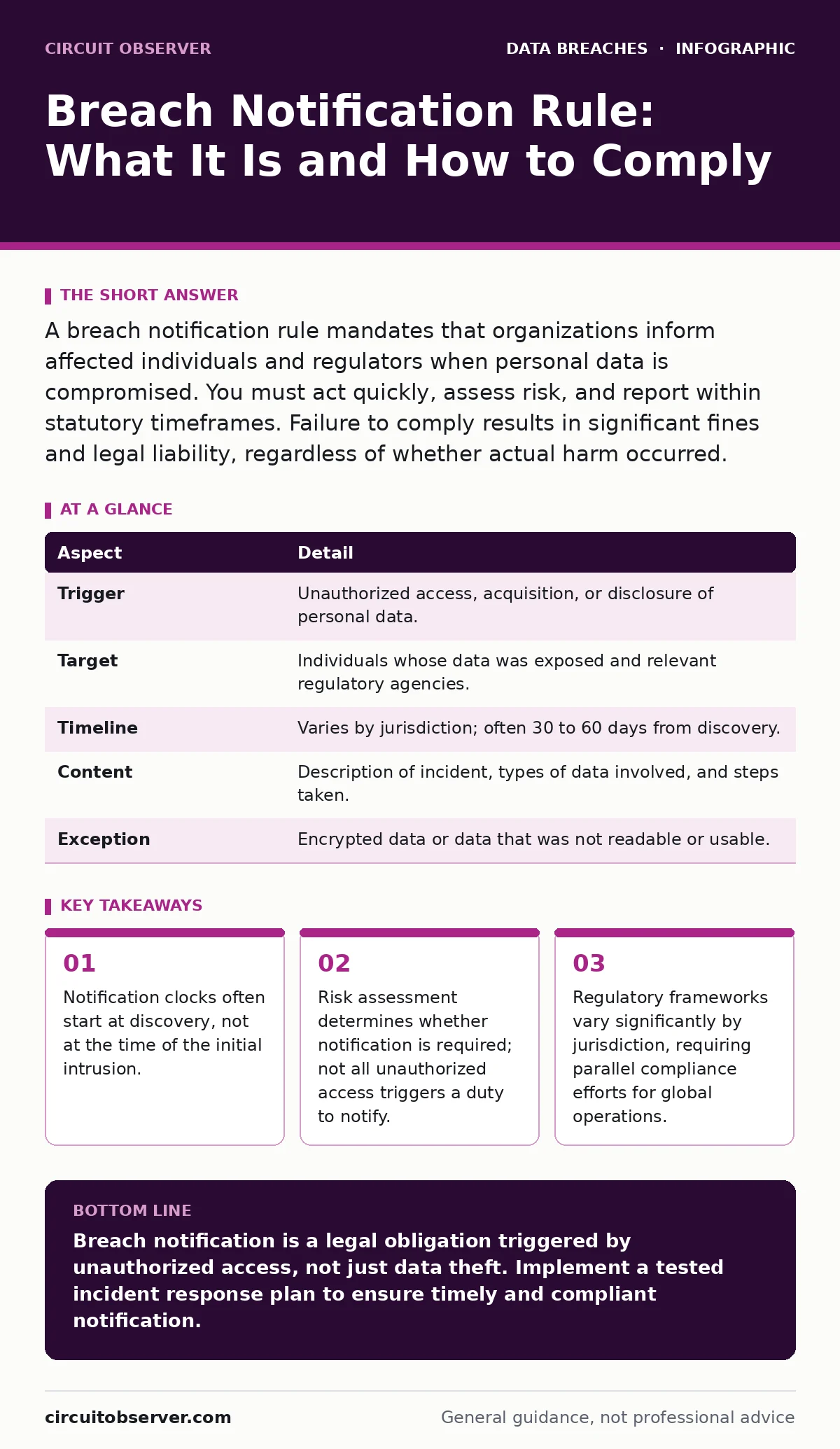
A breach notification rule mandates that organizations inform affected individuals and regulators when personal data is compromised. You must act quickly, assess risk, and report within statutory timeframes. Failure to comply results in significant fines and legal liability, regardless of whether actual harm occurred.
Understanding the Breach Notification Rule
Imagine you find a broken lock on your front door. You did not see who entered, but you know your house was vulnerable. A breach notification rule operates on this same principle of risk and exposure. It is a legal requirement that compels organizations to inform individuals and regulatory bodies when their personal information has been accessed, used, or disclosed without authorization.
The rule does not require you to prove that someone stole money or identity documents. It requires you to report the potential for harm. The core mechanism is transparency. Regulators and affected individuals need to know when their data is at risk so they can take protective measures. This shifts the burden from the victim to the organization that held the data.
| Aspect | Detail |
|---|---|
| Trigger | Unauthorized access, acquisition, or disclosure of personal data. |
| Target | Individuals whose data was exposed and relevant regulatory agencies. |
| Timeline | Varies by jurisdiction; often 30 to 60 days from discovery. |
| Content | Description of incident, types of data involved, and steps taken. |
| Exception | Encrypted data or data that was not readable or usable. |
How the Notification Process Works
The process begins with detection. Your security monitoring systems alert you to unusual activity. You must immediately initiate an investigation to determine the scope of the incident. This is where the concept of "discovery" becomes critical. Discovery is not when the attacker entered the system. Discovery is when a reasonable person, exercising due diligence, would have known about the breach.
Once you confirm a breach, you conduct a risk assessment. You evaluate what data was exposed and the likelihood of harm. If the data is encrypted and the encryption key was not compromised, you may not need to notify anyone. This is a common exception. If the data is plaintext or weakly protected, you must proceed to notification.
You must draft a notification that is clear and concise. It should avoid technical jargon. The notification must include the nature of the breach, the types of information involved, and what the organization is doing to investigate. It must also provide contact information for questions and steps individuals can take to protect themselves.
Who Is Affected by These Rules
Breach notification rules affect any entity that collects, stores, or processes personal data. This includes corporations, non-profits, government agencies, and small businesses. If you hold names, addresses, social security numbers, or financial account details, you are likely subject to these rules.
The rules also affect third-party vendors. If a contractor accesses your data and suffers a breach, you may still be liable for notification. This is because the data remained under your control or responsibility. You must review your contracts to understand liability clauses. Many organizations overlook this connection until an incident occurs.
Individuals are the primary beneficiaries of these rules. They receive the information needed to monitor their credit, change passwords, and freeze accounts. The rule ensures that individuals are not left in the dark while their data circulates on the black market. This transparency is the foundation of identity theft protection for the general public.
What to Do About a Breach
When you suspect a breach, you must act with urgency but precision. Panic leads to errors. Follow a structured incident response plan. The first step is containment. Isolate affected systems to prevent further data exfiltration. Do not shut down systems immediately, as this may destroy evidence needed for digital forensics.
Next, preserve evidence. Create forensic images of affected drives. Log all actions taken by your response team. This documentation is vital for regulators and legal counsel. You need to prove that you acted reasonably and promptly.
Then, assess the scope. Determine exactly what data was accessed. Was it just email addresses, or did it include financial records? The severity of the data dictates the urgency and content of the notification. Consult with legal counsel to ensure compliance with specific jurisdictional requirements.
Common Misconceptions About Notification
Many organizations believe that no notification is required if no data was "stolen." This is incorrect. Unauthorized access alone often triggers the duty to notify. If an attacker accessed the database, even if they did not copy the files, the data is considered compromised. The potential for misuse exists.
Another common error is assuming that encryption always exempts you from notification. This is only true if the encryption key was not also compromised. If the attacker obtained the key, the data is as vulnerable as plaintext. You must verify the security of the keys, not just the data.
Some believe that notifying a small number of people is optional. Most laws set a threshold, but it is often low. Even a single individual's data breach may require notification. You cannot decide that a breach is "too small" to report. The law defines the threshold, not your internal risk appetite.
See also: Malware Payloads: Small Business Defense Strategies · AI Agent Hijacking Response: Containment and Recovery Steps
Managing Third-Party Risk
Your security is only as strong as your weakest vendor. Many breaches occur through third-party access. You must manage user access provisioning carefully. Ensure that vendors have only the minimum access necessary to perform their duties.
Review your contracts for data protection clauses. Ensure that vendors are required to notify you of breaches immediately. If a vendor fails to notify you, you may miss your own notification deadline. This creates a cascading liability. You are responsible for the data, even if the vendor was the point of failure.
Regular audits of vendor security practices are necessary. Do not rely solely on their assurances. Verify their controls. This is particularly important for vendors handling sensitive data like protected health information or financial records. A breach at a vendor can have the same legal consequences as a breach at your own organization.
Legal and Reputational Consequences
Failing to comply with breach notification rules carries significant penalties. Regulators can impose fines based on the severity of the breach and the organization's negligence. These fines can be substantial, especially for large organizations holding vast amounts of data.
Beyond fines, there is reputational damage. Trust is difficult to rebuild. Customers may leave, and partners may sever ties. Transparency in notification can mitigate some of this damage. Showing that you acted quickly and responsibly demonstrates accountability.
Legal liability also extends to class-action lawsuits. Affected individuals may sue for negligence. Proper notification and prompt response can reduce the likelihood of successful litigation. It shows that you took the breach seriously and acted in good faith. This is why employee data breaches require immediate attention, as they often involve sensitive personal information that can lead to significant legal exposure.
Preparing for Future Incidents
Preparation is key to effective breach response. Develop and test an incident response plan regularly. Ensure that your team knows their roles and responsibilities. Conduct tabletop exercises to simulate breach scenarios.
Invest in security monitoring and detection tools. Early detection reduces the time between breach and discovery, giving you more time to respond. Implement strong encryption and access controls to minimize the impact of a breach.
Stay informed about changes in regulations. Laws evolve, and new requirements may emerge. Regular training for staff on data protection and breach response is essential. This ensures that everyone understands their role in maintaining security and complying with notification rules.
Key takeaways
- Notification clocks often start at discovery, not at the time of the initial intrusion.
- Risk assessment determines whether notification is required; not all unauthorized access triggers a duty to notify.
- Regulatory frameworks vary significantly by jurisdiction, requiring parallel compliance efforts for global operations.
Breach notification is a legal obligation triggered by unauthorized access, not just data theft. Implement a tested incident response plan to ensure timely and compliant notification.
Frequently asked questions
Does encrypted data always exempt me from notification?
No, encryption exempts you only if the encryption key was not also compromised or accessible to the attacker.
How do I define the start of the notification clock?
The clock starts at discovery, which is when a reasonable person would have known about the breach, not necessarily when the breach occurred.
What if a third-party vendor causes the breach?
You are typically still responsible for notification if the data was under your control or responsibility, regardless of who caused the breach.
Can I notify individuals after law enforcement clears me?
No, notification deadlines are independent of criminal investigations. You must notify within the statutory timeframe after discovery.
How this guide was produced: written by the Circuit Observer editorial team with AI assistance, checked against the public references listed below, and reviewed when the facts change. See our editorial policy or report an error.