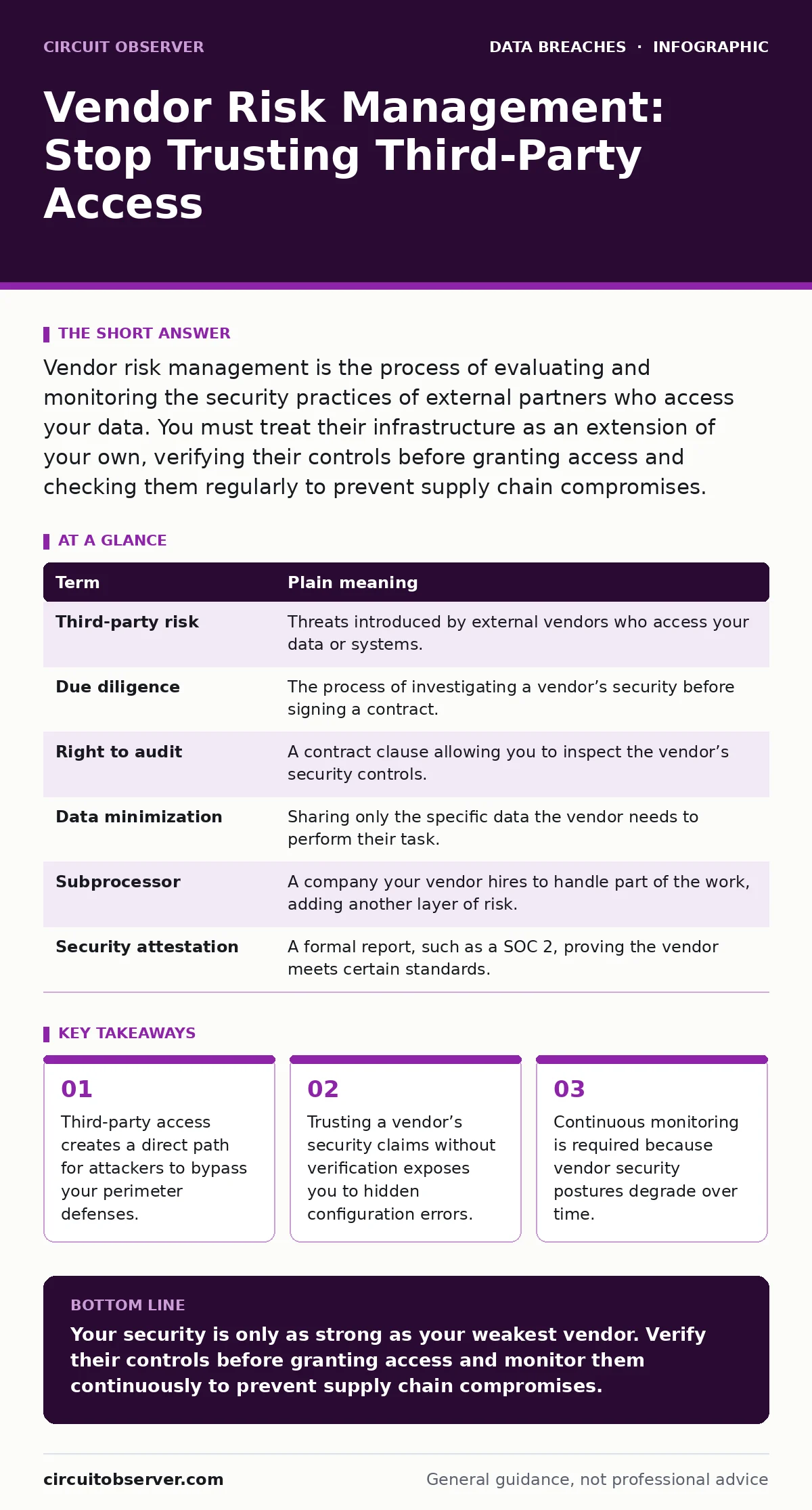
Vendor risk management is the process of evaluating and monitoring the security practices of external partners who access your data. You must treat their infrastructure as an extension of your own, verifying their controls before granting access and checking them regularly to prevent supply chain compromises.
The Leaky Hose Analogy
Imagine your organization is a house with a strong, locked front door. You have built high walls and installed alarms. Now, suppose you hire a plumber to fix a burst pipe. The plumber brings their own tools, ladders, and perhaps an assistant. They need to enter your home, move through your rooms, and connect to your water lines.
If the plumber leaves their tools unlocked in your garage, a thief can use those tools to break into your kitchen. If the plumber’s assistant is careless, they might spill water on your electrical panel. You are responsible for the damage, even though you did not hire the thief. In cybersecurity, vendors are the plumbers. Their access to your systems is the open door.
Defining the Supply Chain
When you buy software or services, you inherit the security posture of the provider. This is known as third-party risk. A vendor might have excellent marketing but poor coding standards. They might store your data on a server that is not encrypted. They might allow employees to access production environments with personal laptops.
You cannot fix their code. You cannot change their firewall rules. You can only decide whether to let them in and how closely to watch them. This dynamic shifts the burden of proof. The vendor must demonstrate safety, not just claim it.
Key Terms for Context
Understanding the vocabulary helps you communicate risks to stakeholders. These terms define the scope of your responsibility.
| Term | Plain meaning |
|---|---|
| Third-party risk | Threats introduced by external vendors who access your data or systems. |
| Due diligence | The process of investigating a vendor’s security before signing a contract. |
| Right to audit | A contract clause allowing you to inspect the vendor’s security controls. |
| Data minimization | Sharing only the specific data the vendor needs to perform their task. |
| Subprocessor | A company your vendor hires to handle part of the work, adding another layer of risk. |
| Security attestation | A formal report, such as a SOC 2, proving the vendor meets certain standards. |
The Illusion of Trust
Many organizations assume that if a vendor is large and well-known, they are secure. This is a dangerous assumption. Large targets attract more attackers. A breach at a major provider can expose thousands of customers simultaneously. This is why credential leaks at one company often ripple through the industry.
Suppose your accounting software provider suffers a ransomware attack. The attackers do not just steal the provider’s money; they steal the data of every client connected to the platform. You did not click a phishing link. You did not use a weak password. Your vendor failed, and you paid the price. This scenario highlights why data extortion tactics often target the weakest link in the supply chain, which is frequently a mid-tier vendor.
Verification Over Certification
A security certificate is a snapshot in time. It tells you the vendor was secure on the day they were audited. It does not tell you if they are secure today. Configuration drift occurs when systems change over time without proper oversight. A server that was secure last year may have an unpatched vulnerability today.
You should demand evidence of continuous monitoring. Ask how the vendor detects anomalies in real-time. Ask how they respond to incidents. If they cannot explain their detection methods, they are likely relying on outdated tools. This approach aligns with the principles of digital forensics, where understanding the timeline of events is critical. A vendor who cannot reconstruct their own logs cannot protect your data.
Practical First Steps
Start with your most critical vendors. These are the partners who have direct access to your sensitive data or core infrastructure. Do not try to assess every small vendor at once. Focus on the ones that matter most.
- Map data flow: Identify exactly what data the vendor sees. Is it personal information, financial records, or source code? Use data minimization to restrict access to only what is necessary. This reduces the potential damage if the vendor is compromised.
- Review contracts: Check for a right to audit clause. If you cannot verify their security, you cannot trust their claims. Ensure the contract defines breach notification timelines. The GDPR breach notification rule sets a strict standard for reporting, which you should mirror in your agreements.
- Request recent reports: Ask for a SOC 2 Type II report or a similar security attestation. Look for the "scope" section to ensure it covers the services you use. Check the "exceptions" section for any failed controls.
Managing the Long Tail
You will have dozens of vendors. You cannot perform deep due diligence on all of them. Categorize them by risk. A vendor that only hosts your static website images poses less risk than a vendor that manages your user access provisioning.
For low-risk vendors, a simple questionnaire may suffice. For high-risk vendors, require technical assessments and regular reviews. Imagine a scenario where a small analytics provider becomes a subprocessor for a major cloud provider. The risk profile changes instantly. You must track these relationships.
The Hidden Cost of Neglect
Ignoring vendor risk is not a neutral choice. It is a decision to accept liability. When a breach occurs, regulators and customers will ask why you trusted a vendor without verification. The cost of remediation is often higher than the cost of prevention.
Consider tokenization as a technical control. If you can replace sensitive data with non-sensitive equivalents before sharing it with a vendor, you reduce the value of the data if the vendor is breached. This shifts the risk. The vendor still has data, but it is useless to attackers.
Continuous Monitoring
Vendor risk management is not a one-time task. It is an ongoing process. You must monitor for changes in the vendor’s security posture. Subscribe to security advisories from your critical vendors. Watch for news about industry-wide vulnerabilities.
If a vendor suffers a breach, act immediately. Revoke access. Rotate credentials. Investigate the impact. Do not wait for the vendor to contact you. Proactive measures reduce the window of exposure. This discipline protects your organization from the cascading effects of third-party failures.
Key takeaways
- Third-party access creates a direct path for attackers to bypass your perimeter defenses.
- Trusting a vendor’s security claims without verification exposes you to hidden configuration errors.
- Continuous monitoring is required because vendor security postures degrade over time.
Your security is only as strong as your weakest vendor. Verify their controls before granting access and monitor them continuously to prevent supply chain compromises.
Frequently asked questions
How do I assess a vendor that refuses to share security details?
Treat them as high risk. Limit their access to non-sensitive data or find an alternative vendor. Transparency is a baseline requirement for trust.
Is a SOC 2 report enough proof of security?
It is a good start, but not sufficient. Review the exceptions and ensure the scope matches your usage. Combine it with continuous monitoring.
What should I do if a vendor suffers a breach?
Revoke their access immediately. Rotate any shared credentials. Investigate if your data was exposed. Notify affected parties if required by law.
How often should I re-evaluate vendor risk?
At least annually. Re-evaluate immediately if the vendor changes services, merges with another company, or suffers a security incident.
How this guide was produced: written by the Circuit Observer editorial team with AI assistance, checked against the public references listed below, and reviewed when the facts change. See our editorial policy or report an error.