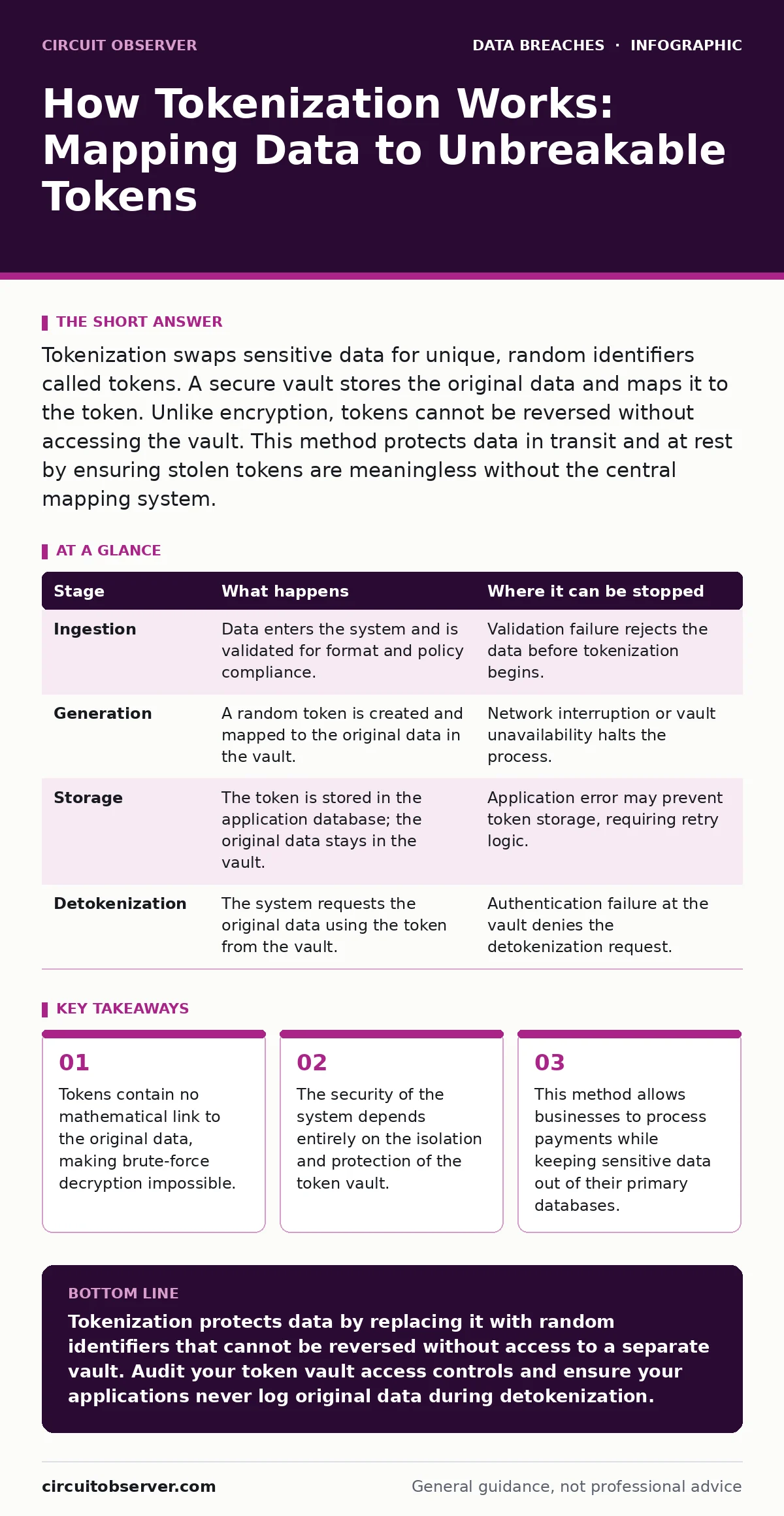
Tokenization swaps sensitive data for unique, random identifiers called tokens. A secure vault stores the original data and maps it to the token. Unlike encryption, tokens cannot be reversed without accessing the vault. This method protects data in transit and at rest by ensuring stolen tokens are meaningless without the central mapping system.
The Mechanics of Data Substitution
Tokenization is a data security technique that replaces sensitive data elements with non-sensitive equivalents, known as tokens. These tokens retain the essential characteristics of the original data, such as length and format, but they hold no intrinsic mathematical value. When you see a long string of numbers on a payment terminal, it is likely a token, not the actual card number. The system uses this token to process transactions, while the real data remains isolated in a separate, highly secure environment.
This approach differs significantly from encryption. Encryption uses a mathematical formula and a key to scramble data. If an attacker obtains the encrypted data and the key, they can reverse the process. Tokenization does not use a formula. It uses a lookup table. If an attacker steals the tokens, they cannot reverse them because there is no mathematical key to crack. They only have access to random strings that mean nothing without the central mapping system.
Stage 1: Data Ingestion and Validation
The process begins when sensitive data enters your system. This could be a credit card number typed into a web form or a social security number entered into a HR portal. The system immediately validates the format of this data. It checks for length, character types, and checksums to ensure the data is structurally correct. If the data fails validation, the process stops here. This step prevents malformed data from entering the tokenization pipeline, which could cause errors downstream.
Validation also determines whether the data requires tokenization. Not all data needs this level of protection. The system applies policy rules to identify which fields are sensitive. For example, a billing address might be stored in plain text, while the payment card number is flagged for substitution. This selective application reduces overhead and ensures that only high-risk data undergoes the tokenization process. It also helps in maintaining compliance with data handling standards by clearly defining what constitutes sensitive information.
Stage 2: Token Generation and Mapping
Once the data is validated, the tokenization service generates a unique token. This token is a random string of characters that matches the format of the original data. If the input is a sixteen-digit card number, the output token will also be sixteen digits. This format preservation is critical because many legacy systems expect data in a specific format. The token allows these systems to function without modification.
Simultaneously, the system creates a mapping record. This record links the token to the original sensitive data. This mapping is stored in a secure token vault. The vault is a separate database with its own access controls and security measures. The link between the token and the data is unidirectional. You can look up the original data using the token, but you cannot derive the token from the data or vice versa through calculation. This one-way relationship is the core security feature of tokenization.
| Stage | What happens | Where it can be stopped |
|---|---|---|
| Ingestion | Data enters the system and is validated for format and policy compliance. | Validation failure rejects the data before tokenization begins. |
| Generation | A random token is created and mapped to the original data in the vault. | Network interruption or vault unavailability halts the process. |
| Storage | The token is stored in the application database; the original data stays in the vault. | Application error may prevent token storage, requiring retry logic. |
| Detokenization | The system requests the original data using the token from the vault. | Authentication failure at the vault denies the detokenization request. |
Stage 3: Secure Storage and Isolation
The token is then stored in your primary database alongside other non-sensitive customer information. This allows your applications to process the data normally. You can search for customers, generate reports, and run analytics using the tokens. Because the tokens look like the original data, your existing software does not need to be rewritten. The sensitive original data, however, remains in the token vault. It never touches your primary database.
This separation of duties is a key security benefit. If an attacker breaches your primary database, they only find tokens. These tokens are useless without access to the vault. The vault is typically hosted in a separate network segment with strict access controls. Only authorized applications can request data from the vault. This architecture limits the blast radius of a breach. Even if the main application server is compromised, the core sensitive data remains protected in the isolated environment.
Stage 4: Detokenization and Retrieval
When your system needs to use the original data, such as for processing a payment, it initiates a detokenization request. The application sends the token to the token vault. The vault verifies the request, checking the identity and permissions of the requesting application. If the request is authorized, the vault looks up the token in its mapping table. It retrieves the original sensitive data and sends it back to the application.
This step is tightly controlled. The vault may enforce additional checks, such as verifying the IP address of the request or ensuring the request comes from a specific application endpoint. The original data is returned only for the duration of the transaction. It is not stored in the application's memory longer than necessary. This minimizes the exposure window for sensitive data. Once the transaction is complete, the data is discarded from the application's memory, and the token is used again for future reference.
See also: Tokens in Language Models: The Hidden Mechanics Explained · Employee Data Breach Prevention Checklist for Internal Threats
Limits and Structural Weaknesses
Tokenization is not a silver bullet. It relies entirely on the security of the token vault. If an attacker gains access to the vault, they can map all tokens back to their original data. This is a single point of failure. Protecting the vault requires rigorous security measures, including strong authentication, encryption at rest, and continuous monitoring. The vault must be treated as the crown jewel of your data security architecture.
Another limitation is the lack of standardization. Different tokenization providers may use different formats or protocols. This can create compatibility issues if you switch providers or integrate with multiple systems. Additionally, tokenization does not protect data in transit unless combined with other measures like TLS. Tokens traveling over an unencrypted network can still be intercepted. While the intercepted tokens are useless without the vault, the privacy of the transaction metadata may still be exposed.
Integration with Security Frameworks
Implementing tokenization requires a broader security strategy. You must manage the risks associated with third-party vendors who operate the token vault. Vendor risk management is critical here. You need to verify that the provider follows strict security practices and undergoes regular audits. If the provider fails, your data is at risk. This dependency means you are sharing control over your sensitive data with another entity.
Tokenization also interacts with other security measures. For instance, if credentials are leaked, attackers might try to access systems that can detokenize data. Therefore, strong user access provisioning is necessary to limit who can request detokenization. Additionally, in the event of a breach, you may need to notify authorities under regulations like the GDPR breach notification rule. Understanding how tokenization affects your liability is part of the implementation process. It changes the nature of the data you hold, which can impact your compliance obligations.
Operational Considerations for Administrators
Managing a tokenization system adds complexity to your operations. You must monitor the health of the token vault and the latency of detokenization requests. High latency can impact application performance and user experience. You also need to plan for disaster recovery. If the vault becomes unavailable, your applications may fail to process transactions. Having a fallback mechanism or a redundant vault setup is advisable.
Furthermore, you must manage the lifecycle of tokens. If a payment card is expired or revoked, the corresponding token must be invalidated. This requires synchronization between your application and the token vault. Failure to update the token status can lead to failed transactions or security risks. Regular testing of the tokenization workflow ensures that the system behaves as expected under various conditions. It also helps identify potential bottlenecks or security gaps before they become critical issues.
Key takeaways
- Tokens contain no mathematical link to the original data, making brute-force decryption impossible.
- The security of the system depends entirely on the isolation and protection of the token vault.
- This method allows businesses to process payments while keeping sensitive data out of their primary databases.
Tokenization protects data by replacing it with random identifiers that cannot be reversed without access to a separate vault. Audit your token vault access controls and ensure your applications never log original data during detokenization.
Frequently asked questions
Is tokenization the same as encryption?
No. Encryption uses a mathematical key to scramble data, which can be reversed with the key. Tokenization replaces data with a random value and stores the original in a separate vault. There is no mathematical key to crack.
Can tokens be reverse-engineered?
No. Tokens are randomly generated and have no mathematical relationship to the original data. Without access to the token vault's mapping table, it is impossible to determine the original value from the token.
What happens if the token vault is breached?
If the vault is breached, an attacker can map all tokens to their original data. This is why the vault must be heavily secured with strict access controls, encryption, and monitoring. It is the single point of failure in the system.
Does tokenization help with GDPR compliance?
Yes. By removing sensitive data from primary databases, tokenization reduces the scope of your data processing. This can simplify compliance efforts and reduce liability in the event of a breach, as the stolen data is unusable without the vault.
How this guide was produced: written by the Circuit Observer editorial team with AI assistance, checked against the public references listed below, and reviewed when the facts change. See our editorial policy or report an error.