
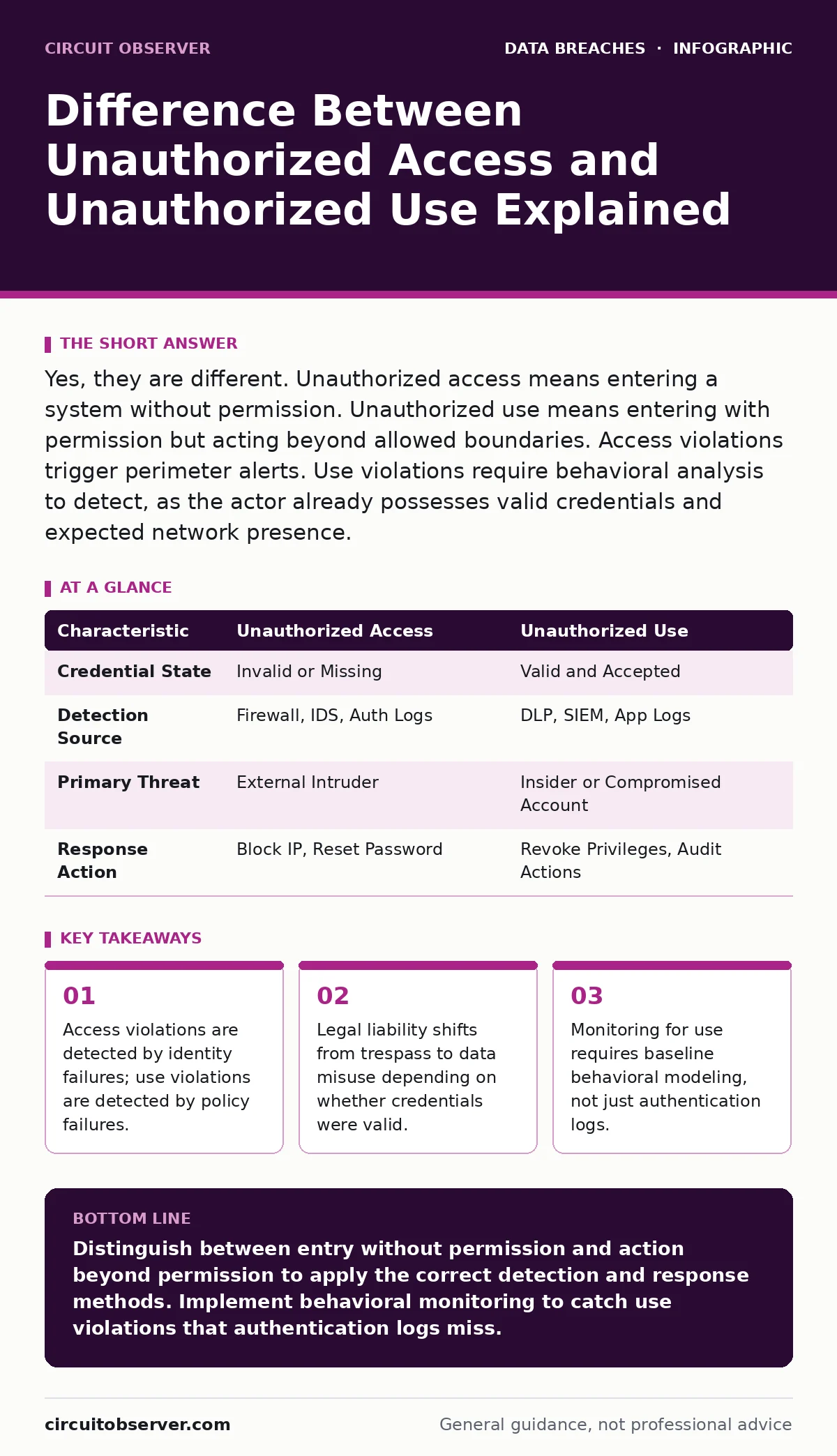
Yes, they are different. Unauthorized access means entering a system without permission. Unauthorized use means entering with permission but acting beyond allowed boundaries. Access violations trigger perimeter alerts. Use violations require behavioral analysis to detect, as the actor already possesses valid credentials and expected network presence.
What is the difference between unauthorized access and unauthorized use?
Unauthorized access involves entering a system without permission, while unauthorized use involves acting within a system beyond granted permissions. The former is a breach of entry. The latter is a breach of policy. You must distinguish these because detection methods differ entirely. Access failures appear in authentication logs. Use violations appear in application logs and file system audits. Treating them as identical obscures the attack vector and delays containment.
How does authentication status define the boundary?
Authentication status determines the classification. If a user presents invalid credentials or no credentials, the event is unauthorized access. The system rejects the entry. If a user presents valid credentials but performs an action outside their role, the event is unauthorized use. The system accepts the entry. This distinction matters for incident response. Access events trigger lockouts. Use events trigger suspension and forensic review of actions taken during the session.
| Characteristic | Unauthorized Access | Unauthorized Use |
|---|---|---|
| Credential State | Invalid or Missing | Valid and Accepted |
| Detection Source | Firewall, IDS, Auth Logs | DLP, SIEM, App Logs |
| Primary Threat | External Intruder | Insider or Compromised Account |
| Response Action | Block IP, Reset Password | Revoke Privileges, Audit Actions |
Where do standard monitoring tools fail to detect use?
Standard monitoring tools often miss unauthorized use because they trust valid credentials. Firewalls and intrusion detection systems see legitimate traffic. They do not inspect the payload or the specific command executed. You need data loss prevention tools and user behavior analytics to spot anomalies. These systems learn normal patterns for each role. A database administrator reading logs is normal. That same administrator downloading customer records is unauthorized use. Without behavioral baselines, this action looks like routine work.
Why does the legal liability shift between these categories?
Legal frameworks often treat trespass differently from theft. Unauthorized access is akin to breaking into a building. The crime is the entry. Unauthorized use is akin to a guest stealing property. The crime is the taking. This affects breach notification requirements. See the GDPR breach notification rule for how data processing violations trigger different timelines than mere system entry. You must classify the incident correctly to determine if you notify regulators, customers, or both. Misclassification leads to compliance failures and fines.
How do insider threats complicate the distinction?
Insider threats blur the line between access and use. An employee has authorized access to their workstation. If they install malicious software to steal data, they are using their access improperly. This is unauthorized use. If they share their credentials with an outsider, the outsider gains unauthorized access. The outcome is similar, but the root cause differs. Reviewing your user access provisioning processes helps prevent the initial grant of excessive rights. Without least privilege, authorized access becomes a gateway for unauthorized use.
See also: How to Prevent Data Exfiltration: Stop Silent Data Loss · Why Is Tailgating Considered a Security Threat and How to Stop It
What role do credential leaks play in this dynamic?
Credential leaks transform authorized access into unauthorized access. If an attacker steals a password, they enter with valid credentials. To the system, this looks like authorized access. However, the intent and ownership are unauthorized. This is a hybrid scenario. It starts as unauthorized use of stolen data and becomes unauthorized access to the target system. You must monitor for impossible travel and concurrent sessions. These anomalies signal that a valid credential is being used by an unexpected entity. Refer to credential leaks mitigation strategies to reduce the surface area for this type of attack.
How do zero-day exploits bypass both categories?
Zero-day exploits bypass both access and use controls by manipulating system code directly. They do not rely on credentials. They exploit flaws in the software itself. This creates unauthorized access without any login attempt. It also allows unauthorized use of system resources without any policy check. Traditional detection fails because there is no login to log and no policy to violate. You must rely on endpoint detection and response systems that monitor process behavior. If a browser spawns a command shell, that is anomalous regardless of who started the browser.
What steps should you take when you detect a violation?
- Isolate the affected system from the network to stop further activity.
- Preserve logs from authentication, application, and network layers.
- Determine if the actor had valid credentials at the time of entry.
- If valid, audit all actions taken during the session for data exfiltration.
- If invalid, trace the source IP and block it at the perimeter.
- Reset credentials for the compromised account and review access rights.
- Report the incident internally to legal and compliance teams.
- Document the timeline and actions for potential breach notification.
How does employee training prevent these specific issues?
Training must address both categories. Users must know how to protect credentials to prevent unauthorized access. They must also understand data handling policies to prevent unauthorized use. Many employees think that having access means they can do anything with the data. This misconception drives insider data theft and employee data breaches. Clear policies define what is allowed. Regular refreshers reinforce these boundaries. Without understanding the difference, users cannot recognize when they are crossing the line from access to misuse.
Key takeaways
- Access violations are detected by identity failures; use violations are detected by policy failures.
- Legal liability shifts from trespass to data misuse depending on whether credentials were valid.
- Monitoring for use requires baseline behavioral modeling, not just authentication logs.
Distinguish between entry without permission and action beyond permission to apply the correct detection and response methods. Implement behavioral monitoring to catch use violations that authentication logs miss.
Frequently asked questions
Can an event be both unauthorized access and unauthorized use?
Yes, if an attacker uses stolen credentials, the entry is technically authorized by the system but unauthorized by the owner, leading to subsequent unauthorized use of data.
Does a hacker need to steal data for it to be unauthorized access?
No, unauthorized access is the act of entering the system without permission. Data theft is a separate outcome that may or may not follow the access.
How does multi-factor authentication help distinguish these?
Multi-factor authentication reduces unauthorized access by making credential theft harder. It does not prevent unauthorized use, as the attacker may still have valid MFA tokens or bypass them.
Are all failed login attempts unauthorized access?
No, failed logins can be user error. Unauthorized access is confirmed when an intrusion is successful or when repeated attempts indicate a brute-force attack targeting the system.
How this guide was produced: written by the Circuit Observer editorial team with AI assistance, checked against the public references listed below, and reviewed when the facts change. See our editorial policy or report an error.