
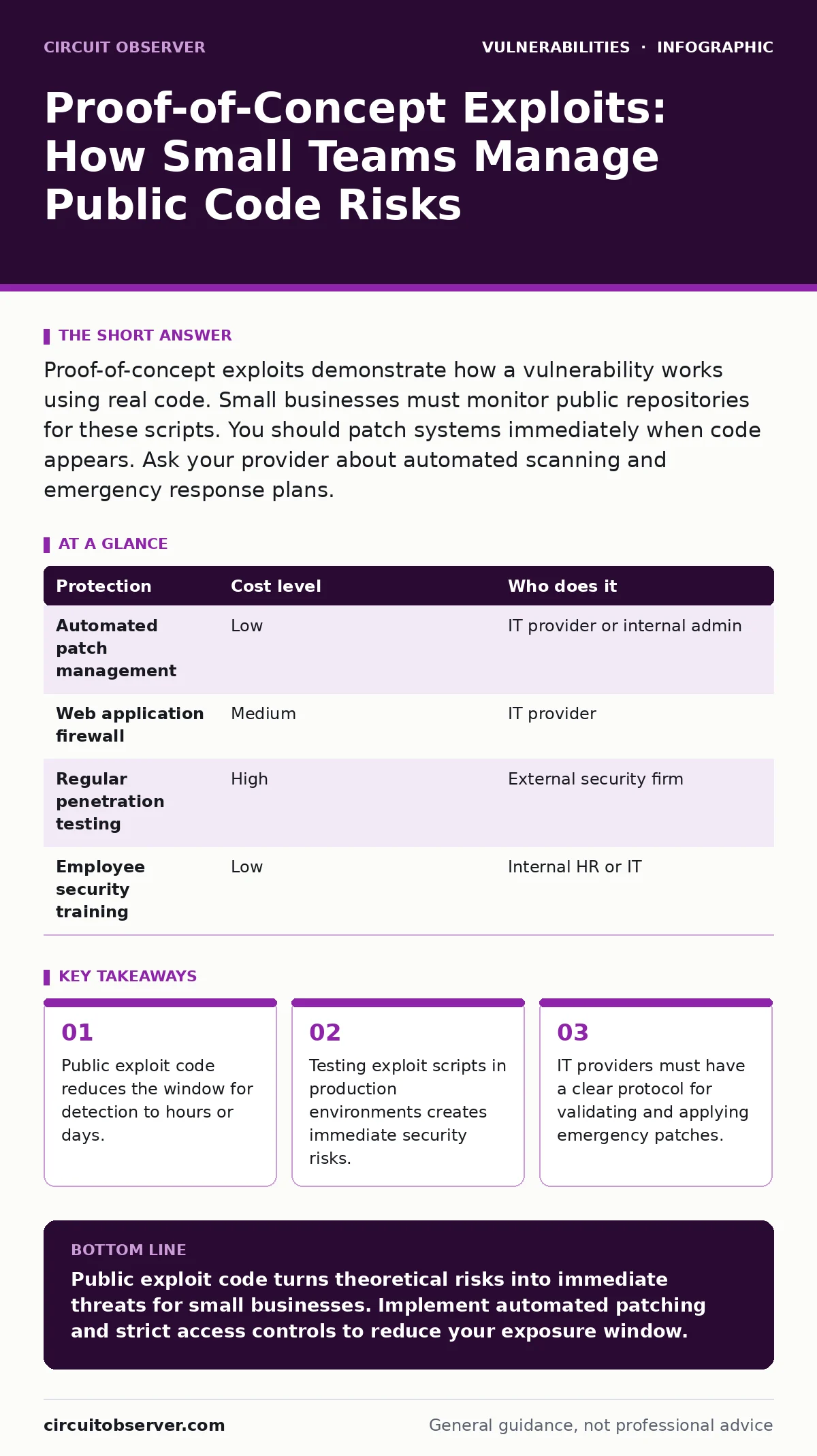
Proof-of-concept exploits demonstrate how a vulnerability works using real code. Small businesses must monitor public repositories for these scripts. You should patch systems immediately when code appears. Ask your provider about automated scanning and emergency response plans.
What Is a Proof-of-Concept Exploit
A proof-of-concept exploit is a piece of code written to demonstrate that a security flaw can be exploited. It proves the vulnerability exists and shows how an attacker can use it. These scripts are often shared on public code repositories or security forums. They are not always polished or efficient. Their primary purpose is to show the path from a theoretical weakness to actual system access.
The existence of this code changes the threat model entirely. Before the code is published, the vulnerability is theoretical. Attackers must discover the flaw independently. After publication, any attacker with basic technical skills can copy and run the script. This democratizes access to sophisticated attacks. Small organizations lose the advantage of obscurity. They become targets because their systems are easier to patch than large enterprises.
Why Small Scale Matters
Small businesses often lack dedicated security teams. They rely on generalist IT staff or external providers. This structure creates a unique vulnerability when proof-of-concept code emerges. Large corporations have teams that monitor threat feeds 24/7. Small teams usually check updates during business hours. The gap between publication and patching widens significantly.
The cost of delay is higher for smaller entities. A large company can absorb a breach financially. A small business may face existential risk. Downtime stops revenue immediately. Data loss can violate customer trust permanently. The presence of public exploit code means the clock starts ticking the moment the script is posted. You do not have weeks to assess the risk. You have hours to react.
| Protection | Cost level | Who does it |
|---|---|---|
| Automated patch management | Low | IT provider or internal admin |
| Web application firewall | Medium | IT provider |
| Regular penetration testing | High | External security firm |
| Employee security training | Low | Internal HR or IT |
The Hidden Cost of Verification
You might think you can test the exploit code yourself to confirm the risk. This approach is dangerous. Running exploit code on your own systems can cause data corruption or service outages. It may also trigger false alerts in monitoring tools. These alerts consume time and resources. They distract from genuine threats.
Verification requires a isolated environment. You need a copy of your production system that mirrors the configuration exactly. Most small businesses do not maintain this level of infrastructure. Without it, you cannot safely validate the exploit. You must rely on vendor advisories or security researchers. Trusting these sources requires a process for evaluating their credibility. Not all posted code is accurate. Some scripts fail on certain configurations.
Practical Steps for Immediate Response
When a new exploit appears, you must act quickly but carefully. First, identify all systems that use the affected software. Check your asset inventory. Look for versions that match the vulnerable range. Do not assume your systems are safe because they are behind a firewall. Many exploits target web-facing services.
Second, apply the vendor patch if one is available. Vendors often release fixes within days of publication. If no patch exists, you must implement compensating controls. These controls reduce the attack surface. They might include blocking specific traffic patterns or restricting access to the vulnerable service. Document every step you take. This record helps with post-incident analysis.
Questions for Your IT Provider
Your IT provider plays a critical role in managing these risks. You need to know their capabilities and processes. Ask specific questions to gauge their readiness. Do not accept vague answers. You need concrete details about their workflow.
- How do you monitor for new vulnerabilities in our specific software stack?
- What is your average time to apply emergency patches after publication?
- Do you perform static application security testing (SAST) on custom code?
- How do you handle situations where no official patch is available?
- What is your process for validating the severity of a reported flaw?
- Do you use dynamic application security testing (DAST) in your CI/CD pipeline?
- How do you ensure least privilege access is enforced during patching?
- Can you provide a report of recent vulnerability scans and remediation actions?
These questions reveal the depth of their security posture. They also help you understand the trade-offs they make. Some providers prioritize speed over thoroughness. Others prioritize stability over rapid patching. You need to align their approach with your business risk tolerance.
See also: Small Business Digital Forensics: Preserve Evidence and Limit Liability · Shadow AI Risks and Protection for Small Businesses
Beyond Patching: Structural Defenses
Patching is not the only defense. You should implement structural controls that reduce impact. Network segmentation limits the spread of an attack. If one system is compromised, others remain isolated. This containment strategy buys you time to respond.
Authorization bypass vulnerabilities are common in web applications. Attackers often exploit flaws in how permissions are checked. Implementing strict authorization checks reduces the effectiveness of many exploits. Even if an attacker gains access, they cannot move laterally. Server-side request forgery (SSRF) is another common flaw. It allows attackers to make requests from your server. Blocking outbound traffic to internal networks mitigates this risk.
The Long-Term Strategy
Managing proof-of-concept exploits is an ongoing process. You cannot patch every flaw instantly. You must prioritize based on risk. Focus on systems that are internet-facing. These systems have the highest exposure. Internal systems with limited access are lower priority.
Coordinated vulnerability disclosure helps vendors fix flaws before public release. Supporting this process benefits the entire ecosystem. However, you cannot rely on it alone. You must maintain your own defense-in-depth strategy. This includes regular audits, employee training, and incident response planning. The goal is to reduce the attack surface and increase detection speed.
Server-side template injection and mass assignment vulnerabilities are common in modern web frameworks. They often arise from misconfigurations rather than code bugs. Regular code reviews and automated testing help catch these issues early. You should integrate security checks into your development lifecycle. This shift-left approach prevents vulnerabilities from reaching production.
Monitoring and Alerting
You need visibility into your systems. Monitoring tools can detect signs of exploitation. Look for unusual traffic patterns or failed login attempts. These indicators may suggest an attacker is probing for the vulnerability. Set up alerts for these events. Ensure that someone reviews them promptly.
Do not rely solely on automated alerts. False positives are common. Human analysis is required to distinguish between noise and signal. Train your team to recognize the signs of an active exploit. They should know how to escalate incidents. Speed of response is critical. The longer an attacker persists, the more damage they can do.
Key takeaways
- Public exploit code reduces the window for detection to hours or days.
- Testing exploit scripts in production environments creates immediate security risks.
- IT providers must have a clear protocol for validating and applying emergency patches.
Public exploit code turns theoretical risks into immediate threats for small businesses. Implement automated patching and strict access controls to reduce your exposure window.
Frequently asked questions
How do I know if a proof-of-concept exploit affects my system?
Check your software versions against the vulnerability report. Look for the specific version range mentioned. If your system matches, assume it is vulnerable until proven otherwise.
Can I ignore exploits for software I do not use?
Yes, if you have confirmed the software is not installed. However, ensure your inventory is accurate. Untracked software often remains on systems and creates hidden risks.
What if the vendor does not release a patch?
Implement compensating controls. Restrict access to the vulnerable service. Block specific traffic patterns. Consider isolating the system from the network if possible.
How this guide was produced: written by the Circuit Observer editorial team with AI assistance, checked against the public references listed below, and reviewed when the facts change. See our editorial policy or report an error.