
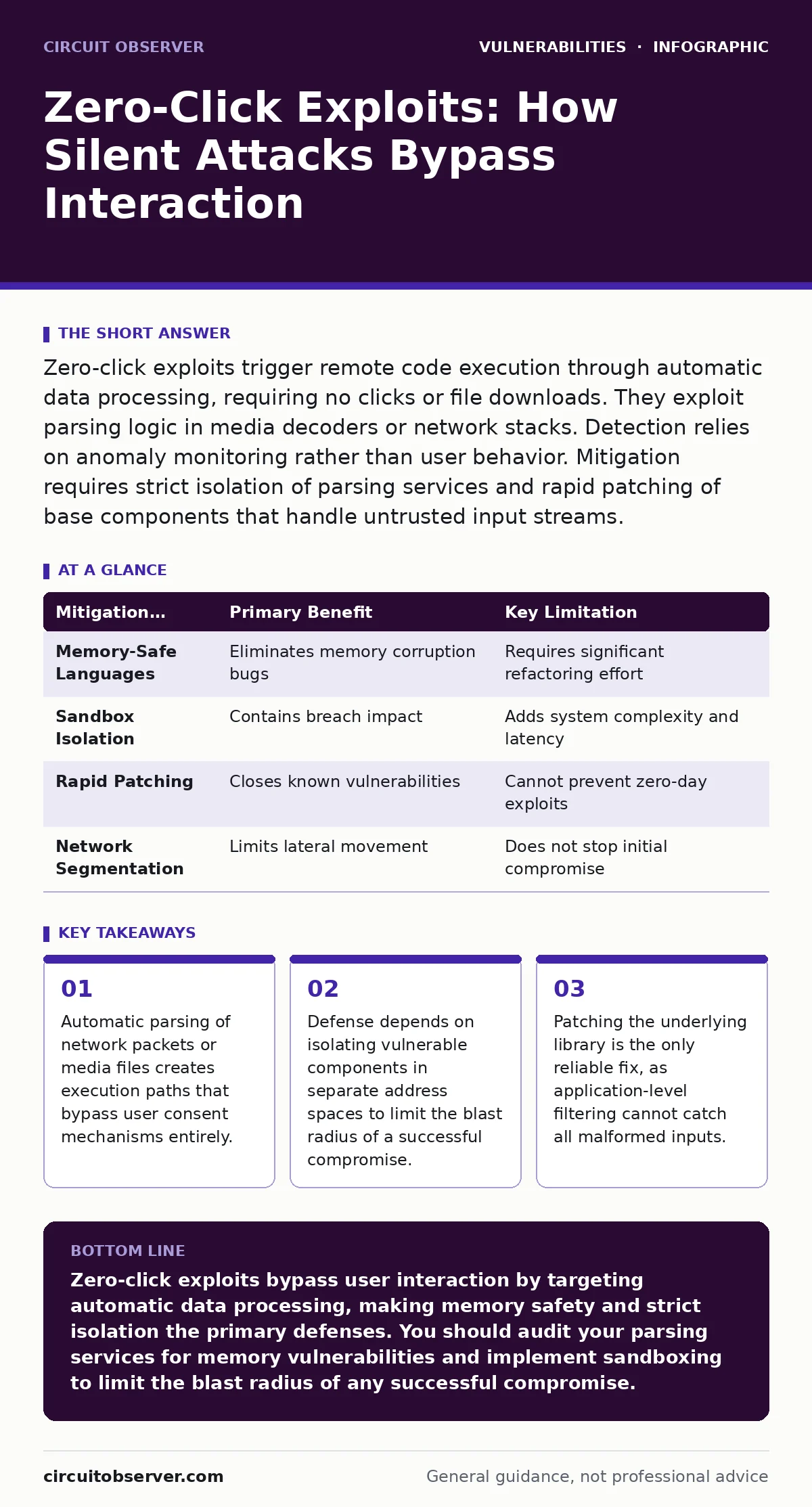
Zero-click exploits trigger remote code execution through automatic data processing, requiring no clicks or file downloads. They exploit parsing logic in media decoders or network stacks. Detection relies on anomaly monitoring rather than user behavior. Mitigation requires strict isolation of parsing services and rapid patching of base components that handle untrusted input streams.
What defines a zero-click exploit in technical terms
A zero-click exploit is a vulnerability that allows an attacker to execute arbitrary code on a target system without any interaction from the user. The term "zero-click" refers to the absence of required user actions, such as clicking a link, opening an attachment, or installing software. The attack vector relies entirely on the automatic processing of data by the victim’s operating system, application, or hardware firmware.
When a device receives a specially crafted packet, image, or message, the parser processes it immediately. If the parser contains a memory corruption bug, the attacker gains control before the user ever sees the content. This distinguishes it from social engineering attacks that rely on human error.
How do attackers trigger execution without user input
Attackers trigger execution by sending malformed data to services that run in the background and process input automatically. Many modern devices constantly listen for incoming network traffic, push notifications, or multimedia streams. The operating system or application layer begins parsing this data to determine how to handle it. For example, a messaging app may automatically decode a received image to generate a thumbnail.
If the image decoder has a buffer overflow vulnerability, the malformed image overwrites memory structures during this automatic decoding phase. The attacker does not need the user to view the image; the mere act of receiving and processing the data triggers the exploit. This reliance on background services makes these attacks highly effective against locked or idle devices.
Which software components are most frequently targeted
Memory-managed parsing libraries and network stacks are the most frequent targets for zero-click exploits. These components handle raw data from untrusted sources and often operate with high privileges. Image decoders, PDF parsers, and network protocol handlers are common entry points because they must interpret complex file formats and packet structures.
Vulnerabilities in these libraries, such as use-after-free errors or integer overwrites, allow attackers to redirect execution flow. The complexity of the file formats increases the likelihood of edge cases that developers miss during testing. When these libraries are integrated into core system services, a successful exploit can lead to full system compromise. The widespread use of shared libraries means a single vulnerability can affect multiple applications simultaneously.
Why is detection of zero-click attacks so difficult
Detection of zero-click attacks is difficult because they leave minimal forensic artifacts and do not generate user-triggered alerts. Traditional endpoint protection relies on monitoring user actions, such as file downloads or script executions. Since zero-click exploits operate at the kernel or library level during automatic processing, they bypass these behavioral monitors.
The malicious code often executes in memory without writing files to disk, evading signature-based detection. Network intrusion detection systems may miss the traffic if it uses encrypted channels or standard ports. The lack of user interaction removes the primary indicator that security teams use to identify phishing or malware campaigns. This silence allows attackers to maintain persistence and exfiltrate data before defenders notice any anomaly.
What is the role of memory safety in prevention
Memory safety is the primary technical defense against zero-click exploits because most of these attacks rely on memory corruption vulnerabilities. Languages like C and C++ allow direct memory manipulation, which can lead to buffer overflows and dangling pointer dereferences if not carefully managed. Modern operating systems use mitigations like Address Space Layout Randomization (ASLR) and Data Execution Prevention (DEP) to complicate exploitation.
However, these measures are not foolproof. Adopting memory-safe languages like Rust or Go for new parsing libraries eliminates entire classes of memory corruption bugs. Refactoring legacy code to use safe abstractions reduces the attack surface. Organizations should prioritize rewriting critical parsing components in memory-safe languages to prevent future zero-click vulnerabilities.
See also: DAST Best Practices: Stop False Positives and Find Real Flaws · What Is Device Hardening: Reduce Attack Surface and Stop Breaches
How does least privilege access limit damage
Implementing least privilege access limits the damage of a zero-click exploit by restricting the permissions of vulnerable services. If a parsing service runs with the minimum necessary privileges, a successful exploit cannot easily escalate to full system control. For example, a media decoder should run in a sandboxed environment with no access to the file system or network.
If the attacker gains code execution within the decoder, they are confined to that sandbox. This containment prevents lateral movement and data exfiltration. System administrators should audit service accounts and ensure that background processes do not run as root or administrator. Isolation strategies, such as micro-VMs or containers, further enhance this protection by separating processes at the hardware or hypervisor level.
What is the hidden cost of automated mitigation
The hidden cost of automated mitigation is the performance overhead and potential for false positives that disrupt legitimate operations. Security controls like runtime application self-protection (RASP) monitor application behavior in real time to block suspicious actions. While effective, RASP adds latency to every transaction and can interfere with complex, legitimate workflows.
Developers must tune these systems carefully to avoid blocking valid traffic. The cost extends to operational complexity, as security teams must maintain and update rule sets continuously. Additionally, heavy reliance on automated detection can create a false sense of security, leading to neglect of fundamental patching practices. Balancing security with usability requires careful measurement of system performance and regular review of alert thresholds.
How does coordinated vulnerability disclosure help
Coordinated vulnerability disclosure helps by ensuring that vendors are aware of vulnerabilities before they are exploited in the wild. When researchers discover a zero-click exploit, they report it to the vendor through a trusted channel. The vendor then develops and tests a patch before releasing it publicly. This process reduces the window of opportunity for attackers.
Without coordinated disclosure, vulnerabilities might be disclosed prematurely, allowing malicious actors to exploit them before users can patch. Organizations should participate in or establish clear disclosure policies to encourage responsible reporting. This collaborative approach strengthens the overall security ecosystem by prioritizing remediation over public exposure.
| Mitigation Strategy | Primary Benefit | Key Limitation |
|---|---|---|
| Memory-Safe Languages | Eliminates memory corruption bugs | Requires significant refactoring effort |
| Sandbox Isolation | Contains breach impact | Adds system complexity and latency |
| Rapid Patching | Closes known vulnerabilities | Cannot prevent zero-day exploits |
| Network Segmentation | Limits lateral movement | Does not stop initial compromise |
Why is patching the only reliable fix
Patching is the only reliable fix because zero-click exploits exploit fundamental flaws in software logic that cannot be mitigated by configuration changes alone. Configuration hardening can reduce the attack surface, but it cannot fix a buffer overflow in a core library. Until the underlying code is corrected, the vulnerability remains exploitable.
Automated patch management systems ensure that updates are deployed rapidly across the infrastructure. Delaying patches extends the exposure window, giving attackers more time to find and exploit the vulnerability. Organizations must prioritize critical patches for systems that handle untrusted input. Regular testing of patches in staging environments prevents deployment issues while ensuring timely protection.
Key takeaways
- Automatic parsing of network packets or media files creates execution paths that bypass user consent mechanisms entirely.
- Defense depends on isolating vulnerable components in separate address spaces to limit the blast radius of a successful compromise.
- Patching the underlying library is the only reliable fix, as application-level filtering cannot catch all malformed inputs.
Zero-click exploits bypass user interaction by targeting automatic data processing, making memory safety and strict isolation the primary defenses. You should audit your parsing services for memory vulnerabilities and implement sandboxing to limit the blast radius of any successful compromise.
Frequently asked questions
Can antivirus software detect zero-click exploits?
Traditional antivirus software often misses zero-click exploits because they execute in memory without writing files to disk, evading signature-based detection methods.
Do firewalls protect against zero-click attacks?
Firewalls can block malicious network traffic, but they cannot inspect encrypted payloads or prevent exploits that use legitimate protocols to deliver malformed data.
How do I know if my system was hit by a zero-click exploit?
Look for unusual process behavior, unexpected network connections, or changes in system files, though detection is difficult due to the silent nature of these attacks.
Are mobile devices vulnerable to zero-click exploits?
Yes, mobile devices process media and network packets automatically, making them susceptible to exploits in operating system libraries and messaging applications.
How this guide was produced: written by the Circuit Observer editorial team with AI assistance, checked against the public references listed below, and reviewed when the facts change. See our editorial policy or report an error.