
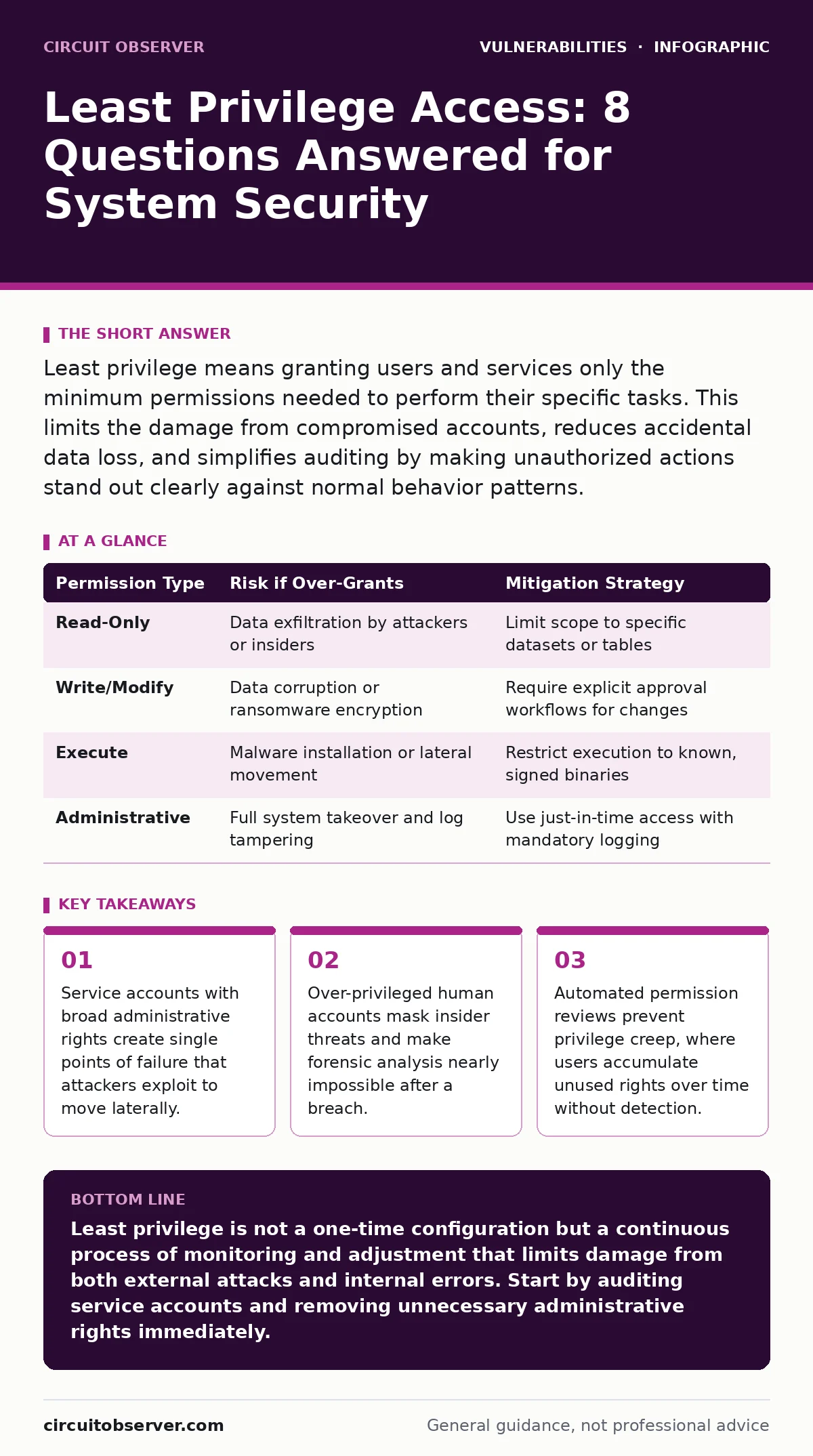
Least privilege means granting users and services only the minimum permissions needed to perform their specific tasks. This limits the damage from compromised accounts, reduces accidental data loss, and simplifies auditing by making unauthorized actions stand out clearly against normal behavior patterns.
Why does least privilege matter beyond stopping breaches?
Least privilege matters because it limits the blast radius of any security failure, whether caused by an attacker or a human error. When a component is compromised, the attacker inherits only the specific permissions assigned to that component, not the entire system. This containment strategy ensures that a single vulnerability does not grant control over unrelated data or services. It also simplifies compliance audits by creating a clear map of who can touch what.
How do I determine the minimum required permissions?
Start by observing actual behavior rather than assuming what a role requires. Monitor the application or service in a non-production environment to log every permission it requests. Strip away any permission not explicitly used during normal operations, then test for failures. If the system works without a permission, that permission is not minimum required. This empirical approach reveals dependencies that documentation often misses.
What is privilege creep and how does it happen?
Privilege creep occurs when users or services accumulate permissions over time that they no longer need. This happens because administrators rarely remove access when roles change, focusing only on adding new rights for new responsibilities. Imagine a developer who becomes a manager; they keep their code deployment rights even though they no longer write code. These unused permissions become high-value targets for attackers seeking lateral movement.
Does least privilege slow down development teams?
Yes, it often slows initial development because developers must request specific permissions rather than assuming broad access. This friction forces teams to define clear interfaces between services, which improves system architecture in the long run. However, it reduces debugging time significantly because permissions errors are caught early rather than manifesting as cryptic runtime failures. The trade-off is higher upfront effort for lower long-term maintenance costs. For deeper insights on identifying these access issues early, see our guide on dynamic application security testing (DAST).
How do I handle service accounts without breaking automation?
Service accounts require careful segmentation because they often run unattended processes that need persistent access. Create separate accounts for each distinct service or job, rather than one shared account for all automation. Assign each account only the permissions needed for its specific task, such as reading from one database and writing to another. Rotate credentials frequently and monitor these accounts for unusual activity patterns.
See also: Identity Theft Protection for Employees: The Hidden Cost of Shared Credentials · How to Prevent Data Exfiltration: Stop Silent Data Loss
What are the hidden costs of implementing least privilege?
The hidden cost is increased operational complexity and the need for continuous monitoring. You must maintain a granular permission matrix that changes as your infrastructure evolves. Administrators spend more time managing individual access rights instead of bulk assignments. Additionally, some legacy applications may break if they rely on implicit permissions or broad access assumptions. You may need to rewrite parts of your application to handle specific permission errors gracefully.
How do I detect violations of least privilege?
Monitor for actions that fall outside the expected baseline for each role or service. Set alerts for privilege escalation attempts, such as a user trying to access administrative commands. Review logs for successful access to sensitive resources by non-administrative accounts. Regular audits should compare current permissions against the documented minimum requirements for each role. This process helps identify both malicious intent and accidental privilege creep.
Why does least privilege help with insider threats?
Insider threats often rely on legitimate access to exfiltrate data or sabotage systems. Least privilege reduces the amount of data any single insider can access, limiting the potential damage. Even if an insider has malicious intent, they cannot access resources outside their defined scope without triggering alerts. This makes it harder for insiders to operate undetected over long periods.
| Permission Type | Risk if Over-Grants | Mitigation Strategy |
|---|---|---|
| Read-Only | Data exfiltration by attackers or insiders | Limit scope to specific datasets or tables |
| Write/Modify | Data corruption or ransomware encryption | Require explicit approval workflows for changes |
| Execute | Malware installation or lateral movement | Restrict execution to known, signed binaries |
| Administrative | Full system takeover and log tampering | Use just-in-time access with mandatory logging |
What happens when least privilege fails?
When least privilege fails, the system experiences a privilege escalation where a low-level component gains higher-level rights. This often happens due to misconfigured permissions or vulnerabilities in how the application handles user input. The result is a breach of trust boundaries, allowing an attacker to move from a restricted zone to a critical zone. Immediate isolation of the affected component is necessary to prevent further spread. To understand how input validation relates to this, read about server-side request forgery (SSRF) and mass assignment vulnerabilities.
How do I balance usability with security?
Balance usability by implementing just-in-time access for rare, high-privilege tasks. Instead of granting permanent administrative rights, provide temporary access that expires after a set period. This allows users to perform necessary tasks without maintaining dangerous permissions permanently. Automate the approval process to reduce friction while maintaining security controls. This approach ensures that security does not become a bottleneck for critical operations.
Key takeaways
- Service accounts with broad administrative rights create single points of failure that attackers exploit to move laterally.
- Over-privileged human accounts mask insider threats and make forensic analysis nearly impossible after a breach.
- Automated permission reviews prevent privilege creep, where users accumulate unused rights over time without detection.
Least privilege is not a one-time configuration but a continuous process of monitoring and adjustment that limits damage from both external attacks and internal errors. Start by auditing service accounts and removing unnecessary administrative rights immediately.
Frequently asked questions
Can least privilege protect against zero-day vulnerabilities?
It cannot prevent a zero-day exploit from occurring, but it limits what an attacker can do after exploitation by restricting the permissions of the compromised component.
How does least privilege relate to broken access control?
Broken access control is a failure to enforce least privilege, allowing users to access resources or functions they should not be able to reach, which attackers exploit for unauthorized data access.
Should I use role-based or attribute-based access control?
Role-based access control is simpler for static environments, while attribute-based access control offers more granular control based on user context, making it better for complex, dynamic systems.
How do I handle emergency access without violating least privilege?
Use a break-glass account with strict logging and immediate notification, ensuring that emergency access is temporary and fully audited to maintain security integrity.
How this guide was produced: written by the Circuit Observer editorial team with AI assistance, checked against the public references listed below, and reviewed when the facts change. See our editorial policy or report an error.