
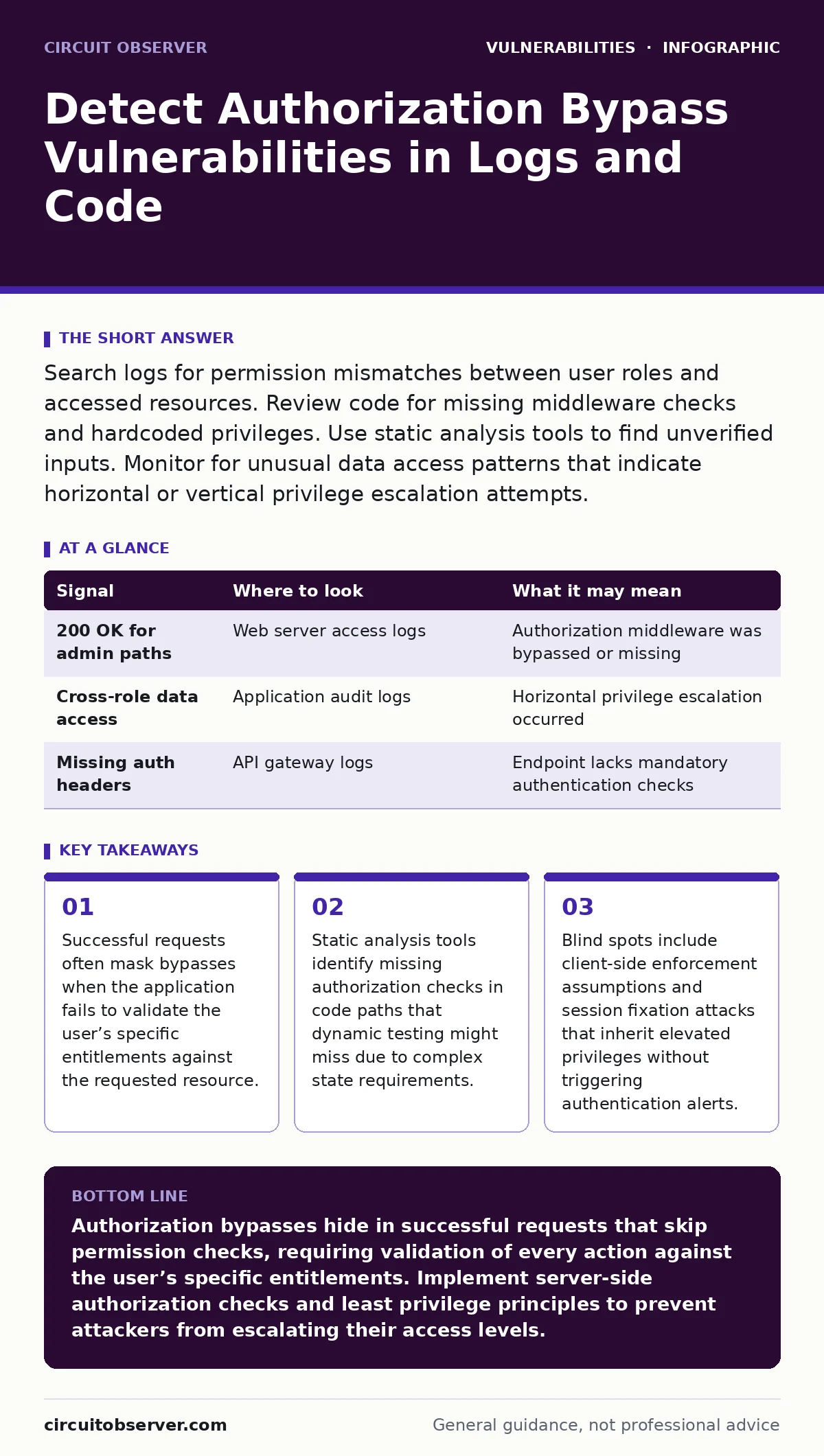
Search logs for permission mismatches between user roles and accessed resources. Review code for missing middleware checks and hardcoded privileges. Use static analysis tools to find unverified inputs. Monitor for unusual data access patterns that indicate horizontal or vertical privilege escalation attempts.
Analyze Access Logs for Permission Mismatches
Authorization bypass vulnerabilities allow users to access resources or perform actions without proper verification. The most direct evidence appears in access logs where a low-privilege user successfully retrieves high-privilege data. You must compare the user role embedded in the request against the sensitivity of the resource returned. A mismatch indicates the application skipped the authorization check entirely.
Look for sequences where a standard user accesses administrative endpoints. These requests often return a 200 OK status code instead of a 403 Forbidden error. The server processed the request but failed to enforce the policy. This pattern distinguishes a bypass from a simple configuration error where the endpoint is publicly accessible by design.
| Signal | Where to look | What it may mean |
|---|---|---|
| 200 OK for admin paths | Web server access logs | Authorization middleware was bypassed or missing |
| Cross-role data access | Application audit logs | Horizontal privilege escalation occurred |
| Missing auth headers | API gateway logs | Endpoint lacks mandatory authentication checks |
Inspect Application Code for Missing Checks
Code review reveals the root cause of many authorization failures. Developers often implement authentication correctly but forget to add authorization logic after the user is identified. You need to trace every route handler to ensure it validates the user’s permissions before processing the request. This is where static application security testing (SAST) becomes valuable for finding these logic gaps at scale.
Check for hardcoded permissions in the codebase. If a function assumes the caller is an administrator without verifying the session token, any authenticated user can trigger that function. This is a common error in microservices where internal services trust each other implicitly. You must ensure every service validates the caller’s identity and scope, even if the caller is another internal component.
Monitor for Horizontal Privilege Escalation
Horizontal privilege escalation occurs when a user accesses data belonging to another user with the same role. This is often harder to detect than vertical escalation because the user role remains consistent. You must monitor for requests where the user ID in the session token does not match the resource ID in the request parameters.
Imagine a user modifies the ID parameter in a URL to view another user’s profile. If the application returns the data, it failed to verify ownership. This is an Insecure Direct Object Reference (IDOR) vulnerability. Automated tools can scan for these patterns by sending requests with swapped IDs and checking for consistent data returns. Manual testing helps confirm whether the data belongs to the requesting user.
Evaluate Session and Token Handling
Session management flaws can lead to authorization bypasses. If an application relies on client-side storage for permission levels, an attacker can modify these values. You must ensure that all authorization decisions are made server-side using signed tokens or secure session stores. Never trust data sent from the client regarding user privileges.
Review how your application handles token expiration and refresh. A flaw here might allow an expired token to retain access temporarily. This window can be exploited to perform actions before the session is invalidated. Ensure that token validation includes a check for the specific permissions required by the endpoint, not just the token’s validity.
Identify Blind Spots in Testing Coverage
Many security tests focus on authentication, leaving authorization under-tested. A common blind spot is assuming that if a user is logged in, they can access all features associated with their role. You must test every role against every endpoint. This includes testing for missing functionality that should be visible only to specific users.
Another blind spot is the assumption that client-side restrictions prevent access. Hiding a button in the user interface does not secure the backend API. Attackers can bypass these UI restrictions by crafting direct API requests. You must treat all backend endpoints as publicly accessible unless proven otherwise through server-side enforcement.
Leverage Automated Security Tools
Automated tools help scale the detection of authorization vulnerabilities. Dynamic application security testing (DAST) tools can simulate attacks by manipulating parameters and checking responses. However, DAST tools often struggle with complex authorization logic that requires specific session states. You must combine DAST with static analysis for better coverage.
Static analysis tools examine the source code for missing authorization checks. They can identify functions that lack permission validation before accessing sensitive data. This helps you find vulnerabilities before deployment. Integrate these tools into your continuous integration pipeline to catch regressions early. Regular re-scans are necessary as code changes introduce new risks.
Correlate with Related Vulnerability Classes
Authorization bypasses often coexist with other vulnerabilities. For example, server-side request forgery (SSRF) can be used to bypass network-level authorization by forcing the server to make internal requests. If an attacker can control the URL in an SSRF attack, they might access internal APIs that lack external authentication. You must evaluate authorization in the context of the entire application stack.
Similarly, open redirect vulnerabilities can be chained with authorization flaws to trick users into performing actions on behalf of the application. This is known as an account takeover via CSRF. Ensuring that your application validates the origin of requests helps mitigate this risk. Review your guides on coordinated vulnerability disclosure to understand how these issues are reported and prioritized.
Implement Least Privilege Access Controls
The most effective defense against authorization bypasses is implementing least privilege access. Each user and service should have only the permissions necessary to perform their function. This limits the impact of a successful bypass. Even if an attacker exploits a vulnerability, they cannot access resources outside their strict permission set.
Regularly audit permissions to remove unnecessary access. Over time, permissions accumulate as users change roles or projects end. Stale permissions increase the attack surface. Automated tools can help identify unused permissions and flag them for review. This reduces the risk of accidental exposure and makes detection of anomalous activity easier.
Key takeaways
- Successful requests often mask bypasses when the application fails to validate the user’s specific entitlements against the requested resource.
- Static analysis tools identify missing authorization checks in code paths that dynamic testing might miss due to complex state requirements.
- Blind spots include client-side enforcement assumptions and session fixation attacks that inherit elevated privileges without triggering authentication alerts.
Authorization bypasses hide in successful requests that skip permission checks, requiring validation of every action against the user’s specific entitlements. Implement server-side authorization checks and least privilege principles to prevent attackers from escalating their access levels.
Frequently asked questions
How do I distinguish between an authentication failure and an authorization bypass?
Authentication failures return 401 Unauthorized errors when credentials are invalid. Authorization bypasses return 200 OK or 403 Forbidden errors when valid credentials are used but the user lacks permission for the specific resource.
Can static analysis tools detect all authorization vulnerabilities?
Static analysis tools identify missing checks in code but cannot verify runtime behavior. They must be combined with dynamic testing to ensure that authorization logic works correctly with actual session data and user inputs.
What is the difference between horizontal and vertical privilege escalation?
Horizontal escalation involves accessing data belonging to another user with the same role. Vertical escalation involves accessing resources or functions reserved for a higher-privilege role, such as an administrator.
Why are client-side restrictions insufficient for security?
Client-side restrictions only hide functionality from the user interface. Attackers can bypass these by sending direct requests to the backend API. Security controls must always be enforced on the server side.
How this guide was produced: written by the Circuit Observer editorial team with AI assistance, checked against the public references listed below, and reviewed when the facts change. See our editorial policy or report an error.