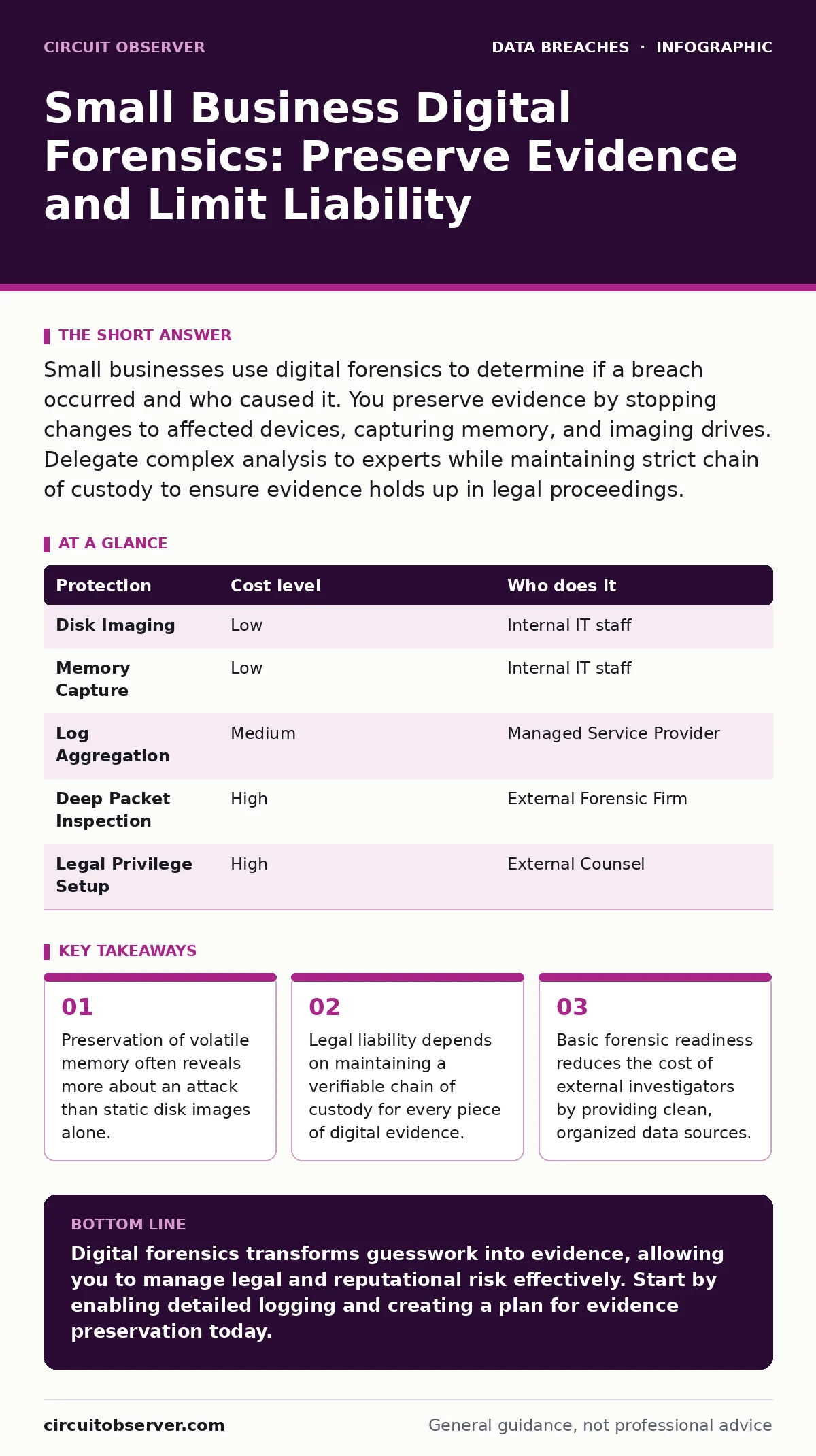
Small businesses use digital forensics to determine if a breach occurred and who caused it. You preserve evidence by stopping changes to affected devices, capturing memory, and imaging drives. Delegate complex analysis to experts while maintaining strict chain of custody to ensure evidence holds up in legal proceedings.
The Ten-Person Company Scenario
Small organizations often ignore digital forensics because they assume they are too small to be targeted. This assumption fails when a single compromised credential exposes client data. Forensics provides the technical proof needed to distinguish between a configuration error and a deliberate attack. Without this distinction, you cannot accurately assess the scope of the incident or determine if regulatory notification is required. The goal is not to catch a criminal, but to understand the event fully.
Why Forensics Matters at Small Scale
Digital forensics matters because it establishes the timeline and scope of an incident. You need to know what data was accessed and when. This information dictates your response strategy and legal obligations. If you cannot prove that data was not exfiltrated, you may be forced to notify customers unnecessarily, damaging trust. Conversely, if you fail to detect exfiltration, you face regulatory penalties. Forensics gives you the factual basis to make these decisions. It turns speculation into evidence.
Small businesses face unique challenges in this area. You likely lack dedicated security staff. You rely on generalist IT support. This creates a gap where evidence is often destroyed by well-meaning but untrained staff. Rebooting a compromised machine clears its memory, which often contains the only trace of certain malware. Formatting a drive to "clean" it destroys the metadata that shows when files were created or modified. These actions make reconstruction impossible.
Affordable Evidence Preservation
You do not need expensive hardware to begin forensic readiness. The most critical step is preventing data alteration. When you suspect a breach, disconnect the affected device from the network immediately. Do not shut it down if possible. Shutting down clears the random access memory, which holds active processes and network connections. If the device must be powered off, document the exact state before doing so.
Use free or open-source tools to create bit-for-bit copies of storage media. These copies, called disk images, allow you to analyze the data without touching the original drive. This preserves the original evidence for potential legal proceedings. You can analyze the image repeatedly without risk of corruption. Many standard operating systems include command-line utilities for this purpose. Ensure you verify the integrity of the image using cryptographic hashes. This proves the copy matches the original exactly.
| Protection | Cost level | Who does it |
|---|---|---|
| Disk Imaging | Low | Internal IT staff |
| Memory Capture | Low | Internal IT staff |
| Log Aggregation | Medium | Managed Service Provider |
| Deep Packet Inspection | High | External Forensic Firm |
| Legal Privilege Setup | High | External Counsel |
What to Delegate to Experts
Some aspects of digital forensics require specialized skills and tools. You should delegate the analysis of complex malware or encrypted data to external experts. Internal staff often lack the training to interpret low-level system artifacts correctly. Misinterpretation can lead to false conclusions about the attack vector. This can cause you to patch the wrong vulnerability, leaving the system exposed.
External firms bring objectivity and established methodologies. They can provide reports that hold up in court or insurance claims. Attempting to perform this analysis internally may invalidate your coverage. You also need to delegate the preservation of legal privilege. Work with legal counsel to ensure communications and findings are protected from discovery. This requires specific protocols and documentation that IT staff are not trained to handle.
Common Mistakes in Small Business Forensics
Many small businesses destroy evidence by trying to "fix" the problem too quickly. The instinct is to restore from backup or reinstall the operating system. This removes the indicators of compromise. You lose the ability to determine how the attacker entered the system. This makes it impossible to prevent recurrence. Another common mistake is failing to document the chain of custody. If you cannot prove who handled the evidence and when, it may be inadmissible in legal proceedings.
Another error is relying solely on antivirus software. Modern threats often evade signature-based detection. You need to look for behavioral anomalies and unusual network traffic. Antivirus logs alone rarely tell the full story. You must correlate system logs, network logs, and application logs. This correlation requires tools and expertise that go beyond standard IT maintenance.
See also: Malware Payloads: Small Business Defense Strategies · Breach Notification Rule: What It Is and How to Comply
Building Forensic Readiness
Forensic readiness involves preparing your systems for investigation before an incident occurs. This includes enabling detailed logging on all critical systems. You must ensure logs are stored securely and cannot be altered by attackers. Centralized log management is key here. If an attacker compromises a server, they can delete local logs. Sending logs to a remote, write-only server prevents this.
You should also maintain an inventory of all hardware and software. This includes serial numbers, model numbers, and installation dates. This information speeds up the investigation process. It helps investigators quickly identify affected systems. You should also define clear roles and responsibilities. Who decides to disconnect a device? Who contacts the forensic firm? Having this plan in place reduces panic and error during an incident.
Questions for Your IT Provider
If you use a managed service provider, you must verify their forensic capabilities. Many providers offer basic monitoring but lack deep forensic skills. You need to ask specific questions to ensure they can support your needs. Do not assume that "security monitoring" includes forensic investigation. These are distinct disciplines with different skill sets.
- Do you maintain detailed logs for at least the past 90 days?
- Can you provide bit-for-bit disk images of affected systems?
- Do you have a process for preserving chain of custody?
- Can you correlate logs across multiple systems and time zones?
- Do you have experience with legal discovery and reporting?
These questions help you determine if your provider can support your forensic readiness. If they cannot, you need to find a partner who can. This may involve hiring a specialized firm for incident response. This is a necessary cost for protecting your business.
Integrating with Broader Security Practices
Digital forensics does not exist in isolation. It connects to other aspects of your security program. For example, understanding the scope of a breach is critical for breach notification. You cannot notify customers accurately without knowing what data was exposed. Forensics provides the data needed to make these determinations.
It also relates to credential leaks. If you detect unauthorized access, forensics can determine if credentials were stolen or guessed. This influences your response. If credentials were stolen, you must assume they are compromised everywhere. If they were guessed, you can focus on strengthening authentication. This distinction saves time and resources.
Furthermore, forensics helps identify data exfiltration attempts. Not all outbound traffic is malicious. Forensics helps you distinguish between normal operations and data theft. This is crucial for protecting intellectual property and client information. By integrating forensics into your broader strategy, you create a more resilient security posture.
Key takeaways
- Preservation of volatile memory often reveals more about an attack than static disk images alone.
- Legal liability depends on maintaining a verifiable chain of custody for every piece of digital evidence.
- Basic forensic readiness reduces the cost of external investigators by providing clean, organized data sources.
Digital forensics transforms guesswork into evidence, allowing you to manage legal and reputational risk effectively. Start by enabling detailed logging and creating a plan for evidence preservation today.
Frequently asked questions
How long should I keep forensic logs?
Keep logs for at least 90 days, but longer retention is better for detecting slow-moving threats. Check your industry regulations for specific requirements.
Can I use free tools for forensic analysis?
Yes, many open-source tools are effective for basic imaging and analysis. However, complex investigations may require commercial tools and expert interpretation.
Do I need a lawyer for every forensic investigation?
Not always, but involving counsel early helps protect attorney-client privilege and ensures legal compliance. This is especially important if litigation is likely.
What is the first step when I suspect a breach?
Isolate the affected system from the network without powering it off. Capture memory if possible, then create a disk image before any other actions.
How this guide was produced: written by the Circuit Observer editorial team with AI assistance, checked against the public references listed below, and reviewed when the facts change. See our editorial policy or report an error.