
Prevent data exfiltration by enforcing least privilege access and monitoring outbound traffic for anomalies. You must restrict who can touch sensitive data and verify where that data travels. Blocking common ports is insufficient because attackers use standard HTTPS channels to hide their activity.
How to Prevent Data Exfiltration Immediately
How to prevent data exfiltration requires shifting focus from perimeter defense to internal control. Most organizations assume their firewall stops data loss. This assumption is dangerous. Attackers often gain authorized access before stealing data. They use legitimate credentials to copy files. They send those files over standard web ports. Your firewall sees this as normal traffic. You must treat every internal user as a potential threat vector.
The fastest way to reduce risk is to audit user permissions. Remove access rights that are no longer needed. An employee who changes departments should not retain access to old files. This process is called user access provisioning. It ensures that individuals only hold the keys they need for their current role. You cannot protect data if everyone can read it.
The Hidden Cost of Unrestricted Access
Unrestricted access creates a silent risk. Imagine a developer who needs access to production databases for testing. They keep that access after the project ends. Months later, their credentials are compromised. The attacker uses those valid credentials to download the entire customer database. The firewall allows this traffic because the connection is authenticated and encrypted.
This scenario highlights the failure of perimeter-only security. You must implement identity-aware proxy controls. These tools check not just if a user is logged in, but if they are allowed to access specific resources from specific locations. If a user logs in from an unusual country, the system should block data transfer. This adds friction to legitimate use but stops automated theft.
Priority Measures for Risk Reduction
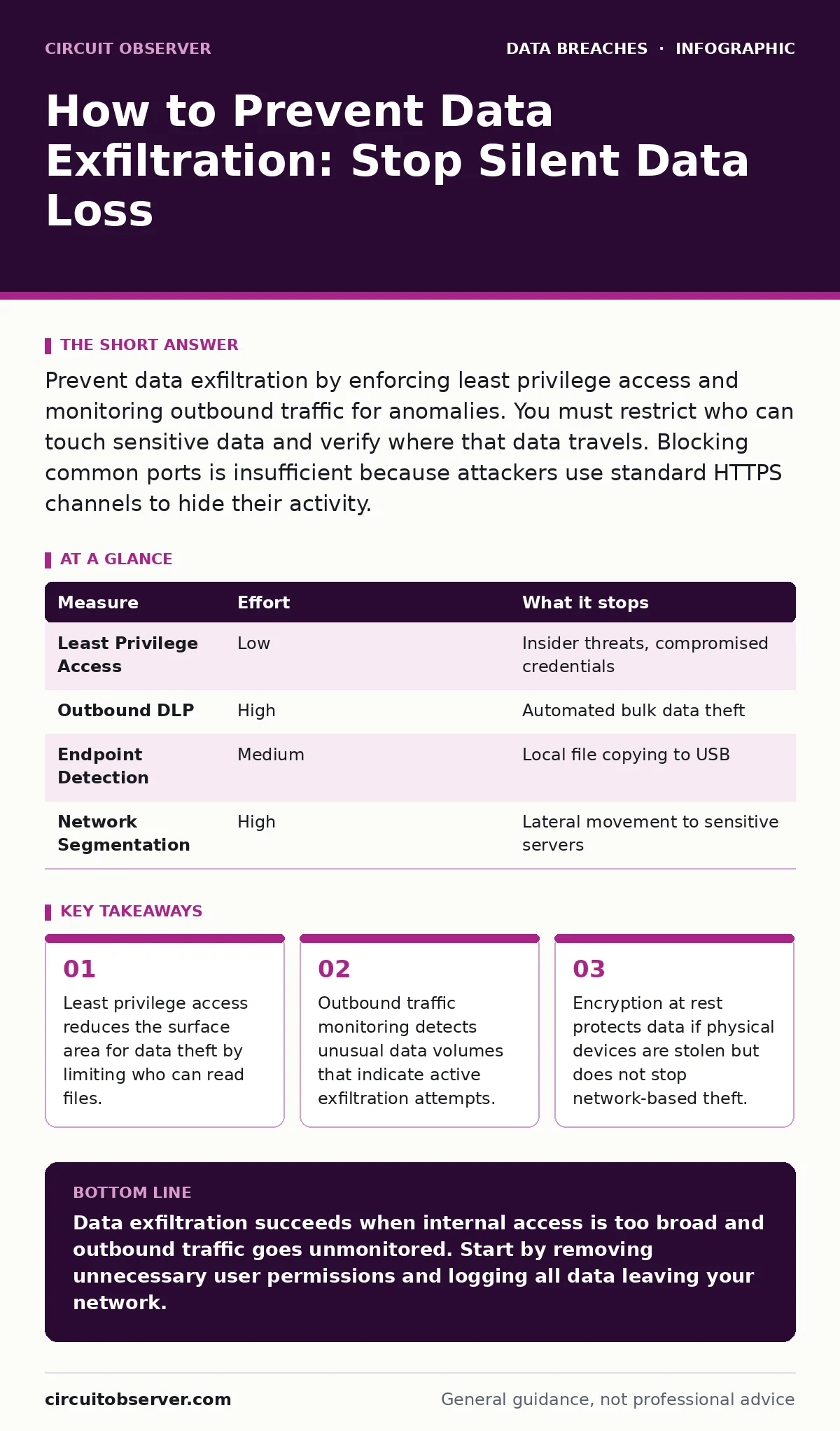
You should rank your prevention measures by how much risk they remove. Not all controls are equal. Some provide high visibility with low effort. Others require significant engineering but block advanced threats. The table below outlines the most effective strategies.
| Measure | Effort | What it stops |
|---|---|---|
| Least Privilege Access | Low | Insider threats, compromised credentials |
| Outbound DLP | High | Automated bulk data theft |
| Endpoint Detection | Medium | Local file copying to USB |
| Network Segmentation | High | Lateral movement to sensitive servers |
Implementing least privilege access is the highest return investment. It prevents an attacker from moving laterally. If they breach one system, they cannot reach the data store. This containment is vital for limiting damage. You must map your data flows to understand where sensitive information lives. Without this map, you cannot protect it effectively.
Why Standard Firewalls Fail
Standard firewalls inspect headers and ports. They do not inspect content. An attacker can compress and encrypt data before sending it. The firewall sees an encrypted packet. It checks the destination port. Port 443 is used for HTTPS. The firewall allows the traffic. The data leaves your network unseen.
This is why you need Data Loss Prevention tools. These tools inspect the payload of the data. They look for patterns like credit card numbers or social security numbers. They can block transfers that match these patterns. However, they struggle with encrypted traffic. You must decrypt traffic at the edge to inspect it. This creates a performance bottleneck and a privacy concern.
The Role of Encryption and Tokenization
Encryption protects data at rest and in transit. If a laptop is stolen, the data remains unreadable without the key. This addresses physical theft. It does not address network exfiltration. If the attacker has the decryption key, encryption offers no protection.
Tokenization replaces sensitive data with non-sensitive equivalents. The original data is stored in a secure vault. The application uses the token. If the application database is breached, the attacker only gets tokens. They cannot reverse them to find the original data. This reduces the value of stolen data. It is a strong control for payment card data. It requires integration with tokenization services. This adds complexity to your architecture.
See also: Employee Data Breach Prevention Checklist for Internal Threats · Identity Theft Protection for Employees: The Hidden Cost of Shared Credentials
Monitoring Outbound Traffic Anomalies
You must monitor the volume and destination of outbound traffic. A single user sending 10 gigabytes of data to an unknown cloud storage bucket is suspicious. Standard logs may not flag this. You need specialized monitoring tools. These tools establish a baseline of normal behavior. They alert you when deviations occur.
Imagine a database administrator who normally exports small reports. Suddenly, they export the entire customer table. The volume is unusual. The destination is unusual. The monitoring tool flags this activity. Security teams can intervene before the data leaves the network. This detection relies on accurate baselines. Noisy environments create false positives. You must tune your alerts carefully.
What Does Not Work Alone
Many organizations rely on a single control. They believe a strong password prevents data theft. This is incorrect. If an attacker steals a session cookie, the password is irrelevant. They do not need to log in. They already have access. You must monitor for session hijacking. You must enforce short session timeouts.
Another common mistake is ignoring vendor risk management. Third-party vendors often have access to your data. If their security is weak, your data is exposed. You must assess their controls. You must limit their access. You must monitor their activity. Treating vendors as trusted partners is a critical error. They are part of your attack surface.
Closing Checklist for Today
You must take action immediately. Do not wait for a breach to implement these controls. The cost of inaction is high. Use this checklist to prioritize your efforts.
- Audit user permissions and remove unnecessary access rights.
- Enable logging for all outbound data transfers.
- Review vendor access agreements and restrict data scope.
These three steps address the most common failure points. They reduce the likelihood of successful exfiltration. They do not eliminate risk. They make it harder for attackers. You must maintain these controls over time. Security is a continuous process.
Key takeaways
- Least privilege access reduces the surface area for data theft by limiting who can read files.
- Outbound traffic monitoring detects unusual data volumes that indicate active exfiltration attempts.
- Encryption at rest protects data if physical devices are stolen but does not stop network-based theft.
Data exfiltration succeeds when internal access is too broad and outbound traffic goes unmonitored. Start by removing unnecessary user permissions and logging all data leaving your network.
Frequently asked questions
Can a VPN prevent data exfiltration?
A VPN encrypts traffic but does not inspect it. Attackers can use a VPN to hide their exfiltration activities from network monitors. You must inspect traffic inside the VPN tunnel.
How do I detect if data has already been stolen?
Look for unusual outbound traffic volumes and unauthorized access to sensitive files. Monitor for large downloads to cloud storage services. Check for new administrative accounts created recently.
Does encrypting emails stop data theft?
Encryption protects the email in transit. If the recipient is an attacker, encryption helps them. You must control who receives the email. Use recipient validation and access controls.
Should I block USB drives to prevent exfiltration?
Blocking USB drives stops physical copying. It does not stop network-based theft. It is a useful control but insufficient alone. Combine it with network monitoring for better protection.
How this guide was produced: written by the Circuit Observer editorial team with AI assistance, checked against the public references listed below, and reviewed when the facts change. See our editorial policy or report an error.