
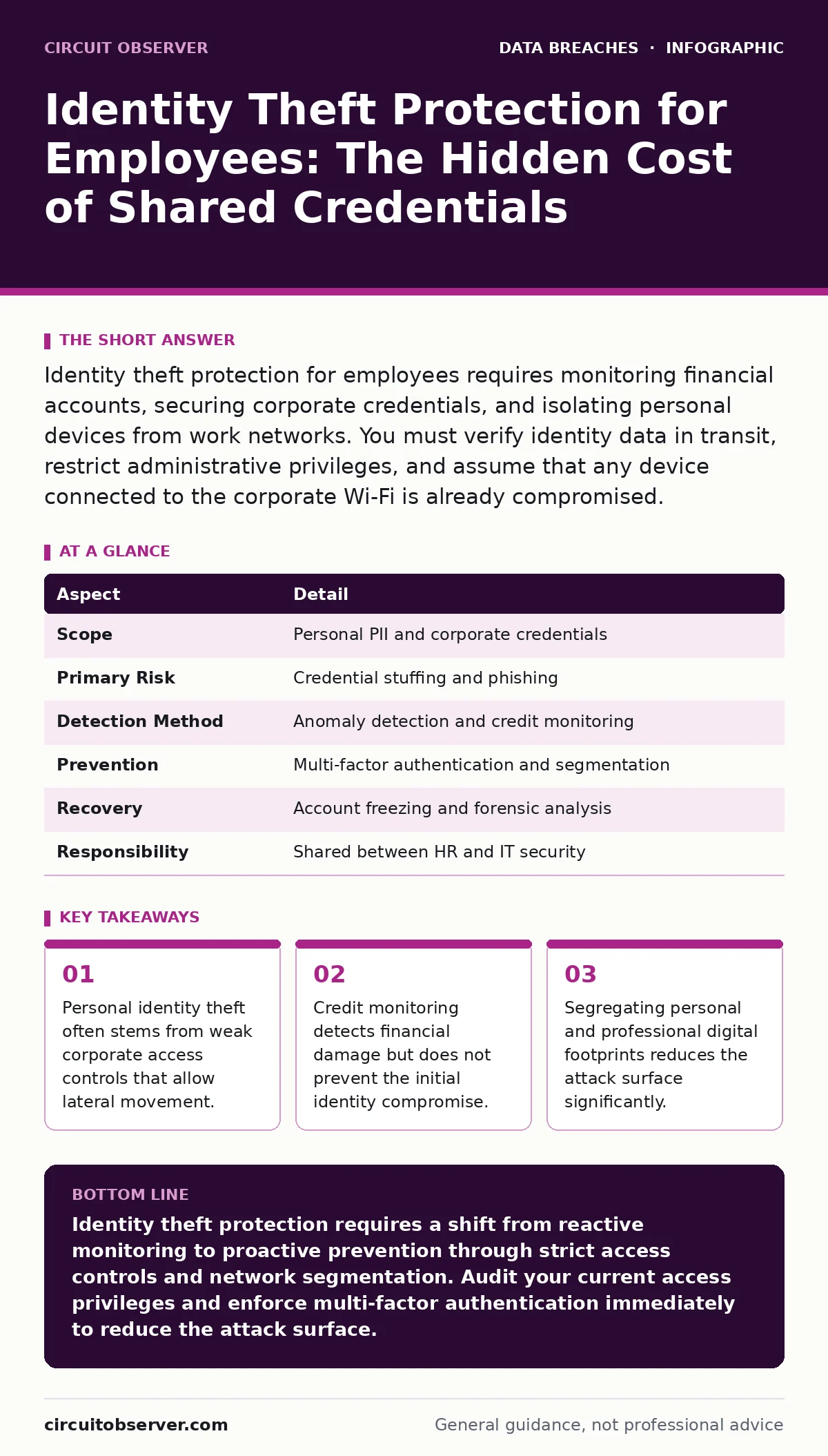
Identity theft protection for employees requires monitoring financial accounts, securing corporate credentials, and isolating personal devices from work networks. You must verify identity data in transit, restrict administrative privileges, and assume that any device connected to the corporate Wi-Fi is already compromised.
The Digital Wallet Analogy
Imagine leaving your physical wallet on a public table while you attend a meeting. A thief does not need to pick your pocket; they simply wait for you to leave. Digital identity works the same way. Your online accounts are the wallet, and the internet is the public table. Identity theft protection for employees is not about locking the wallet. It is about ensuring that the thief cannot walk away with it even if they are standing right next to you. This requires constant vigilance over what data is exposed and how it is accessed.
| Aspect | Detail |
|---|---|
| Scope | Personal PII and corporate credentials |
| Primary Risk | Credential stuffing and phishing |
| Detection Method | Anomaly detection and credit monitoring |
| Prevention | Multi-factor authentication and segmentation |
| Recovery | Account freezing and forensic analysis |
| Responsibility | Shared between HR and IT security |
How Identity Theft Protection Works
Identity theft protection operates on three layers: prevention, detection, and remediation. Prevention reduces the amount of data available to attackers. This includes using multi-factor authentication, which requires a second form of verification beyond a password. Detection identifies unauthorized access attempts. Systems monitor for unusual login locations or rapid password changes.
Remediation limits the damage after a breach. This involves freezing credit reports and resetting compromised credentials. Most organizations focus heavily on detection. They neglect prevention because it requires changing user behavior. You must enforce strict password policies and limit the data stored on endpoints. Storing less data means there is less to steal.
Who Is Affected by Corporate Identity Theft
Every employee with a corporate email address is a potential target. Attackers do not distinguish between junior staff and executives. They target anyone who can provide a foothold into the network. However, certain roles face higher risks. Finance personnel handle sensitive transactions. Human resources staff manage personal identification documents.
System administrators have elevated privileges that allow them to access multiple systems. When an attacker compromises an account, they can impersonate that person. They can request password resets for other accounts. They can initiate fraudulent transfers. The damage spreads quickly because internal trust is built into most corporate networks. A compromised employee account is a trusted entry point.
Identity Theft Protection for Employees
You need a structured approach to identity theft protection for employees. Start by mapping all data flows. Identify where personal information enters and leaves the organization. Implement data loss prevention tools to block unauthorized transfers. Use privileged access management to restrict administrative rights. Only grant elevated access when absolutely necessary.
Monitor user behavior analytics for signs of compromise. Look for logins from new devices or unusual times. Educate staff on recognizing phishing attempts. Phishing remains the most common entry point for identity theft. Regular training helps users spot suspicious emails. Assume that some users will click malicious links. Design your network to contain the blast radius.
What People Usually Get Wrong
Most organizations believe that providing credit monitoring services is sufficient. This is a fundamental error. Credit monitoring alerts users after damage has occurred. It does not prevent the theft. Another common mistake is assuming that personal devices are separate from corporate risk. If an employee connects a personal phone to the corporate Wi-Fi, that device becomes part of the network.
Malware on the personal device can scan the network for vulnerabilities. It can intercept unencrypted traffic. Organizations often ignore the risk of credential reuse. Employees use the same passwords for personal and work accounts. If a personal account is breached, the attacker tries those credentials on the corporate system. This is called credential stuffing. It bypasses password complexity requirements because the password is already known.
See also: Employee Data Breach Prevention Checklist for Internal Threats · How to Prevent Data Exfiltration: Stop Silent Data Loss
The Hidden Cost of Shared Credentials
When employees share credentials to collaborate, they create a single point of failure. If one person’s account is compromised, all shared accounts are exposed. This practice violates the principle of least privilege. Each user should have their own unique identity. This allows for precise auditing and access control. Shared credentials make it impossible to determine who performed an action.
Forensic analysis becomes difficult when multiple people use the same login. You must enforce individual account ownership. Disable shared accounts immediately. Use group permissions instead. Group permissions allow multiple users to access resources without sharing a single password. This maintains accountability and reduces risk.
Integration with Broader Security Frameworks
Identity theft protection does not exist in isolation. It must integrate with broader security frameworks. Review your vendor risk management practices regularly. Third-party vendors often have access to your data. If a vendor is compromised, your data is at risk. Ensure that your breach notification plans include identity theft scenarios. Notify affected individuals promptly.
Provide clear instructions on how to protect their identities. Consider implementing tokenization for sensitive data. Tokenization replaces sensitive data with non-sensitive equivalents. This reduces the value of stolen data. Even if an attacker accesses the database, they cannot use the tokenized values. Combine these measures with regular digital forensics exercises. Test your ability to detect and respond to identity theft incidents.
Practical Steps for Immediate Implementation
Begin by auditing all user accounts. Remove inactive accounts and unnecessary privileges. Enforce multi-factor authentication across all systems. This single step blocks the majority of automated attacks. Segment your network to isolate critical systems. Limit lateral movement for attackers who compromise an endpoint. Provide clear guidelines on data handling. Employees should know what data is sensitive and how to protect it.
Regularly update your incident response plan. Include specific procedures for identity theft cases. Test these procedures with simulated incidents. Training is most effective when it is realistic and frequent. Do not rely on annual compliance videos. Use interactive simulations to reinforce learning. Monitor for changes in employee behavior. Sudden changes in work patterns can indicate a compromised account.
Key takeaways
- Personal identity theft often stems from weak corporate access controls that allow lateral movement.
- Credit monitoring detects financial damage but does not prevent the initial identity compromise.
- Segregating personal and professional digital footprints reduces the attack surface significantly.
Identity theft protection requires a shift from reactive monitoring to proactive prevention through strict access controls and network segmentation. Audit your current access privileges and enforce multi-factor authentication immediately to reduce the attack surface.
Frequently asked questions
Does multi-factor authentication stop all identity theft?
Multi-factor authentication blocks most automated attacks but does not stop sophisticated phishing that steals the second factor in real time.
How long should I keep employee records?
Retain records only as long as legally required. Excessive retention increases the amount of data available to attackers in a breach.
Can remote workers be protected effectively?
Remote workers require strict endpoint security and network segmentation. Assume the home network is untrusted and encrypt all data in transit.
What is the role of HR in identity theft protection?
HR manages the lifecycle of employee data. They must ensure secure onboarding and offboarding processes to prevent unauthorized access.
How this guide was produced: written by the Circuit Observer editorial team with AI assistance, checked against the public references listed below, and reviewed when the facts change. See our editorial policy or report an error.