
Obtaining a Reddit API key requires creating a script application profile within your account preferences, which generates a unique client identifier and secret. These credentials authenticate automated requests against public endpoints while enforcing strict limits on how frequently your software can fetch data.
Misreading: A single key grants access to every platform endpoint forever
Correct reading:
Application classifications strictly limit what operations your software can perform across network boundaries. Reddit divides developer accounts into distinct categories like scripts, web apps, and installed clients. Choosing the wrong category restricts your ability to execute automated tasks without throwing opaque error codes. Selecting a script application suits background server jobs, whereas web applications require redirect URIs for user authentication flows.
Matching your configuration to your actual use case prevents sudden authentication failures when scaling infrastructure. Proper credential design mirrors the planning required for data center security operations where boundary definitions dictate overall system resilience. 3 distinct permission models exist, each dictating specific token lifetimes and scope limitations. Failing to account for these boundaries leads to unexpected runtime exceptions when background workers attempt user-scoped actions.
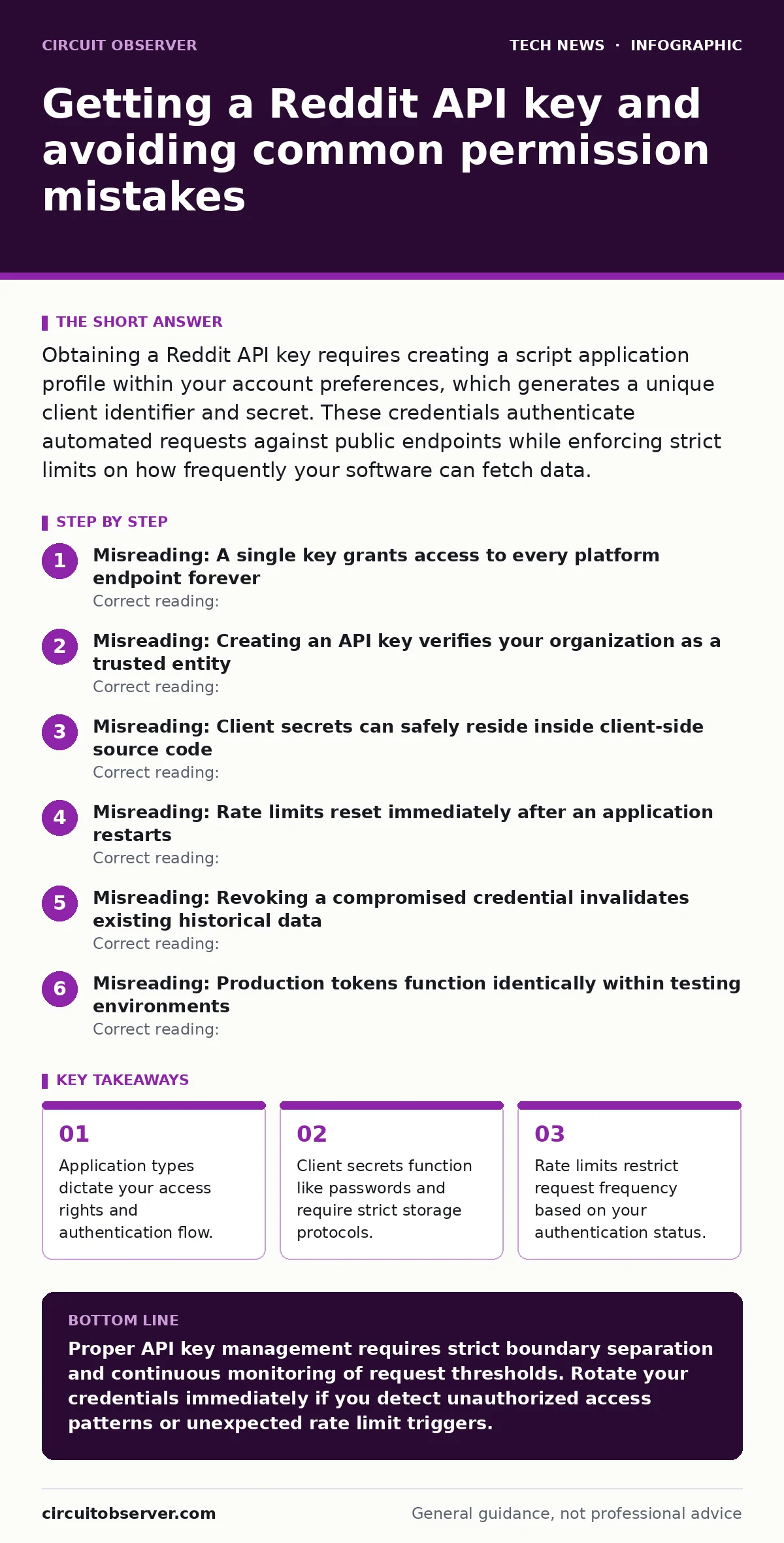
Misreading: Creating an API key verifies your organization as a trusted entity
Correct reading:
Account creation processes for developer access involve minimal validation beyond standard email confirmation. Anonymous registration means anyone can generate credentials within seconds without proving legal identity or operational intent. Security teams often mistake basic platform registration for formal vetting, leaving internal systems exposed if external tools behave maliciously. Building resilient architectures requires treating external API credentials as untrusted inputs until proven otherwise.
Platform administrators retain the absolute right to revoke tokens without prior warning if anomalous traffic patterns emerge. Automated abuse detection systems monitor request volumes independently of your verification status, meaning corporate backing offers zero immunity against rate suspensions. 4 distinct triggers cause immediate revocation, ranging from credential leakage to unexpected payload spikes. Maintaining system uptime requires designing fallback mechanisms that handle sudden credential invalidation gracefully.
Misreading: Client secrets can safely reside inside client-side source code
Correct reading:
Client secrets operate as private authentication keys that must never be distributed publicly in distributed binaries. Embedding secrets directly into front-end JavaScript or compiled desktop applications exposes your credentials to immediate extraction by malicious actors. Software architectures must route API requests through a secure backend proxy that hides sensitive authentication tokens from end users. Protecting these tokens requires the cryptographic discipline you apply when managing SHA-256 hashes for database integrity.
Source code inspection tools routinely scan public repositories for leaked API tokens within seconds of publication. Hardcoding credentials in source control systems guarantees eventual compromise once repositories become public or suffer unauthorized access. Environment variables injected at runtime provide a safer alternative for managing sensitive authentication parameters across different deployment stages. Operational safety demands treating secret management as a continuous lifecycle process rather than a static configuration task.
Misreading: Rate limits reset immediately after an application restarts
Correct reading:
Throttling mechanisms track request frequencies globally across server infrastructure rather than relying on local application state. Restarting your script or clearing your local cache does not bypass platform-enforced request ceilings or grant fresh token quotas. Developers frequently miscalculate backoff algorithms, causing automated systems to trigger persistent bans during high-traffic events. Implementing exponential backoff strategies ensures your software respects server constraints and maintains reliable communication channels over extended periods.
Sliding window algorithms used by API gateways calculate request rates across rolling time intervals rather than fixed calendar hours. Assuming quotas reset at the top of the hour leads to catastrophic request failures when traffic clusters near boundary edges. 2 separate tracking metrics govern access, measuring both burst limits and sustained throughput simultaneously. Designing robust software requires caching responses locally to minimize redundant network calls during peak operational windows.
Misreading: Revoking a compromised credential invalidates existing historical data
Correct reading:
Credential revocation stops future unauthorized requests but leaves previously retrieved information intact on your local storage drives. Deleting an API key terminates active token sessions immediately, yet it offers zero remediation if data was exfiltrated prior to discovery. Incident response plans must account for local data purging alongside key rotation procedures. Maintaining operational safety demands treating downloaded datasets with the vigilance applied to handling expired one-time passwords used in authentication systems.
Database caches populated by automated scrapers retain historical records long after upstream API tokens are permanently deleted from developer consoles. Purging stale records requires implementing automated data retention policies that strip sensitive information once its operational utility expires. 5 distinct deletion steps are necessary to ensure complete eradication of cached payloads across distributed storage nodes. Neglecting local data hygiene turns old log files into persistent security liabilities long after credentials change.
See also: What Is Replay Attacks: How Recordings Compromise Your Systems · Passkeys vs Yubikey: Which Authentication Method Secures Your Account
Misreading: Production tokens function identically within testing environments
Correct reading:
Development sandboxes enforce different rate ceilings and data isolation rules compared to live production endpoints. Using production credentials inside staging environments risks accidental data pollution and triggers automated security alerts for abnormal usage patterns. Platform operators provide separate testing namespaces specifically to prevent development errors from impacting live services. Maintaining strict environment segregation ensures your testing pipelines do not inadvertently consume production quotas or corrupt upstream databases.
Configuration drift between environments often causes scripts that pass staging tests to fail immediately upon deployment to live infrastructure. 3 specific environment variables must change between staging and production modes to prevent accidental cross-contamination of request traffic. Developers must implement automated configuration validation checks during the build phase to catch mismatched API targets early. Treating test environments as second-class citizens leads to fragile deployments and unpredictable runtime behavior during critical rollouts.
Key takeaways
- Application types dictate your access rights and authentication flow.
- Client secrets function like passwords and require strict storage protocols.
- Rate limits restrict request frequency based on your authentication status.
Proper API key management requires strict boundary separation and continuous monitoring of request thresholds. Rotate your credentials immediately if you detect unauthorized access patterns or unexpected rate limit triggers.
Frequently asked questions
How long does a generated Reddit API key remain active before expiring?
A generated Reddit API key remains active indefinitely unless you manually revoke it through your account settings or platform administrators invalidate it due to policy violations. Token sessions themselves expire periodically, requiring your application to request fresh access tokens using your persistent client credentials.
Can multiple background workers share a single set of API credentials simultaneously?
Multiple background workers can share a single set of credentials, but doing so aggregates their request counts against a shared rate limit pool. Scaling your infrastructure requires careful monitoring to ensure parallel processes do not inadvertently trigger platform throttling thresholds.
What happens when an application exceeds its allotted platform request quota?
Exceeding an allotted platform request quota results in temporary HTTP error responses that block further data retrieval until the sliding time window resets. Automated backoff logic must interpret these specific status codes to pause execution safely without crashing the running process.
Why do web applications require redirect URIs during the developer setup process?
Web applications require redirect URIs because they facilitate the authorization code grant flow, allowing the platform to securely return authentication tokens directly to your server. This mechanism ensures that user credentials and access tokens never pass unprotected through the user's browser environment.
How this guide was produced: written by the Circuit Observer editorial team with AI assistance, checked against the public references listed below, and reviewed when the facts change. See our editorial policy or report an error.