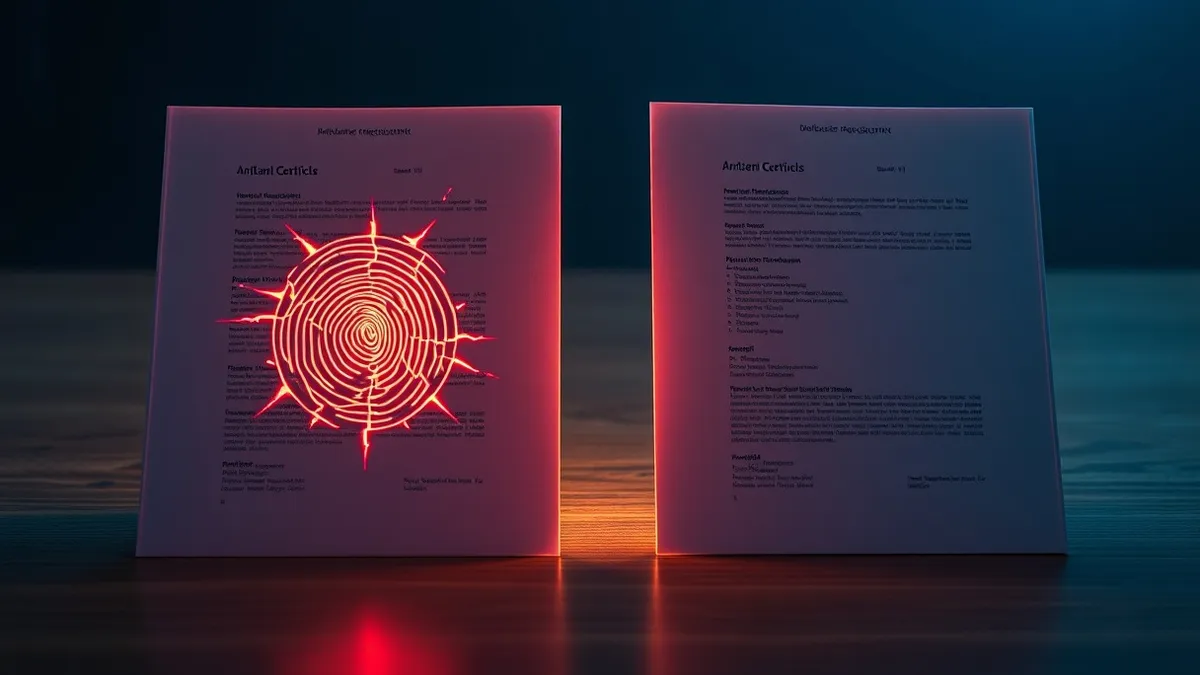
SHA-256 vs SHA-1 differs in security and output length. SHA-1 produces 160-bit hashes but is vulnerable to collision attacks, meaning two different files can share the same hash. SHA-256 produces 256-bit hashes and resists these attacks. You must replace SHA-1 in any security context. Use SHA-256 for verifying software integrity, signing documents, or securing data structures.
The Core Difference Between SHA-256 vs SHA-1
The fundamental difference between SHA-256 vs SHA-1 lies in their resistance to collision attacks. A collision occurs when two distinct inputs produce the identical hash output. SHA-1, with its 160-bit output, allows attackers to craft these collisions with reasonable computational effort. SHA-256, producing a 256-bit output, makes such collisions practically impossible. This distinction determines whether your data integrity checks can be trusted or easily spoofed. You cannot rely on SHA-1 to prove that a file has not been altered.
What Is SHA-1?
SHA-1, or Secure Hash Algorithm 1, was designed in the 1990s to create a fixed-length digital fingerprint of data. It processes input data in 512-bit blocks and outputs a 160-bit hash value. This algorithm became the standard for verifying file integrity and securing email security protocols like S/MIME. Over time, researchers discovered weaknesses in its compression function. These weaknesses allow an attacker to find two different messages that hash to the same value. This breaks the core promise of a cryptographic hash.
What Is SHA-256?
SHA-256 is part of the SHA-2 family, designed to address the weaknesses found in earlier algorithms. It processes data in 512-bit blocks but uses a more complex internal structure with 64 rounds of mixing. The output is a 256-bit hash, providing a vastly larger space of possible values. This size increase is not merely cosmetic; it exponentially increases the difficulty of finding collisions. SHA-256 is currently the industry standard for blockchain technology, digital signatures, and secure communications. It remains resistant to all known practical attacks.
Point-by-Point Comparison
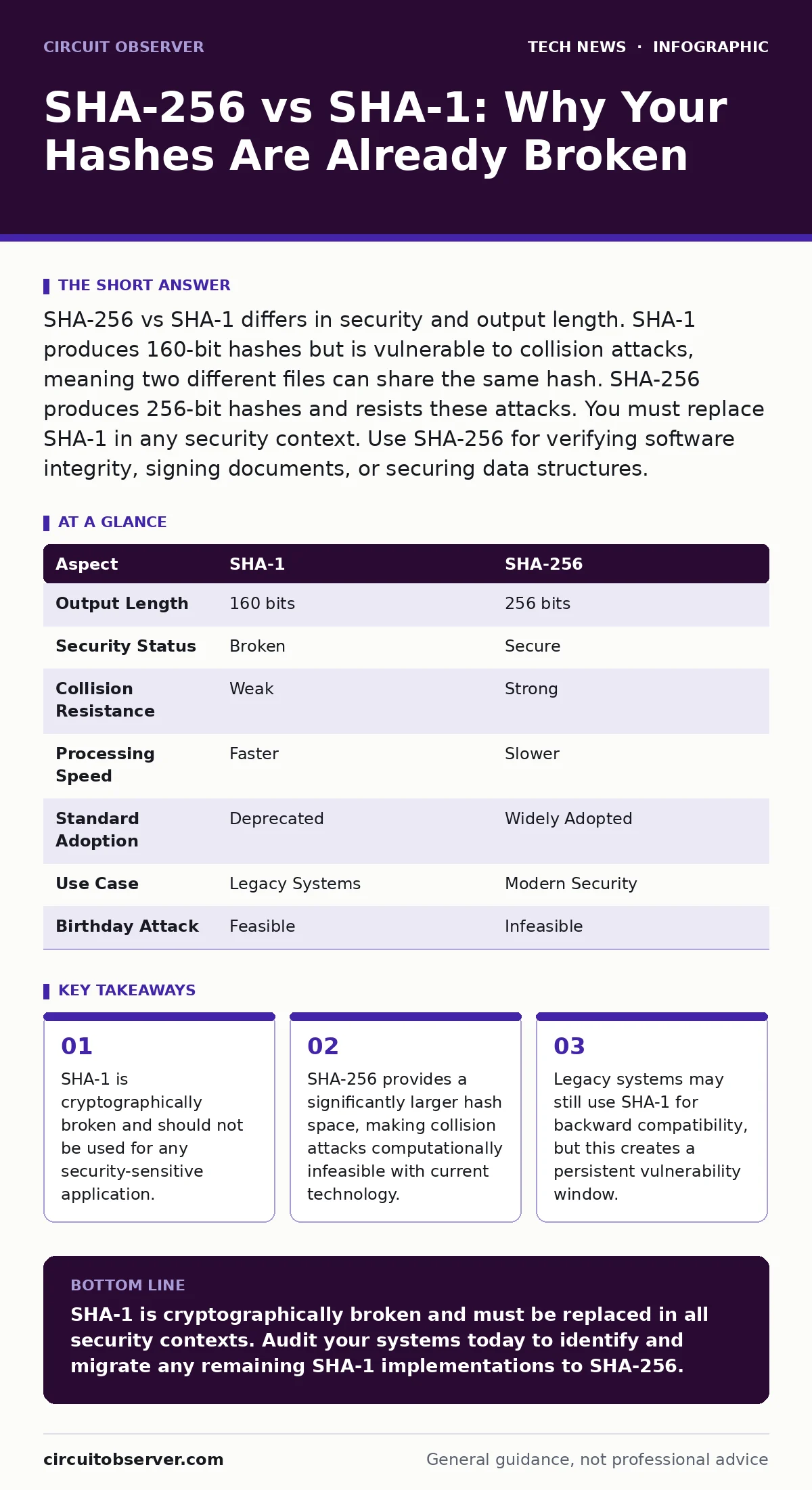
| Aspect | SHA-1 | SHA-256 |
|---|---|---|
| Output Length | 160 bits | 256 bits |
| Security Status | Broken | Secure |
| Collision Resistance | Weak | Strong |
| Processing Speed | Faster | Slower |
| Standard Adoption | Deprecated | Widely Adopted |
| Use Case | Legacy Systems | Modern Security |
| Birthday Attack | Feasible | Infeasible |
When To Choose SHA-256
Choose SHA-256 when you need to verify that data has not been tampered with by a malicious actor. This includes verifying software downloads, creating digital signatures for contracts, or securing password storage. If you are configuring reverse proxies to validate content delivery, use SHA-256 checksums. The slight performance cost is negligible compared to the risk of accepting a forged file. Imagine a scenario where an attacker replaces a legitimate update package with a malicious one. If you use SHA-1, they can craft a matching hash. With SHA-256, they cannot.
See also: Data Center Security Mistakes: Fix These 7 Silent Infrastructure Risks
When To Choose SHA-1
Choose SHA-1 only when you are forced to by legacy system constraints that cannot be updated. Some older hardware devices or proprietary protocols may hardcode SHA-1 for checksums. In these cases, you must isolate the system from untrusted networks. Do not use SHA-1 for any new development. Even if the data is not sensitive, the habit of using broken algorithms creates technical debt. It also complicates auditing. You might think a non-security checksum is harmless, but it erodes the overall security posture.
Where They Overlap
Both algorithms belong to the broader category of cryptographic hashing. They both take variable-length input and produce fixed-length output. They are both deterministic, meaning the same input always produces the same output. They are both relatively fast to compute, which makes them suitable for real-time data verification. However, this speed is a double-edged sword. It allows attackers to perform brute-force attacks more efficiently. This is why understanding the difference between hashing and encryption is vital. Encryption hides data; hashing verifies it.
Mitigating Legacy Risks
If you must support SHA-1 for compatibility, implement strict controls. Use it only for non-critical integrity checks where tampering is not a security threat. Monitor for collision warnings in your logs. Plan a migration path to SHA-256 or SHA-3. Consider using one-time passwords for authentication instead of relying on weak hashes for session management. This reduces the impact of a compromised hash. For mobile device security, ensure that apps do not rely on SHA-1 for certificate pinning. This prevents man-in-the-middle attacks.
Final Recommendations
Transitioning from SHA-1 to SHA-256 is a necessary step for any modern infrastructure. The computational gap between the two is too wide to ignore. SHA-1 is no longer a secure choice for any application where trust matters. SHA-256 provides the necessary margin of safety against current and near-future threats. Review your systems for hidden SHA-1 usage. Check your IP addresses configuration if they rely on certificate validation. Ensure your macOS security settings enforce secure protocols. BitLocker and other disk encryption tools often use SHA-256 for key derivation, which is correct.
Key takeaways
- SHA-1 is cryptographically broken and should not be used for any security-sensitive application.
- SHA-256 provides a significantly larger hash space, making collision attacks computationally infeasible with current technology.
- Legacy systems may still use SHA-1 for backward compatibility, but this creates a persistent vulnerability window.
SHA-1 is cryptographically broken and must be replaced in all security contexts. Audit your systems today to identify and migrate any remaining SHA-1 implementations to SHA-256.
Frequently asked questions
Can I use SHA-1 for non-security purposes?
You can use SHA-1 for non-security purposes like deduplication, but you must accept the risk of accidental collisions. For any data where integrity matters, even slightly, use SHA-256.
Is SHA-256 too slow for real-time applications?
SHA-256 is slightly slower than SHA-1, but modern processors handle it efficiently. The performance difference is negligible for most applications and is outweighed by the security benefits.
What if my software only supports SHA-1?
You should update the software. If that is impossible, isolate the system from untrusted networks and treat all data from it as unverified. Plan for immediate replacement.
Does SHA-256 prevent all types of attacks?
SHA-256 prevents collision and pre-image attacks. It does not prevent brute-force attacks if your input is weak, such as a short password. Always combine hashing with salting and key stretching.
How this guide was produced: written by the Circuit Observer editorial team with AI assistance, checked against the public references listed below, and reviewed when the facts change. See our editorial policy or report an error.