
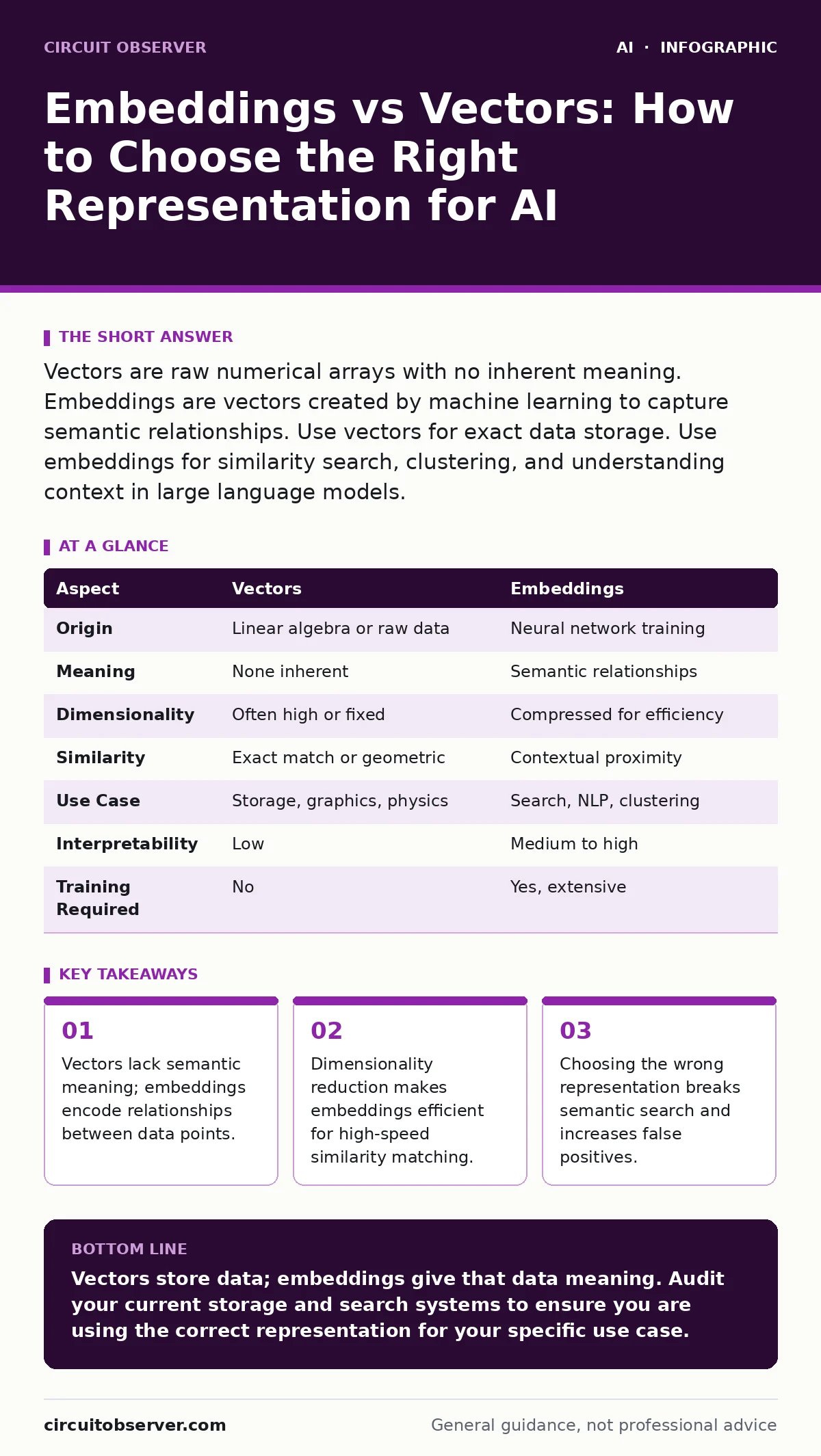
Vectors are raw numerical arrays with no inherent meaning. Embeddings are vectors created by machine learning to capture semantic relationships. Use vectors for exact data storage. Use embeddings for similarity search, clustering, and understanding context in large language models.
The Core Difference Between Embeddings and Vectors
You need to understand that a vector is a mathematical container, while an embedding is a specific type of vector with semantic weight. A vector is simply an ordered list of numbers. It has direction and magnitude in a geometric space, but those numbers do not imply meaning on their own. An embedding is a vector produced by a neural network. That network trains the numbers to represent the meaning of the input data. When you compare two embeddings, the distance between them reflects how similar their meanings are. This distinction matters because it determines how you store, retrieve, and analyze data.
What Each Concept Actually Is
A vector exists in linear algebra. It represents a point in space. In computing, you use vectors for coordinates, pixel values, or sensor readings. The value "5" in the third position of a vector might mean nothing, or it might mean a specific temperature. The vector itself does not know. An embedding maps complex data into a lower-dimensional vector space. The model learns that words like "king" and "queen" should sit close together. It learns that images of cats and dogs should cluster separately. The numbers in an embedding carry the context of the training data. This allows machines to understand nuance rather than just matching exact strings.
Point-by-Point Comparison Table
| Aspect | Vectors | Embeddings |
|---|---|---|
| Origin | Linear algebra or raw data | Neural network training |
| Meaning | None inherent | Semantic relationships |
| Dimensionality | Often high or fixed | Compressed for efficiency |
| Similarity | Exact match or geometric | Contextual proximity |
| Use Case | Storage, graphics, physics | Search, NLP, clustering |
| Interpretability | Low | Medium to high |
| Training Required | No | Yes, extensive |
When to Choose Vectors
You choose raw vectors when you need exact precision without interpretation. If you are storing image pixels, the vector holds the color values. Changing one number changes the image, but it does not change the "meaning" of the picture in a semantic way. You use vectors when performing physics simulations. The velocity vector has magnitude and direction. It does not have context. You also use vectors when building basic lookup tables. If you need to find an exact match for a user ID, a vector representation is efficient and simple. There is no need for a model to guess if two IDs are "similar." They are either identical or they are not.
Choose the first when:
- You require exact numerical precision.
- You are storing raw sensor or pixel data.
- You need fast, deterministic lookups.
When to Choose Embeddings
You choose embeddings when you need to find things that are similar but not identical. Imagine you are building a search engine for security logs. You want to find logs that describe a similar attack pattern, even if the wording differs. An embedding can map "unauthorized access" and "breach of entry" to nearby points in space. A raw vector cannot do this. You also use embeddings when working with large language models. These models convert text into embeddings to understand context. This allows the system to answer questions about intent rather than just keyword matching.
Choose the second when:
- You need semantic similarity search.
- You are clustering related items.
- You are feeding data into large language models.
Where They Overlap and Intersect
Every embedding is a vector, but not every vector is an embedding. This overlap causes confusion in system design. You will often store embeddings in vector databases. These databases are optimized for finding the nearest neighbors in high-dimensional space. The database treats the embedding as a vector for storage purposes. It uses the vector structure to perform fast distance calculations. However, the value comes from the embedding process that created those numbers. You must understand this duality. The storage layer sees vectors. The application layer sees meaning. Confusing these layers leads to performance bottlenecks and inaccurate results.
Practical Implications for Security
In security operations, you use embeddings to detect novel threats. A signature-based system uses exact vectors. It fails if the attacker changes one byte. An embedding-based system looks for behavioral similarity. It can flag a new attack that resembles known patterns. This connects directly to how you handle prompt injection attacks. If you embed user prompts, you can detect malicious intent even if the wording is obfuscated. However, embeddings are not perfect. They can be fooled by adversarial examples. You must combine them with other controls. See our guide on LLM guardrails for strategies to protect these models.
Final Selection Criteria
Your choice depends on your goal. If you need to store and retrieve exact data, use vectors. If you need to understand, compare, or cluster data based on meaning, use embeddings. Do not use embeddings for simple storage. They are larger and require more processing. Do not use vectors for semantic search. They will fail to capture nuance. Test both approaches with your specific data. Measure the recall and precision of your search results. Adjust your dimensionality and training parameters accordingly. Understanding this difference prevents architectural mistakes that are hard to fix later.
Key takeaways
- Vectors lack semantic meaning; embeddings encode relationships between data points.
- Dimensionality reduction makes embeddings efficient for high-speed similarity matching.
- Choosing the wrong representation breaks semantic search and increases false positives.
Vectors store data; embeddings give that data meaning. Audit your current storage and search systems to ensure you are using the correct representation for your specific use case.
Frequently asked questions
Can I use embeddings for exact matching?
No, embeddings are designed for similarity, not exact matches. Use vectors or hash tables for exact matching to ensure precision and speed.
How do I calculate the similarity between embeddings?
You typically use cosine similarity or Euclidean distance. Cosine similarity measures the angle between vectors, ignoring magnitude, which is often better for semantic text data.
Do embeddings require internet access to function?
No, once trained, embeddings can be generated locally. However, many organizations use cloud-based models for generation, which may require network connectivity.
Are embeddings secure against adversarial attacks?
Embeddings can be vulnerable to adversarial examples. You must implement robust validation and monitoring, similar to the controls discussed in AI governance frameworks.
How this guide was produced: written by the Circuit Observer editorial team with AI assistance, checked against the public references listed below, and reviewed when the facts change. See our editorial policy or report an error.