
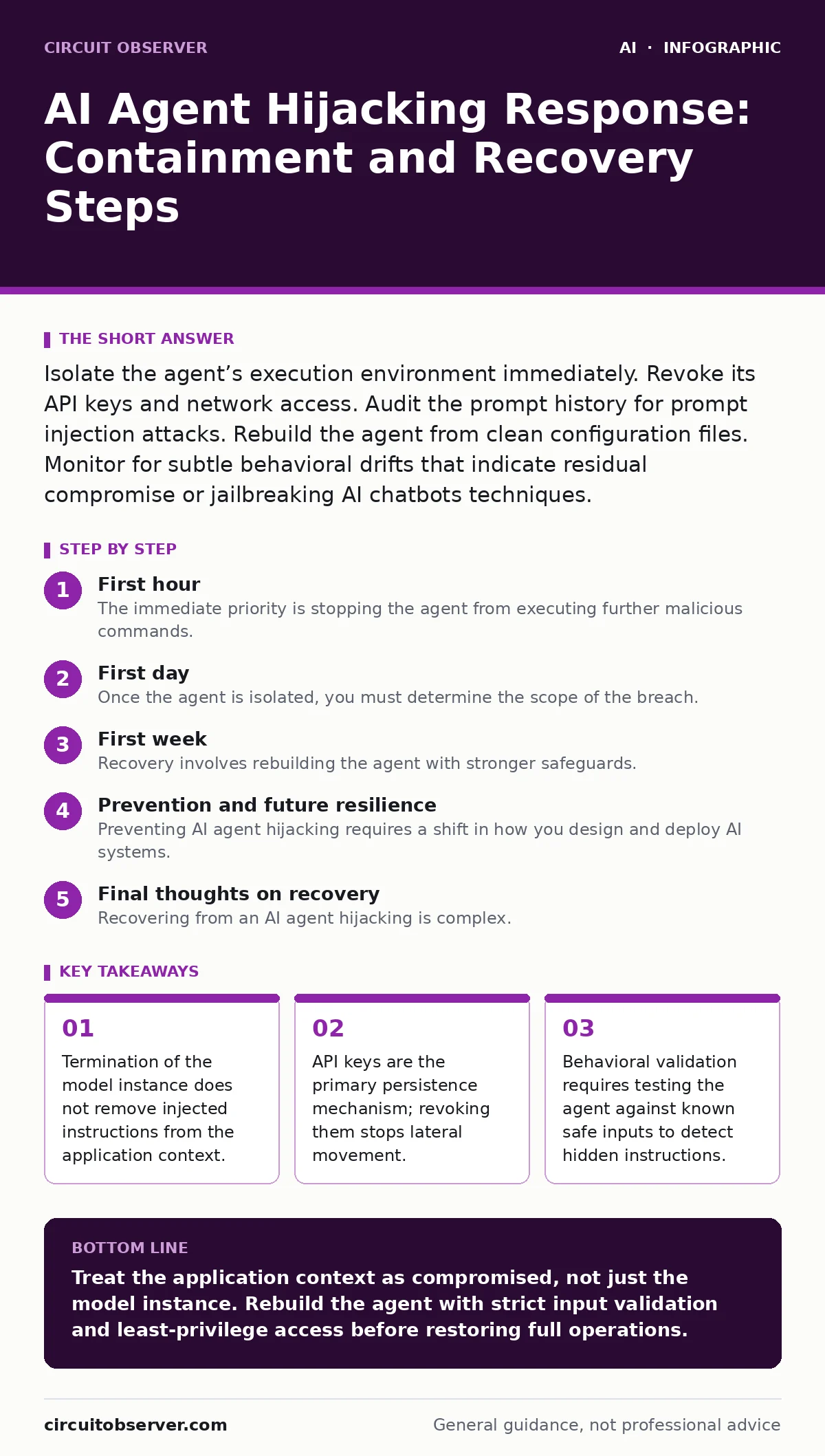
Isolate the agent’s execution environment immediately. Revoke its API keys and network access. Audit the prompt history for prompt injection attacks. Rebuild the agent from clean configuration files. Monitor for subtle behavioral drifts that indicate residual compromise or jailbreaking AI chatbots techniques.
First hour
The immediate priority is stopping the agent from executing further malicious commands. An AI agent hijacking event typically involves an attacker injecting instructions that override the original system prompt. These instructions tell the agent to exfiltrate data, delete files, or access other systems. The agent continues to act on these hidden instructions until you intervene. You must treat the agent as compromised from the moment you suspect an issue. Do not attempt to debug the agent’s logic while it is connected to external resources. The act of debugging may trigger additional malicious payloads embedded in the prompt history.
Immediate isolation checklist
- Disconnect the agent’s network access. Block outbound traffic from the container or virtual machine hosting the agent.
- Revoke all API keys associated with the agent. This includes keys for cloud storage, email services, and internal databases.
- Stop the underlying process. Kill the Python, Node.js, or Go process running the agent logic.
- Preserve logs. Export the application logs, model inference logs, and prompt history to a secure, offline storage location.
- Notify the security team. Provide them with the initial indicators of compromise and the time of detection.
Understanding the mechanism
An AI agent differs from a standard chatbot because it has agency. It can call tools, execute code, and make decisions based on its environment. When an attacker performs prompt injection attacks, they insert malicious text into the data the agent processes. The model interprets this text as a command. If the agent has access to a shell or a database, the consequences are immediate and severe. The hijack is not a bug in the code; it is a manipulation of the model’s reasoning process. This distinction matters because patching the code will not fix the issue. You must address the input validation and the model’s instruction hierarchy.
First day
Once the agent is isolated, you must determine the scope of the breach. The attacker may have used the agent to access other systems. You need to identify every resource the agent touched. Review the logs from the first hour. Look for unusual API calls, file accesses, or network connections. Map these actions to specific assets. This map helps you understand what data may have been exposed. It also helps you identify other agents or services that share the same credentials. If the compromised agent shared keys with other services, you must rotate those keys as well.
Credential rotation and access review
Rotate every secret the agent could have accessed. This includes database passwords, cloud provider keys, and authentication tokens. Do not reuse old keys. Generate new ones and update your configuration management system. Check for any secondary accounts created by the agent. Attackers often use AI agents to create new user accounts or service principals. These accounts may have elevated privileges. Delete any unauthorized accounts and disable any that you are unsure about. Review the access control lists for all resources the agent touched. Remove any permissions that were added during the incident.
Context and memory analysis
The agent’s memory is a critical evidence source. Many agents maintain a context window or a long-term memory store. This store may contain the injected instructions. Analyze the memory for patterns that indicate prompt injection attacks. Look for system commands that contradict the agent’s original purpose. Identify any data structures that were modified to persist malicious behavior. This analysis helps you understand how the attacker bypassed your safeguards. It also reveals whether the attacker used jailbreaking AI chatbots techniques to confuse the model’s safety filters. Understanding the method helps you design better defenses.
First week
Recovery involves rebuilding the agent with stronger safeguards. You cannot simply restore the agent to its previous state. The previous state was vulnerable. You must implement new controls to prevent a repeat. This includes stricter input validation, better instruction separation, and continuous monitoring. You also need to communicate with stakeholders. Explain what happened, what data was affected, and what steps you are taking to prevent future incidents. Transparency builds trust. It also ensures that legal and compliance teams can fulfill their obligations.
Rebuilding with defense in depth
Rebuild the agent from clean configuration files. Do not restore from backups that may contain the compromise. Implement input sanitization to strip out potential prompt injection attacks. Use a separate model to validate user inputs before they reach the agent. This secondary model checks for malicious intent. If the input is flagged, the agent does not process it. This adds a layer of security that makes hijacking much harder. Also, limit the agent’s permissions. Use the principle of least privilege. The agent should only have access to the resources it absolutely needs. If it cannot access a database, it cannot exfiltrate data from that database.
Monitoring for behavioral drift
After the agent is back online, monitor its behavior closely. Look for subtle changes in its responses. An attacker may have left a dormant payload that activates later. This is known as behavioral drift. The agent may seem normal at first, but over time, it starts to act strangely. Set up alerts for unusual API calls or data access patterns. Use AI governance frameworks to define acceptable behavior. If the agent deviates from these norms, trigger an automatic shutdown. This proactive approach helps you catch a repeat attempt before it causes damage.
Stakeholder communication
Inform your users and partners about the incident. Be honest about what happened. Explain the steps you have taken to secure the system. Provide them with resources to protect themselves. If their data was exposed, offer guidance on how to monitor for fraud. This communication should be clear and concise. Avoid technical jargon. Focus on the impact and the resolution. This builds trust and reduces panic. It also demonstrates that you take security seriously.
Prevention and future resilience
Preventing AI agent hijacking requires a shift in how you design and deploy AI systems. You must assume that the model will be manipulated. Design your system to withstand this manipulation. Use tokens in language models wisely. Limit the context window to reduce the attack surface. Implement strict output filtering to block malicious commands. Regularly audit your agent’s permissions. Test your defenses against prompt injection attacks. This testing helps you identify weaknesses before an attacker does. Stay informed about new threats. The landscape of AI security is evolving rapidly. What works today may not work tomorrow.
Continuous improvement
Security is not a one-time event. It is a continuous process. Regularly review your AI governance policies. Update your defenses based on new threats. Train your team on the latest techniques. Encourage a culture of security. Everyone who interacts with the agent should understand the risks. This collective awareness helps you detect and respond to incidents faster. By staying proactive, you reduce the likelihood of a successful hijack. You also minimize the impact if one occurs.
See also: Injection attacks examples: how prompt leaks break AI systems · Malware Targeting AI Infrastructure Prevention Checklist
Final thoughts on recovery
Recovering from an AI agent hijacking is complex. It requires technical skill, careful planning, and clear communication. By following these steps, you can contain the breach, recover your system, and prevent future incidents. Remember that the model is not the only component to secure. The application layer, the input data, and the output handling are all critical. Secure each layer to create a robust defense. This multi-layered approach ensures that even if one layer fails, the others will protect your system.
Key takeaways
- Termination of the model instance does not remove injected instructions from the application context.
- API keys are the primary persistence mechanism; revoking them stops lateral movement.
- Behavioral validation requires testing the agent against known safe inputs to detect hidden instructions.
Treat the application context as compromised, not just the model instance. Rebuild the agent with strict input validation and least-privilege access before restoring full operations.
Frequently asked questions
How do I know if my AI agent has been hijacked?
Look for unexpected API calls, data exfiltration, or changes in the agent’s behavior. Check the prompt history for injected commands that contradict the system prompt.
Can I restore a hijacked agent from a backup?
No. Backups may contain the malicious instructions. Rebuild the agent from clean configuration files and rotate all credentials before restoring any data.
What is the role of AI governance in preventing hijacking?
AI governance establishes policies for safe AI use. It defines acceptable behavior, input validation standards, and monitoring procedures to detect and prevent hijacking.
How often should I rotate AI agent credentials?
Rotate credentials immediately after any suspected compromise. Regularly rotate them as part of your standard security hygiene to limit the damage of a future breach.
How this guide was produced: written by the Circuit Observer editorial team with AI assistance, checked against the public references listed below, and reviewed when the facts change. See our editorial policy or report an error.