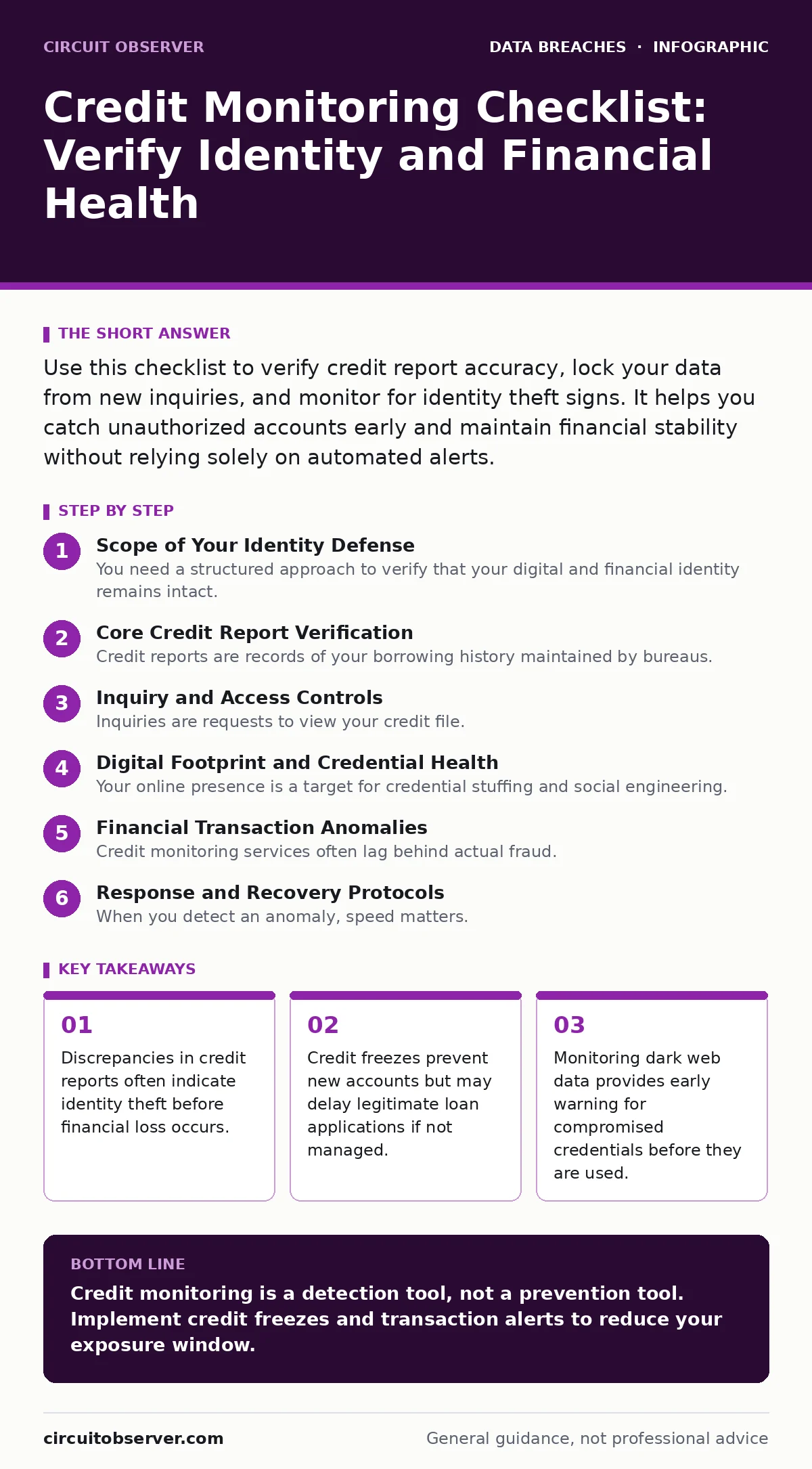
Use this checklist to verify credit report accuracy, lock your data from new inquiries, and monitor for identity theft signs. It helps you catch unauthorized accounts early and maintain financial stability without relying solely on automated alerts.
Scope of Your Identity Defense
You need a structured approach to verify that your digital and financial identity remains intact. This checklist applies to anyone managing personal or organizational identity assets. It moves beyond basic alerts to verify the underlying data integrity.
Core Credit Report Verification
Credit reports are records of your borrowing history maintained by bureaus. Errors here can signal identity theft or administrative failure. You must verify that every entry matches your actual activity.
- Verify every open account listed: unauthorized accounts may appear with slight name variations to bypass simple name-matching filters.
- Check for closed accounts listed as open: a hacker may reopen a dormant account to establish credit history for fraud.
- Review public records for judgments or liens: identity thieves sometimes use your identity to incur legal judgments that damage your score.
- Confirm employment history matches your records: fraudsters often add fake employment to support loan applications for stolen identities.
Inquiry and Access Controls
Inquiries are requests to view your credit file. Hard inquiries occur when you apply for credit and can lower your score. Soft inquiries do not affect your score but still indicate access.
- Audit hard inquiries for the past two years: any inquiry you did not personally initiate suggests someone is testing your credit limits.
- Place credit freezes with all bureaus: this prevents new accounts from being opened, but you must remember to unfreeze them when you legitimately apply for credit.
- Enable fraud alerts on your files: these alerts require lenders to verify your identity before issuing credit, adding a layer of friction for attackers.
- Monitor for soft inquiry spikes: a sudden increase may indicate a marketing list leak or a sophisticated actor probing your profile.
- Review authorized users on joint accounts: removing former spouses or business partners is critical to prevent lingering access to your credit.
Digital Footprint and Credential Health
Your online presence is a target for credential stuffing and social engineering. Compromised credentials often precede financial fraud.
- Check for exposed email addresses in breaches: services like Have I Been Pwned can tell you if your email appeared in known data dumps.
- Rotate passwords for financial accounts immediately: reuse across sites allows a breach on a minor site to compromise your bank login.
- Enable multi-factor authentication on all financial apps: this adds a second verification step that attackers cannot bypass with just a password.
- Review session management on banking apps: ensure you are logged out of shared devices to prevent session hijacking.
- Monitor for new device logins: banks often alert you when a login occurs from a new browser or operating system.
Financial Transaction Anomalies
Credit monitoring services often lag behind actual fraud. Real-time transaction monitoring is more effective for catching immediate theft.
- Set up transaction alerts for all credit cards: receive instant notifications for any charge, regardless of amount, to catch small test transactions.
- Monitor for changes to your mailing address: identity thieves often redirect mail to intercept verification codes and new cards.
- Check for unauthorized changes to payment methods: attackers may update your default payment method on subscription services to divert funds.
- Verify utility and phone bill payments: late payments can damage your credit score and signal that someone has access to your accounts.
See also: Insider Data Theft: Early Signs and Detection Strategies · Protected Health Information: 6 Common Misreadings That Increase Risk
Response and Recovery Protocols
When you detect an anomaly, speed matters. Having a plan reduces the time attackers have to cause damage.
- Freeze credit immediately upon suspicion: this stops new accounts from being opened while you investigate.
- File an identity theft report with law enforcement: this document is often required by banks to dispute fraudulent charges.
- Contact creditors to close compromised accounts: do not just change passwords; close the account to prevent further unauthorized access.
- Dispute inaccurate entries with credit bureaus: provide evidence of the error and request removal within the statutory timeframe.
- Monitor for synthetic identity fraud: attackers may combine your real SSN with a fake name, creating a new identity that is hard to detect.
Key takeaways
- Discrepancies in credit reports often indicate identity theft before financial loss occurs.
- Credit freezes prevent new accounts but may delay legitimate loan applications if not managed.
- Monitoring dark web data provides early warning for compromised credentials before they are used.
Credit monitoring is a detection tool, not a prevention tool. Implement credit freezes and transaction alerts to reduce your exposure window.
Frequently asked questions
Does credit monitoring prevent identity theft?
No, it only detects signs of theft after they have occurred. Prevention requires freezing credit and using strong authentication methods.
How often should I check my credit reports?
Check them at least quarterly. More frequent checks help you catch small errors or anomalies before they escalate into major fraud.
Is a credit freeze better than a fraud alert?
A credit freeze is stronger because it blocks all new credit applications. A fraud alert only requires lenders to verify your identity, which some may skip.
What if I find an error on my credit report?
Dispute it immediately with the credit bureau. Provide supporting documentation and follow up to ensure the error is corrected within the legal timeframe.
How this guide was produced: written by the Circuit Observer editorial team with AI assistance, checked against the public references listed below, and reviewed when the facts change. See our editorial policy or report an error.