
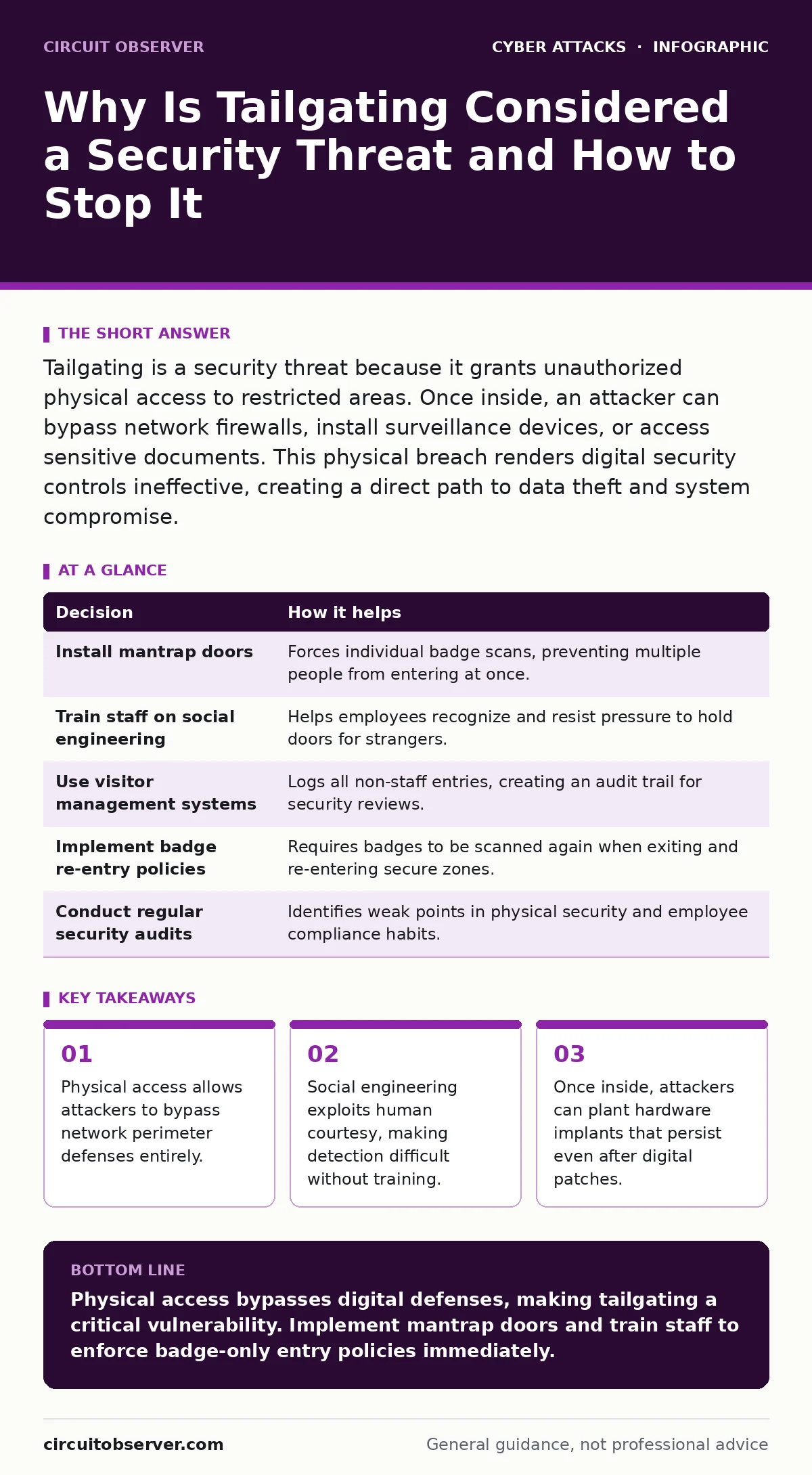
Tailgating is a security threat because it grants unauthorized physical access to restricted areas. Once inside, an attacker can bypass network firewalls, install surveillance devices, or access sensitive documents. This physical breach renders digital security controls ineffective, creating a direct path to data theft and system compromise.
Why Is Tailgating Considered a Security Threat
Tailgating is considered a security threat because it circumvents the physical security layer that protects your digital infrastructure. Most organizations invest heavily in firewalls, encryption, and multi-factor authentication. These digital controls assume that only authorized personnel can physically reach the devices.
When an unauthorized person walks behind an employee through a secured door, that assumption fails. The attacker gains proximity to servers, workstations, and network ports. This proximity allows for direct hardware manipulation that remote attacks cannot achieve. The threat is not just about entering a building. It is about gaining the physical leverage needed to compromise systems from the inside.
Physical access is the final barrier between an attacker and your data. Digital defenses protect data in transit and at rest. They do not protect the physical device holding that data. An attacker who tailgates into a server room can plug in a malicious device. They can install a hardware keylogger on a manager’s keyboard. They can photograph whiteboards with system diagrams. These actions require no network connection. They require no password. They require only the momentary lapse of judgment by an employee who holds the door open.
The Human Element of Physical Breaches
Security protocols often fail because they rely on human compliance rather than mechanical enforcement. Employees are trained to be helpful and polite. Holding a door open for someone carrying boxes is a social norm. This norm conflicts with the security requirement to verify identity before granting access. Attackers exploit this conflict. They dress appropriately, carry convincing props like laptop bags or delivery boxes, and act confident. This behavior triggers a psychological response in employees. The employee feels social pressure to comply. They assume the person behind them is authorized because they look the part.
This social engineering tactic is effective because it targets empathy, not ignorance. Employees know the rules. They choose to ignore them to avoid awkwardness. The attacker does not need to pick a lock. They do not need to hack a badge reader. They simply walk through an open door. This method is low-risk for the attacker. If challenged, they can claim they forgot their badge. The employee, wanting to be nice, lets them in. The security breach occurs without any technical exploit.
Hidden Costs of Physical Access
The immediate cost of tailgating is the breach itself. The hidden costs are the long-term consequences that follow. Once an attacker is inside, they can move laterally through the network. They can access internal systems that are not exposed to the internet. These internal systems often have weaker defenses because administrators assume they are safe from external threats. The attacker can install cryptomining attacks on exposed servers that are only visible on the local network. This creates a persistent presence that is difficult to detect.
Another hidden cost is the erosion of security culture. When tailgating is tolerated, employees begin to view other security measures as optional. They may reuse passwords or ignore software updates. The physical breach signals that the organization does not take security seriously. This cultural shift makes other attacks, such as invoice fraud or domain spoofing, more likely to succeed. Employees become less vigilant overall. The organization loses the defensive depth needed to stop determined attackers.
What Goes Wrong When Controls Fail
When physical access controls fail, the attacker gains a foothold. This foothold allows them to bypass many digital security measures. For example, they can bypass two-factor authentication by resetting passwords on a local machine. They can install keyloggers to capture credentials as they are typed. They can photograph notes with passwords written on sticky notes. These actions are impossible to prevent with software alone. Software cannot see what is happening in the physical room.
The attacker can also disconnect security cameras or disable alarms. They can tamper with hardware security keys that are left on desks. They can access backup tapes or hard drives that are stored in the office. The range of possible actions is limited only by the attacker’s skill and time. The organization has no way to know the breach occurred until data is stolen or systems are damaged. By then, the attacker has already covered their tracks.
Decision | How it helps
| Decision | How it helps |
|---|---|
| Install mantrap doors | Forces individual badge scans, preventing multiple people from entering at once. |
| Train staff on social engineering | Helps employees recognize and resist pressure to hold doors for strangers. |
| Use visitor management systems | Logs all non-staff entries, creating an audit trail for security reviews. |
| Implement badge re-entry policies | Requires badges to be scanned again when exiting and re-entering secure zones. |
| Conduct regular security audits | Identifies weak points in physical security and employee compliance habits. |
See also: AI-Generated Phishing: How Models Bypass Human Detection · Difference Between Unauthorized Access and Unauthorized Use Explained
Mitigating the Risk of Tailgating
Mitigating tailgating requires a combination of physical controls and cultural change. Physical controls include mantrap doors, turnstiles, and badge readers that require individual entry. These mechanisms enforce the rule that only one person can enter at a time. They remove the burden from employees to make security decisions. The door itself becomes the enforcer. This reduces the social pressure on employees. They do not need to confront strangers. The door does it for them.
Cultural change involves training employees to understand the risks. Training should not just list rules. It should explain the consequences of tailgating. Employees need to know that holding a door open can lead to data theft. They need to practice refusing entry to unbadged individuals. This practice builds confidence. It makes it easier to say no in real situations. Organizations should also reward employees who report suspicious behavior. This reinforces the importance of physical security.
Integrating Physical and Digital Security
Physical security is not separate from digital security. They are interconnected layers of defense. A breach in one layer compromises the other. Organizations must integrate their security strategies. This means treating physical access logs as important as network logs. It means investigating physical anomalies with the same rigor as digital anomalies. When an employee reports a stranger in the office, it should trigger a security review. This review should include checking network access logs for that time period.
Integration also means using technology to support physical security. Video analytics can detect tailgating attempts. Badge readers can alert security if multiple badges are scanned in quick succession. These alerts provide real-time visibility into physical breaches. They allow security teams to respond immediately. This proactive approach stops attackers before they can cause damage. It also provides evidence for post-incident analysis.
Building a Resilient Security Culture
A resilient security culture accepts that breaches will happen. It focuses on detection and response. This mindset applies to physical security as well. Organizations should assume that tailgating will occur. They should design their security to limit the damage. This includes segmenting networks so that physical access to one area does not grant access to all systems. It includes monitoring for unusual activity on internal networks.
Employees play a key role in this culture. They are the first line of defense. They see what cameras and sensors miss. They can report suspicious behavior in real time. Organizations must empower them to act. This means providing clear guidelines on what to do if they see someone tailgating. It means supporting them when they enforce these rules. A strong security culture protects the organization from both digital and physical threats.
Key takeaways
- Physical access allows attackers to bypass network perimeter defenses entirely.
- Social engineering exploits human courtesy, making detection difficult without training.
- Once inside, attackers can plant hardware implants that persist even after digital patches.
Physical access bypasses digital defenses, making tailgating a critical vulnerability. Implement mantrap doors and train staff to enforce badge-only entry policies immediately.
Frequently asked questions
How do I stop tailgating without annoying employees?
Use automated physical controls like mantrap doors that enforce individual entry. This removes the social burden from employees while maintaining security.
Can software prevent tailgating?
No, software cannot prevent physical entry. However, network segmentation can limit the damage an attacker causes once inside.
What is the difference between tailgating and piggybacking?
Tailgating is when an unauthorized person follows without permission. Piggybacking is when an authorized person invites them in. Both result in unauthorized access.
How do I audit physical security?
Review badge logs, camera footage, and employee reports. Look for patterns of multiple entries or after-hours access that does not match staffing schedules.
How this guide was produced: written by the Circuit Observer editorial team with AI assistance, checked against the public references listed below, and reviewed when the facts change. See our editorial policy or report an error.