Domain spoofing tricks recipients into trusting a fake sender by forging address headers. You stop it by enforcing strict authentication protocols that verify the sender’s identity cryptographically, not just by looking at the display name or email address surface text.
What is domain spoofing?
Domain spoofing is the act of forging an email header or website address to impersonate a trusted entity. The attacker creates a message that appears to come from a legitimate source, such as your organization or a known vendor. This deception relies on the fact that most email clients display only the "From" name, which is easily manipulated. The actual technical origin of the message is hidden in the header data.
How does domain spoofing differ from phishing?
Spoofing is the technical method used to create a false identity, while phishing is the broader social engineering campaign that uses that identity. You can have spoofing without phishing if the goal is purely to bypass technical filters. However, most attackers combine the two to trick users into clicking malicious links. Understanding this distinction helps you focus on both technical controls and user awareness.
Why can’t I just check the sender’s email address?
The email address you see in your inbox is just a label, not a proof of origin. Attackers can set this label to anything they want, including exact copies of executive names or IT support addresses. The true source of the email is contained in the SMTP envelope, which is rarely visible to the average user. Relying on visual cues is a security failure because the interface lies by design.
What is typosquatting and how does it relate?
Typosquatting involves registering domain names that are slight misspellings of popular brands or your own organization. If your domain is company.com, an attacker might register conpany.com or company.co. Users often type these errors manually, landing directly on the attacker’s site. This is a form of domain spoofing that bypasses email filters entirely because it targets the browser’s address bar. Imagine typing a bank’s URL and missing one letter; you are now on a fake site that looks identical.
How do DMARC, SPF, and DKIM work together?
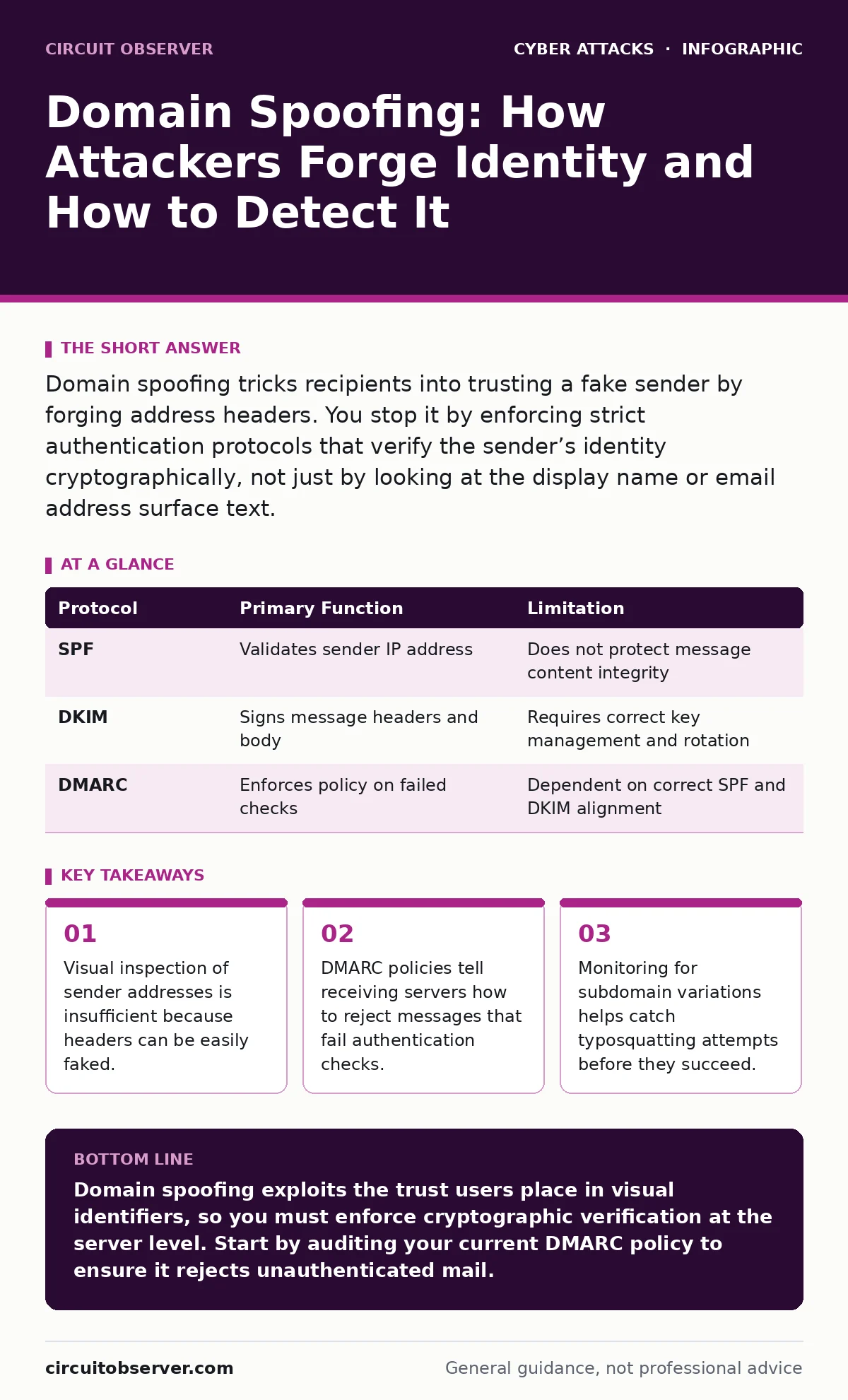
These three protocols form the standard defense against email spoofing. SPF (Sender Policy Framework) lists the IP addresses authorized to send mail for your domain. DKIM (DomainKeys Identified Mail) adds a cryptographic signature to each message, proving it was not altered in transit. DMARC (Domain-based Message Authentication, Reporting, and Conformance) tells receiving servers what to do if SPF or DKIM fail. Without DMARC, the other two are merely advisory.
| Protocol | Primary Function | Limitation |
|---|---|---|
| SPF | Validates sender IP address | Does not protect message content integrity |
| DKIM | Signs message headers and body | Requires correct key management and rotation |
| DMARC | Enforces policy on failed checks | Dependent on correct SPF and DKIM alignment |
See also: OSI Model Acronym: What Each Layer Does for Your Network Security · What Is a Vishing Attack: How Voice Phishing Bypasses Security
Can attackers bypass these protections?
Yes, by using subdomain spoofing or compromised third-party services. If you authorize a marketing platform to send emails via SPF, an attacker who compromises that platform can send spoofed mail that passes checks. This is why privileged access management is critical for any service that sends outbound communication. Additionally, attackers may use a completely different domain that looks similar visually, bypassing technical checks but failing user scrutiny.
How do I detect a spoofed domain in my logs?
Look for discrepancies between the "From" header and the Return-Path or HELO hostname. In your email filtering logs, identify messages where the claimed domain does not match the authenticated identity. Pay attention to spikes in failed authentication attempts from specific IP ranges. These patterns often indicate an attacker testing your defenses before launching a larger campaign. This detection method complements standard eavesdropping attacks monitoring by focusing on origin validation.
What is the impact of a successful spoofing attack?
A successful spoof can lead to invoice fraud, where attackers redirect payments to their own accounts. It can also facilitate gift card scams by impersonating HR or IT requesting gift card codes as "emergency credentials." Beyond financial loss, it erodes trust in your communications channel. Employees may begin ignoring legitimate alerts, fearing they are fake. This secondary effect is often more damaging than the initial breach.
How do I stop domain spoofing effectively?
Start by publishing strict SPF and DKIM records for all your domains, including subdomains. Then, implement a DMARC policy that moves from monitoring to rejection over time. Regularly audit your third-party senders to ensure their IPs are correctly listed in your SPF records. Educate users to look for subtle domain differences, such as .co instead of .com. Finally, integrate these checks with your cyber incident response team procedures to automate the blocking of malicious sources.
Key takeaways
- Visual inspection of sender addresses is insufficient because headers can be easily faked.
- DMARC policies tell receiving servers how to reject messages that fail authentication checks.
- Monitoring for subdomain variations helps catch typosquatting attempts before they succeed.
Domain spoofing exploits the trust users place in visual identifiers, so you must enforce cryptographic verification at the server level. Start by auditing your current DMARC policy to ensure it rejects unauthenticated mail.
Frequently asked questions
Does HTTPS prevent domain spoofing?
HTTPS encrypts the connection but does not verify that the domain owner authorized the content. You can have a secure connection to a perfectly spoofed site if you mistyped the URL or clicked a bad link.
Can I spoof my own domain for testing?
Only if your DMARC policy allows it. Most strict policies will reject your own test emails if they do not pass SPF and DKIM alignment, so you must configure test exceptions carefully.
What is the difference between spoofing and replay attacks?
Spoofing creates a fake identity, while replay attacks capture and resend legitimate traffic. Spoofing tricks the recipient about who is speaking; replay tricks the system about when and if the message was new.
How long does it take to set up DMARC?
It depends on your DNS propagation and the complexity of your third-party senders. You can publish a monitoring policy in minutes, but a full rejection policy may take weeks to tune without blocking legitimate mail.
How this guide was produced: written by the Circuit Observer editorial team with AI assistance, checked against the public references listed below, and reviewed when the facts change. See our editorial policy or report an error.