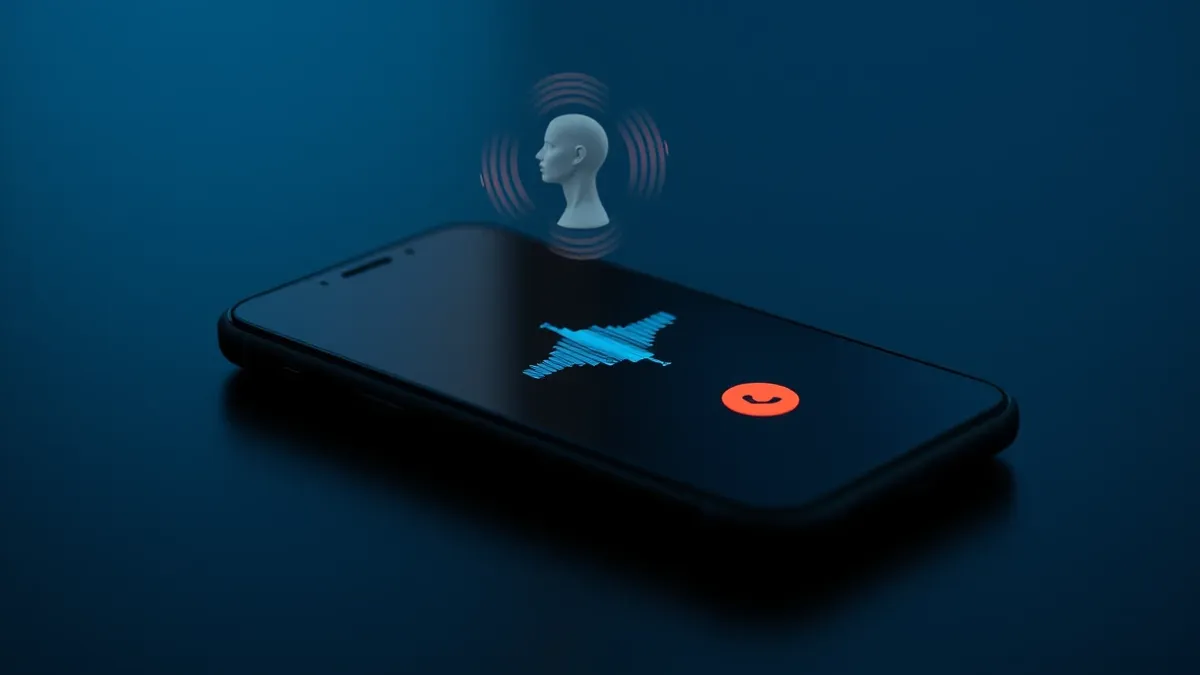
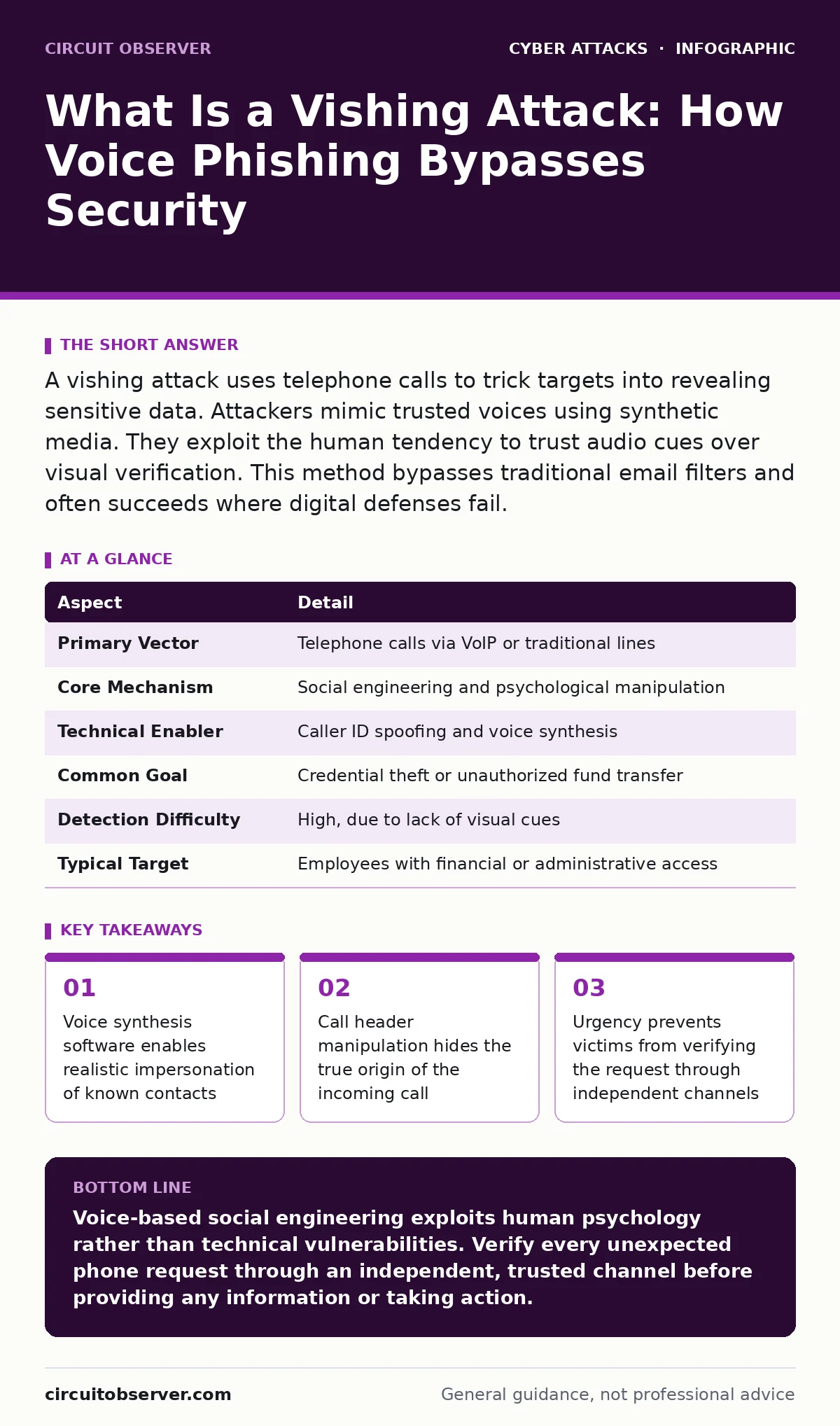
A vishing attack uses telephone calls to trick targets into revealing sensitive data. Attackers mimic trusted voices using synthetic media. They exploit the human tendency to trust audio cues over visual verification. This method bypasses traditional email filters and often succeeds where digital defenses fail.
The Mechanics of Deception
Imagine a bank teller who verifies your identity solely by hearing your voice. Now imagine that voice is generated by an algorithm trained on public social media clips. This is the core mechanism of a vishing attack. The attacker does not need to hack a server or exploit a software vulnerability. They exploit the psychological weight of human speech. When you hear a familiar tone or accent, your brain lowers its defensive barriers. This biological response is hardwired and difficult to override with training alone.
The attacker uses Voice over IP (VoIP) technology to route calls through multiple countries. This routing obscures the true source of the call. Standard caller ID displays a local number or a recognizable corporate prefix. This technique is called caller ID spoofing. It makes the call appear legitimate before you even answer. The attacker then uses pre-recorded scripts or live improvisation to create a scenario that demands immediate action.
What Is a Vishing Attack
A vishing attack is a social engineering campaign conducted over the telephone. The term combines "voice" and "phishing." The goal is identical to email phishing: stealing credentials, installing malware, or transferring funds. The medium is different. Audio provides a richer channel for manipulation than text. An attacker can hear your hesitation, your confusion, or your compliance. They adjust their pitch, speed, and urgency in real-time based on your vocal reactions. This dynamic interaction makes the deception more effective than static messages.
The attack often begins with reconnaissance. The attacker gathers details about you from public records, social media, or previous data breaches. They know your manager's name, your project deadlines, and your banking institution. When the call comes, they use this information to build credibility. They do not ask for your password immediately. They ask for confirmation of facts you already know. This builds trust before the request for sensitive data arrives.
| Aspect | Detail |
|---|---|
| Primary Vector | Telephone calls via VoIP or traditional lines |
| Core Mechanism | Social engineering and psychological manipulation |
| Technical Enabler | Caller ID spoofing and voice synthesis |
| Common Goal | Credential theft or unauthorized fund transfer |
| Detection Difficulty | High, due to lack of visual cues |
| Typical Target | Employees with financial or administrative access |
The Hidden Cost of Trust
Most organizations invest heavily in digital security. They deploy firewalls, intrusion detection systems, and encryption. They rarely invest in training staff to recognize synthetic voices. This creates a blind spot. An attacker can bypass all digital controls by simply calling the help desk. The help desk agent hears a voice that sounds like the CEO. The request seems reasonable. The agent complies. The security controls never trigger because no malicious code entered the network.
The cost of this failure is not just the immediate theft. It is the erosion of verification protocols. Once a vishing attack succeeds, the organization realizes that voice is an unreliable authenticator. They must then implement stricter procedures for verbal requests. This slows down operations. It creates friction between departments. Employees become hesitant to follow urgent instructions, even when they are legitimate. The attacker has changed the behavior of the target organization without touching a single server.
EXAMPLE: The Synthetic Executive
Suppose you work in the finance department. Your phone rings. The caller ID shows the office number of your regional director. You answer. The voice sounds exactly like your director, but slightly stressed. He says he is in a meeting and cannot use his computer. He needs you to process an urgent vendor payment to avoid a service interruption. He provides the vendor details. He asks you to bypass the standard approval workflow because the system is slow. You hesitate. He raises his voice slightly, mentioning a penalty fee. You process the payment. The money is gone. The voice was generated by software. The caller ID was spoofed. The payment was irreversible.
Who Bears the Risk
Vishing attacks target anyone with access to resources. This includes employees, contractors, and even customers. However, certain roles are more valuable to attackers. Finance staff control money. IT staff control access. Executive assistants control schedules and communications. Attackers prioritize these roles because the payoff is higher. They do not care about your job title. They care about your permissions.
Small businesses are often seen as easy targets. They may lack dedicated security teams. They may have fewer verification steps. However, large enterprises are not safe. They have complex hierarchies and many points of contact. An attacker can pick a low-level employee and work their way up the chain. They use the employee's credentials to access higher-level systems. The initial vishing call is just the entry point. The real damage happens after the credentials are stolen.
See also: AI-Generated Phishing: How Models Bypass Human Detection · Hardware Security Keys: 6 Misconceptions That Weaken Your Defense
Common Misconceptions About Vishing
Many people believe that vishing is rare. They think it is a legacy threat from the early days of the internet. This is incorrect. The technology has improved. Voice synthesis is now accessible and affordable. The attacks are more sophisticated. Another misconception is that caller ID is reliable. It is not. Caller ID can be manipulated with minimal effort. Do not trust the number on your screen. Trust the verification process you establish independently.
Some users think that hanging up is enough protection. It is not. Attackers will call back. They will try different angles. They will wait for a moment when you are distracted. You must treat every unsolicited call from an unknown or unexpected source as suspicious. You must verify the identity of the caller through a separate channel. Do not use the number provided by the caller. Use a number you already have on file.
Verification Strategies That Work
To defend against vishing, you must change how you handle phone requests. The first step is to never provide sensitive information over the phone. This includes passwords, one-time codes, and personal identification numbers. Legitimate organizations will not ask for this information via an inbound call. If they do, they are lying.
The second step is to verify the caller's identity. If someone claims to be from your IT department, hang up. Call the IT department using the official number listed on the company website. Do not use the number on your caller ID. Do not use the number the caller provides. Use a known, trusted source. This breaks the attacker's chain of deception.
The third step is to implement multi-factor authentication. This ensures that even if an attacker steals your password, they cannot access your account. They need the second factor, which is usually a physical device or a cryptographic key. Hardware security keys provide strong protection against this type of credential theft. They cannot be phished via phone because they require physical presence.
Technical Defenses for Organizations
Organizations must deploy technical controls to reduce the risk of vishing. Call authentication protocols help verify the origin of a call. These protocols use digital signatures to prove that the caller ID has not been tampered with. While not all carriers support these protocols, adopting them where possible adds a layer of security.
Rate limiting can help detect automated calling campaigns. If a single number makes an unusual number of calls in a short period, the system can flag or block those calls. This is similar to how bot protection works on websites. It identifies abnormal behavior patterns.
Domain spoofing protections are also relevant. Attackers often use email to follow up on phone calls. They send a message that appears to come from a trusted domain. Implementing strict email authentication policies prevents this. It ensures that emails claiming to be from your organization actually originate from your servers.
Integrating Security Practices
Security is not a single tool. It is a set of habits. You must combine technical controls with human awareness. Use passkeys where possible. They eliminate the need for passwords, which are often the target of vishing attacks. If you do not have a password, the attacker cannot steal it.
Be aware of cryptomining attacks on exposed servers. While not directly related to vishing, these attacks indicate that your infrastructure may be vulnerable. If your servers are exposed, attackers may use them to host malicious content or launch further attacks. Secure your infrastructure to reduce the attack surface.
CAPTCHA mechanisms can help protect web forms from automated abuse. This is less relevant for phone calls, but it is part of a broader strategy to prevent automated attacks. Rate limiting and bot protection work together to identify and block malicious activity.
Key takeaways
- Voice synthesis software enables realistic impersonation of known contacts
- Call header manipulation hides the true origin of the incoming call
- Urgency prevents victims from verifying the request through independent channels
Voice-based social engineering exploits human psychology rather than technical vulnerabilities. Verify every unexpected phone request through an independent, trusted channel before providing any information or taking action.
Frequently asked questions
Can I block vishing calls on my phone?
You can block specific numbers, but attackers constantly change their source numbers. Blocking is not a reliable defense. Focus on verification habits instead of technical blocking.
Is vishing different from phishing?
Yes. Phishing typically uses email or text messages. Vishing uses voice calls. The medium changes the tactics. Voice allows for real-time interaction and emotional manipulation, which text does not.
How do I report a vishing attempt?
Report the incident to your organization's security team. Provide details such as the caller ID, the time of the call, and the nature of the request. Do not engage with the caller further.
Can AI detect vishing calls automatically?
Some systems can analyze call patterns and flag suspicious activity. However, AI is not perfect. It may miss sophisticated attacks or flag legitimate calls. Human verification remains the most reliable defense.
How this guide was produced: written by the Circuit Observer editorial team with AI assistance, checked against the public references listed below, and reviewed when the facts change. See our editorial policy or report an error.