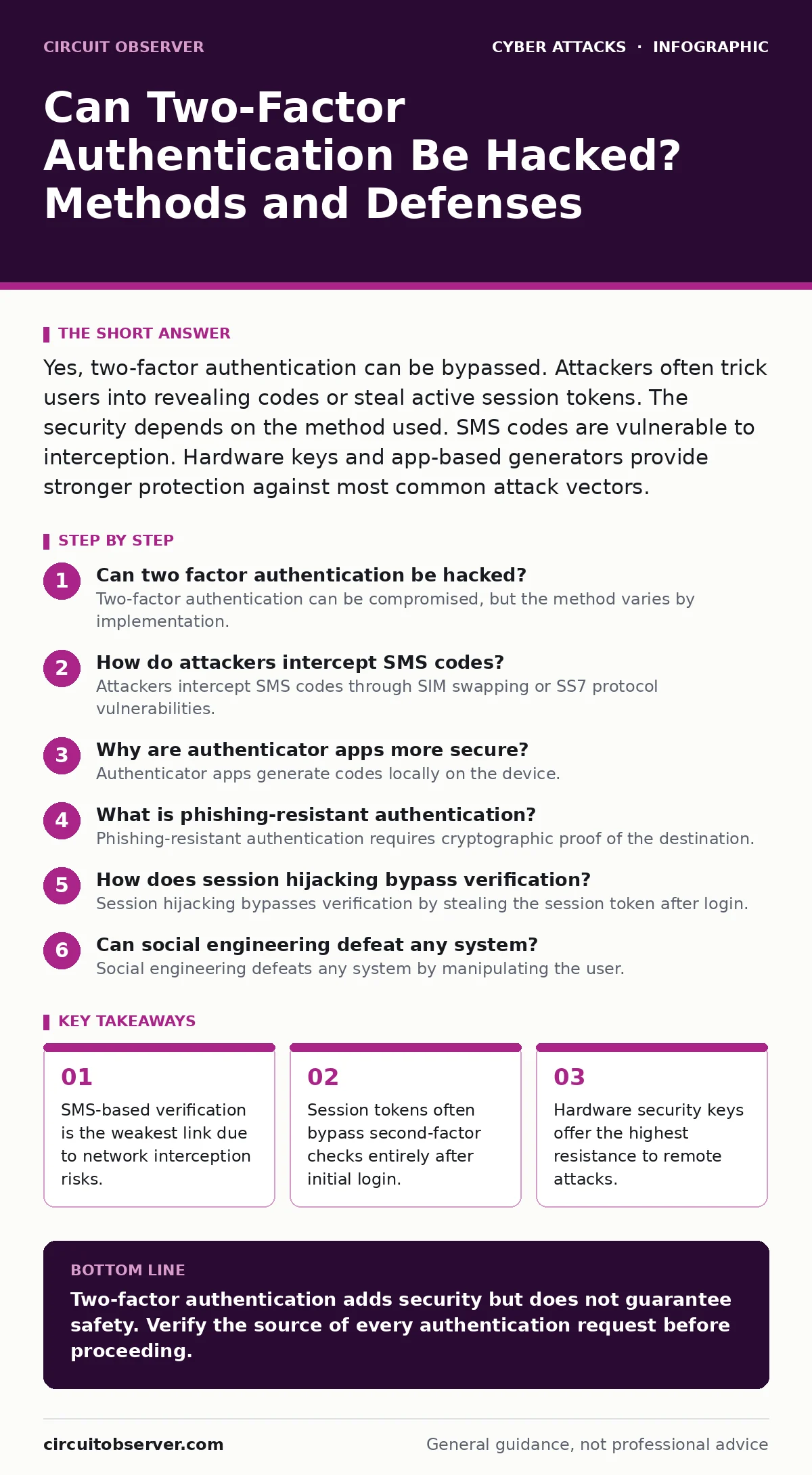
Yes, two-factor authentication can be bypassed. Attackers often trick users into revealing codes or steal active session tokens. The security depends on the method used. SMS codes are vulnerable to interception. Hardware keys and app-based generators provide stronger protection against most common attack vectors.
Can two factor authentication be hacked?
Two-factor authentication can be compromised, but the method varies by implementation. The system itself rarely fails mathematically. The failure usually occurs at the human interface or the network layer. Attackers target the delivery mechanism of the second factor. They do not crack the encryption. They intercept the code or trick the user into handing it over. Understanding this distinction changes how you defend your systems. You must protect the channel, not just the credential.
How do attackers intercept SMS codes?
Attackers intercept SMS codes through SIM swapping or SS7 protocol vulnerabilities. A SIM swap occurs when a fraudster convinces a mobile carrier to transfer a phone number to a new SIM card. The attacker then receives all text messages intended for the victim. This includes one-time passwords. The SS7 protocol is the global signaling system for mobile networks. Flaws in this legacy infrastructure allow remote interception of messages. You cannot fix SS7 flaws yourself. You must avoid relying on SMS for high-value accounts.
Why are authenticator apps more secure?
Authenticator apps generate codes locally on the device. They use a shared secret key established during setup. The code changes every 30 seconds. No network transmission occurs for the code itself. This eliminates interception risks associated with SMS. The secret key never leaves the device after setup. If the device is lost, the attacker needs physical access and the device PIN. This adds a layer of physical security. You should migrate all possible accounts from SMS to time-based one-time password apps.
What is phishing-resistant authentication?
Phishing-resistant authentication requires cryptographic proof of the destination. Hardware security keys, such as those using FIDO2 standards, bind the authentication attempt to the specific domain. An attacker cannot trick the key into signing a request for a fake site. The key checks the origin URL. If the URL does not match the registered service, the signature fails. This prevents credential harvesting. Even if a user clicks a phishing link, the attack stops. This is the gold standard for remote access.
| Method | Interception Risk | Phishing Resistance | Cost |
|---|---|---|---|
| SMS Codes | High | None | Low |
| Authenticator App | Low | Low | Free |
| Hardware Key | None | High | Moderate |
How does session hijacking bypass verification?
Session hijacking bypasses verification by stealing the session token after login. Most systems treat a valid session token as proof of identity. The second factor is only checked at the initial login. Once logged in, the user navigates freely. Attackers use malware or cross-site scripting to steal this token. They then impersonate the user without needing the second factor. This renders the second factor useless for that session. You must monitor for impossible travel or unusual activity patterns.
See also: How Remote Work Security Works: The Zero Trust Mechanism · SAML Misconceptions: Why Your Single Sign-On Implementation Fails
Can social engineering defeat any system?
Social engineering defeats any system by manipulating the user. Attackers pose as IT support or trusted colleagues. They request the current code to "verify" an account. The user provides the code voluntarily. The attacker uses it immediately. This works even with hardware keys if the user manually enters a passcode. It works with authenticator apps if the user reads the code aloud. No technology stops a willing participant. Training must focus on never sharing codes, even with verified identities.
What are the limits of backup codes?
Backup codes are single-use strings provided during setup. They allow recovery if the primary method is lost. If an attacker steals these codes, they gain permanent access. Users often store them in insecure locations. A text file on a desktop is a common mistake. An attacker with malware can scan for these files. You must store backup codes offline. Use a physical safe or encrypted password manager. Treat them with the same secrecy as your master password.
How do you detect compromise early?
You detect compromise by monitoring login anomalies. Look for logins from new devices or countries. Check for multiple failed attempts followed by a success. Review active sessions regularly. Revoke sessions that look unfamiliar. Implement strict session timeouts. Force re-authentication for sensitive actions. This limits the window of opportunity for an attacker. You should also review related topics like insider threats to understand internal risks. Combining external and internal monitoring creates a complete picture.
What steps should you take now?
You should audit your authentication methods immediately. Remove SMS from all high-value accounts. Enable hardware keys for administrative access. Review active sessions on all critical services. Update your cyber incident response team plan to include authentication failures. Consider domain spoofing risks in your email filters.
Align your verification steps with payment verification procedures for financial integrity. Implement rate limiting on login endpoints to slow down brute force attempts. Protect against replay attacks by ensuring tokens expire quickly. Use bot protection to filter automated login attempts. Address invoice fraud by verifying changes through secondary channels.
Key takeaways
- SMS-based verification is the weakest link due to network interception risks.
- Session tokens often bypass second-factor checks entirely after initial login.
- Hardware security keys offer the highest resistance to remote attacks.
Two-factor authentication adds security but does not guarantee safety. Verify the source of every authentication request before proceeding.
Frequently asked questions
Is SMS two-factor authentication secure?
No, SMS is vulnerable to SIM swapping and network interception. It is the weakest form of second-factor authentication and should be avoided for sensitive accounts.
Can I use two-factor authentication on mobile devices?
Yes, mobile devices are ideal for authenticator apps and hardware key pairing. Ensure the device itself is locked with a strong PIN or biometric scan.
What if I lose my hardware security key?
You should always set up a backup key or backup codes. Store these securely offline. Without a backup, you may be locked out permanently.
Do I need two-factor authentication for personal email?
Yes, email is often the gateway to other accounts. Compromising email allows attackers to reset passwords for banking and social media. Protect it with strong verification.
How this guide was produced: written by the Circuit Observer editorial team with AI assistance, checked against the public references listed below, and reviewed when the facts change. See our editorial policy or report an error.