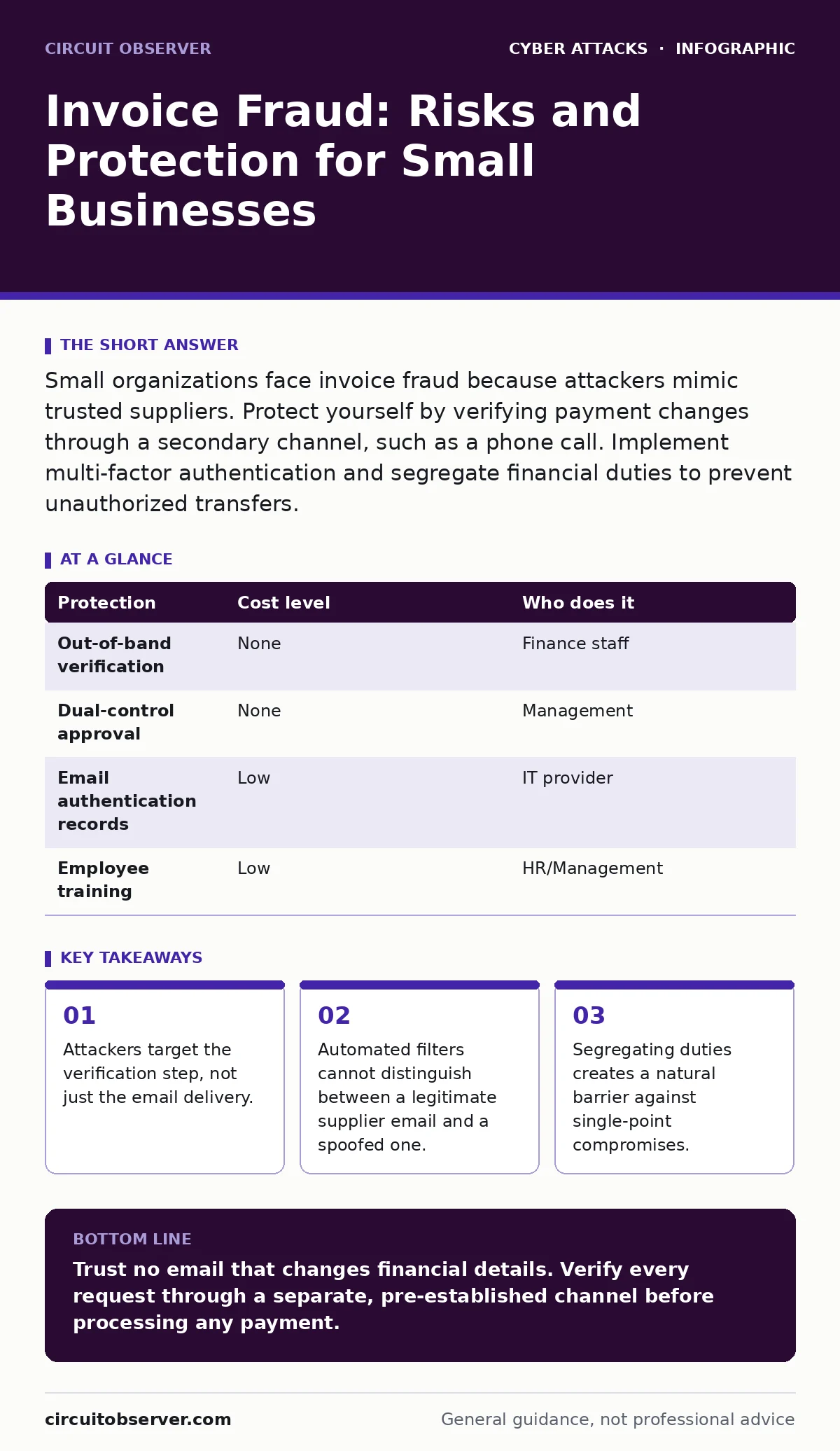
Small organizations face invoice fraud because attackers mimic trusted suppliers. Protect yourself by verifying payment changes through a secondary channel, such as a phone call. Implement multi-factor authentication and segregate financial duties to prevent unauthorized transfers.
This scenario illustrates the core vulnerability in small business operations. You rely on trust in your supply chain, and attackers exploit that trust. They do not need to hack your network directly. They only need to convince one person to change a bank account number.
The Anatomy of a Supply Chain Compromise
Invoice fraud relies on social engineering rather than technical intrusion. The attacker sends a message that appears to come from a known vendor. This message requests a change in banking details. It creates a sense of urgency, often citing a system migration or a banking error.
You might think your email filtering system will catch this. It will not. The message is not malware. It does not contain a virus. It is a plain text request that mimics normal business communication. The filter sees a legitimate-looking email from a domain that resembles your supplier. The threat lies in the content, not the code.
The attacker targets the human element. They study your communication patterns. They know when invoices are due. They know who processes payments. This knowledge allows them to time their attack for maximum impact. They wait until you are busy and likely to skip verification steps.
Why Small Organizations Are Exposed
Small businesses often lack the bureaucratic layers that protect larger corporations. In a large firm, changing a vendor’s bank details requires multiple approvals. In a small firm, one person may handle both the email inbox and the banking software. This concentration of power is efficient but dangerous.
There is no segregation of duties. The same employee who receives the invoice request also executes the payment. There is no independent check. If that employee is deceived, the transfer happens immediately. There is no second set of eyes to catch the error.
Additionally, small teams often reuse communication channels. You might discuss payment details over the same email thread used for general inquiries. Attackers monitor these threads. They see the relationship. They mimic the tone. They insert their request into an ongoing conversation, making it appear seamless.
The Hidden Cost of Convenience
Automated payment systems offer speed, but they reduce friction. Friction is a security feature. When you must manually verify a change, you pause. That pause allows your brain to detect anomalies. Removing that pause removes the safety net.
Many businesses adopt digital invoicing platforms to save time. These platforms can be secured, but they also centralize risk. If an attacker compromises the platform’s login credentials, they can issue fake invoices directly. This bypasses email entirely. The invoice appears in your dashboard as legitimate.
This is where privileged access management becomes relevant. If only one person has access to the payment settings, the risk is high. If multiple people must approve changes, the risk decreases. You must balance efficiency with control. Too much access invites abuse. Too little access slows operations.
Low-Cost Protections You Can Implement Today
You do not need expensive software to mitigate this risk. You need process changes. The most effective defense is out-of-band verification. This means confirming payment details through a different channel than the one used for the request.
If you receive an email asking for a new bank account, do not reply. Call the supplier using a number you already have on file. Do not use the number in the email. Attackers often provide a fake phone number in the same message. Use your existing records. Ask the supplier directly if they changed their details.
Implement a dual-control policy for payments. Require two people to approve any transfer above a certain threshold. One person initiates the payment; another approves it. This ensures that no single individual can divert funds alone. It adds a step, but it prevents catastrophic loss.
| Protection | Cost level | Who does it |
|---|---|---|
| Out-of-band verification | None | Finance staff |
| Dual-control approval | None | Management |
| Email authentication records | Low | IT provider |
| Employee training | Low | HR/Management |
What to Ask Your IT Provider
Your IT provider plays a critical role in securing your communication channels. You must ensure they are not just managing hardware, but also configuring security protocols. Ask specific questions about how they protect your identity.
- Do you publish DMARC records for our domain? DMARC (Domain-based Message Authentication, Reporting, and Conformance) prevents others from sending email that looks like it comes from you. It stops attackers from spoofing your address to trick your partners.
- How do you monitor for unusual login activity? You need alerts when someone accesses your email from a new location or device.
- Do you implement CAPTCHA on your web forms? This helps distinguish humans from bots that might scrape your website for contact information.
- What is your process for recovering compromised accounts? If an attacker gains access, you need a clear plan to regain control.
- How do you handle gift card scams reporting? Employees may still fall for other social engineering tactics. Your provider should have a process for reporting these attempts.
Your provider should be able to explain these measures in plain language. If they cannot, they may not be implementing them correctly. You need a partner who understands the business impact of security failures.
See also: Shadow AI Risks and Protection for Small Businesses · What Is a Vishing Attack: How Voice Phishing Bypasses Security
The Limits of Technical Solutions
No technology can stop a determined attacker who has inside information. If an employee’s email is compromised, the attacker can send messages that appear to come from that employee. These messages bypass many filters because they originate from a trusted source.
This is why bot protection on your public-facing sites is necessary, but insufficient. Bots can harvest email addresses from your website. They can automate the initial phase of an attack. But the final step always involves a human making a decision.
You must assume that emails are untrusted. Treat every request for sensitive information as suspicious. This mindset shift is the hardest part of security. It requires you to question your own assumptions. You must verify before you trust.
Building a Resilient Process
Security is not a product you buy. It is a process you follow. You must integrate verification into your daily workflow. Make it a habit to pause before sending money. Make it a rule to confirm changes verbally.
Review your vendor list regularly. Update contact details manually. Do not rely on information provided in unsolicited emails. If a supplier changes their banking details, they should notify you through multiple channels. They should call you. They should send a letter. They should email you.
This redundancy creates layers of defense. If one channel is compromised, the others remain intact. You create a system where fraud requires multiple points of failure. This makes the attack difficult and risky for the perpetrator. Most attackers will move on to easier targets.
The Role of Incident Response
If a fraud occurs, you need a plan. Do not wait until the money is gone to decide what to do. Have a cyber incident response team or a designated person who knows the steps to take. This includes notifying your bank, your IT provider, and law enforcement.
Speed matters. The longer you wait, the harder it is to recover funds. Your bank can sometimes reverse a transfer if notified immediately. But they need proof of fraud. Document everything. Save the emails. Save the call logs. Keep a record of the verification steps you took.
This documentation helps prove that you acted reasonably. It shows that you had controls in place. It demonstrates that the fraud succeeded despite your best efforts. This can be important for insurance claims and legal proceedings.
Key takeaways
- Attackers target the verification step, not just the email delivery.
- Automated filters cannot distinguish between a legitimate supplier email and a spoofed one.
- Segregating duties creates a natural barrier against single-point compromises.
Trust no email that changes financial details. Verify every request through a separate, pre-established channel before processing any payment.
Frequently asked questions
How do I know if an email is spoofed?
Look closely at the sender’s address. Spoofed emails often have slight misspellings or extra characters. Check the domain name against your known vendors. If it looks slightly off, treat it as suspicious.
Can multi-factor authentication stop invoice fraud?
MFA protects your account from being hacked, but it does not stop you from being tricked. If you willingly give an attacker your login details, MFA may not help. It prevents unauthorized access, not authorized misuse.
What if my IT provider says DMARC is too complex?
DMARC is not complex to implement, but it requires configuration. If your provider refuses, find a new one. DMARC is a standard protocol that significantly reduces the risk of domain spoofing. It is a basic security requirement.
Should I stop using email for business communications?
No. Email is a standard business tool. You cannot avoid it. Instead, change how you use it. Treat it as an untrusted channel for sensitive information. Always verify critical requests through other means.
How this guide was produced: written by the Circuit Observer editorial team with AI assistance, checked against the public references listed below, and reviewed when the facts change. See our editorial policy or report an error.