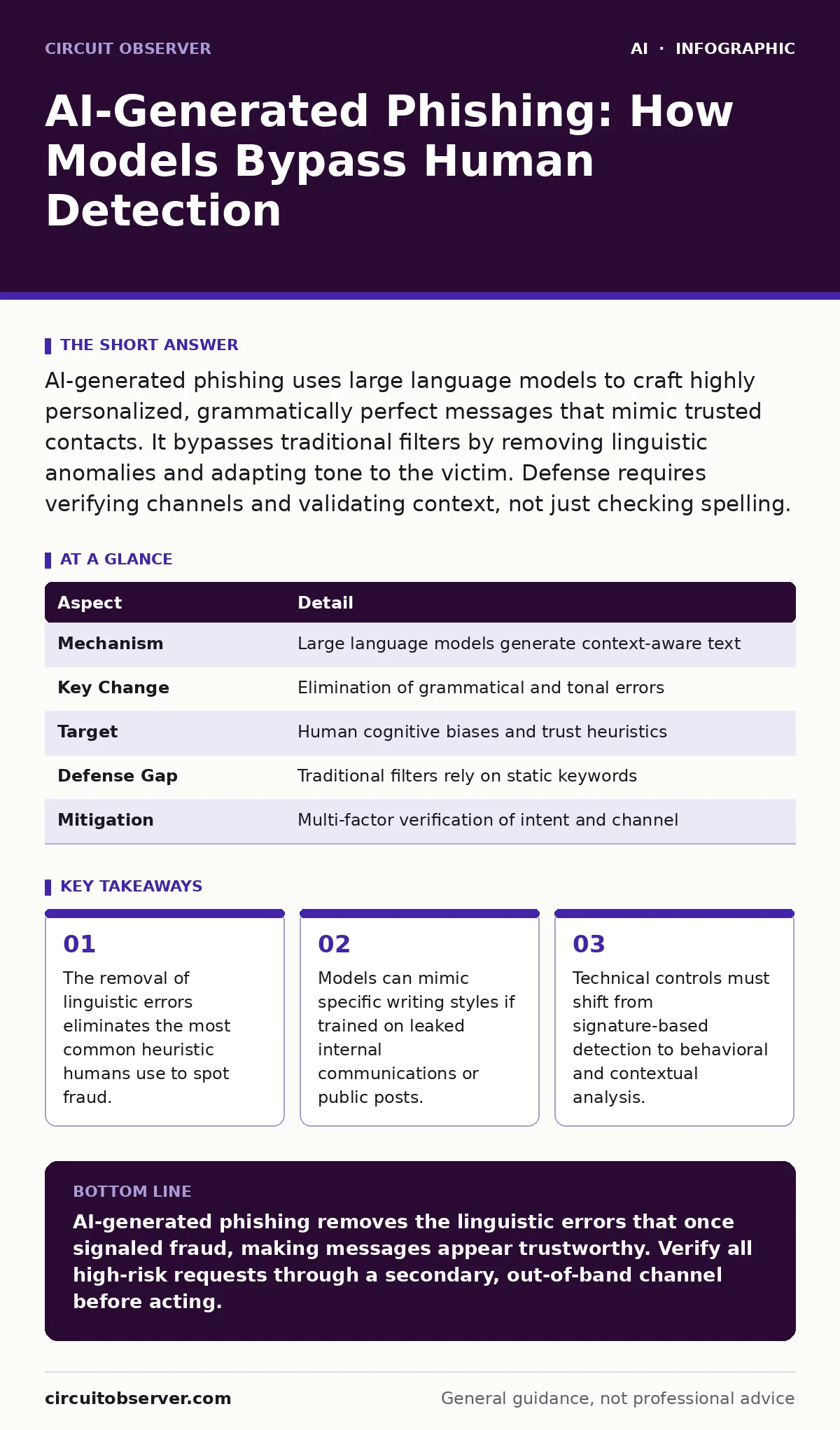
AI-generated phishing uses large language models to craft highly personalized, grammatically perfect messages that mimic trusted contacts. It bypasses traditional filters by removing linguistic anomalies and adapting tone to the victim. Defense requires verifying channels and validating context, not just checking spelling.
The Erosion of Linguistic Friction
Imagine you receive an email from your boss asking for urgent financial details. In the past, you might have hesitated because the sentence structure was awkward or the spelling was off. That friction was your brain’s way of flagging a mismatch between the sender’s identity and their capability. Generative artificial intelligence removes that friction. It produces text that is not only grammatically correct but also stylistically consistent with the person you believe is sending it.
This shift changes the attack surface. Previously, defenders relied on the fact that sophisticated attackers were few and often non-native speakers. Now, the barrier to entry for creating convincing social engineering content has collapsed. The threat is no longer about finding a clever lie; it is about generating a believable truth at scale. You can no longer trust that poor grammar indicates a benign sender, nor can you trust perfect grammar indicates a legitimate one.
| Aspect | Detail |
|---|---|
| Mechanism | Large language models generate context-aware text |
| Key Change | Elimination of grammatical and tonal errors |
| Target | Human cognitive biases and trust heuristics |
| Defense Gap | Traditional filters rely on static keywords |
| Mitigation | Multi-factor verification of intent and channel |
The Mechanics of Synthetic Persuasion
The process begins with data harvesting. An attacker gathers public information about a target, such as LinkedIn profiles, company newsletters, or code repositories. They feed this data into a large language model to create a persona. The model learns the vocabulary, punctuation habits, and emotional tone of the target or their colleagues. Once the persona is established, the model drafts messages that align with ongoing projects or recent events.
This is not simple template filling. The model can maintain a conversation history, remembering details mentioned in previous messages. If you reply to a phishing email, the model can adjust its next response to stay in character. This creates a persistent, coherent narrative that feels organic. The attacker does not need to manually rewrite drafts. The model handles the nuance, allowing the attacker to focus on volume and timing rather than craft.
Why Traditional Filters Fail
Most email security gates operate on rules. They look for known malicious URLs, suspicious attachments, or specific keywords associated with fraud. AI-generated phishing bypasses these controls by using clean, legitimate infrastructure and natural language. The text contains no blacklisted words. The links point to freshly registered domains that do not yet appear in threat intelligence feeds.
The core problem is that these systems are designed to catch anomalies, but AI makes the attack look normal. A message that perfectly matches the expected behavior of a colleague will pass through most static filters. The filter sees a well-formed email from a known sender pattern and lets it through. You are protected against the unexpected, but the attack has become expected in its structure. This leaves the human recipient as the final line of defense, a role for which most people are not adequately trained.
Common Forms of the Attack
The most prevalent form is business email compromise. Attackers impersonate executives or vendors to request wire transfers or sensitive data. Because the language is polished, victims feel pressure to comply quickly. Another form is credential harvesting. The attacker creates a login page that looks identical to your corporate portal and sends a link via email. The accompanying text explains the need to update credentials due to a "policy change," using language that matches internal communications.
A third form is spear-phishing with code. Developers receive emails containing snippets of code or links to repositories. The code may appear to be a helpful utility or a patch. The model generates the explanation text to match the developer’s technical level. This form is dangerous because it targets users who are accustomed to clicking links and running scripts. The technical accuracy of the message lowers their guard, making them less likely to inspect the code before execution.
What People Usually Get Wrong
Many organizations assume that training employees to "be skeptical" is sufficient. This advice is vague and ineffective. Skepticism requires a specific trigger. When a message is perfectly written and contextually relevant, there is no trigger. The brain processes fluent text more easily, a phenomenon known as processing fluency. This fluency creates a false sense of truth. You believe it because it reads well, not because you have verified it.
Another misconception is that technical solutions can solve this alone. While tools are improving, they cannot read your mind or know your internal context. A tool can flag a message as suspicious, but it cannot determine if the request is legitimate without human input. Relying solely on technology creates a false sense of security. The defense must be a combination of technical controls and procedural verification.
See also: Injection attacks examples: how prompt leaks break AI systems
Reducing the Risk Through Process
The most effective defense is out-of-band verification. If you receive a request for money, data, or access, do not reply to the email. Call the sender on a known phone number or use an internal messaging platform to confirm the request. This breaks the attacker’s control over the communication channel. The attacker can mimic your email server, but they cannot easily mimic your voice or your internal chat handle.
Implement strict policies for financial and data requests. Require dual approval for any wire transfer or export of sensitive information. Use multi-factor authentication for all external communications. This ensures that even if an attacker gains access to an account, they cannot act without additional verification. Document these processes and enforce them consistently. The cost of a few extra minutes of verification is far lower than the cost of a successful breach.
The Role of Advanced Defenses
You can enhance your technical defenses by integrating AI security testing into your workflow. This involves using models to simulate attacks against your own systems. By testing how your filters respond to generated content, you can identify gaps in your detection logic. Some organizations also use AI in security operations to analyze email traffic for subtle anomalies. These systems look for deviations in tone or timing rather than specific keywords.
However, these tools are not silver bullets. They require careful tuning to avoid false positives. A model that flags too many legitimate emails will cause users to ignore warnings. A model that flags too few will leave you exposed. You must balance sensitivity with usability. Regularly review alerts and adjust thresholds based on your organization’s specific communication patterns.
RELATED TOPICS: For deeper technical controls, see our guide on LLM guardrails. To understand how attackers might misuse your own models, read about AI model theft. If you suspect data has already left your network, consult the section on sensitive data leaks through AI chatbots. For proactive measures, explore AI security testing.
Key takeaways
- The removal of linguistic errors eliminates the most common heuristic humans use to spot fraud.
- Models can mimic specific writing styles if trained on leaked internal communications or public posts.
- Technical controls must shift from signature-based detection to behavioral and contextual analysis.
AI-generated phishing removes the linguistic errors that once signaled fraud, making messages appear trustworthy. Verify all high-risk requests through a secondary, out-of-band channel before acting.
Frequently asked questions
How do I know if an email is AI-generated?
You often cannot tell by reading it. AI produces fluent, error-free text that mimics human writing. Rely on context and verification, not text analysis.
Can I use AI to detect AI phishing?
Yes, but with limitations. AI detectors can identify statistical patterns in text, but attackers can tweak models to evade detection. Use it as one layer of defense, not the only one.
How this guide was produced: written by the Circuit Observer editorial team with AI assistance, checked against the public references listed below, and reviewed when the facts change. See our editorial policy or report an error.