
Payment verification adds friction to stop unauthorized transfers and catch data errors. It fails against social engineering, insider threats and logic flaws. Implement strict controls only for high-risk transactions where the cost of a false positive is low and the cost of a breach is high.
The Mechanics of Transaction Integrity
Payment verification procedures exist to confirm that a transfer matches the intent of the authorized party. This process typically involves checking the recipient account details, validating the amount and ensuring the request originates from an approved source. You implement these checks to catch typos, prevent duplicate payments and block unauthorized changes to bank details. The mechanism relies on the assumption that the input data is trustworthy. This assumption is often where the control fails.
Benefits and Structural Trade-offs
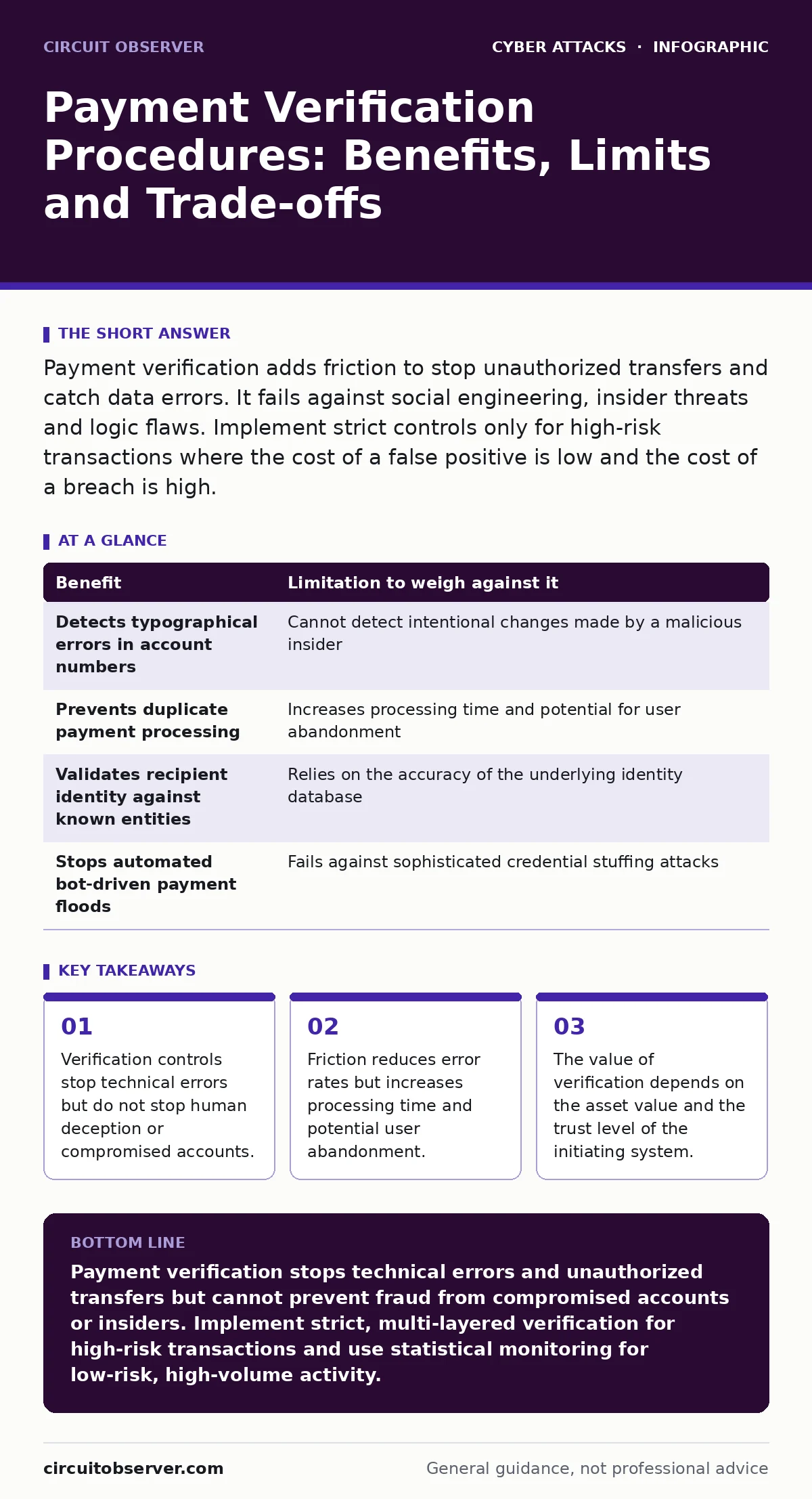
Every verification step adds a layer of security but also introduces latency and operational cost. You must weigh the benefit of catching an error against the limitation of slowing down legitimate business. The table below outlines the primary benefits and the specific limitations you must manage for each.
| Benefit | Limitation to weigh against it |
|---|---|
| Detects typographical errors in account numbers | Cannot detect intentional changes made by a malicious insider |
| Prevents duplicate payment processing | Increases processing time and potential for user abandonment |
| Validates recipient identity against known entities | Relies on the accuracy of the underlying identity database |
| Stops automated bot-driven payment floods | Fails against sophisticated credential stuffing attacks |
The Illusion of Source Authority
A common misconception is that verifying the source of a payment request guarantees its validity. Suppose an attacker compromises a vendor’s email account. They send a request to change the bank account details for an upcoming invoice. Your verification system checks the request against the vendor’s known email address. The check passes. The payment is sent to the attacker’s account. This is not a failure of verification; it is a failure of trust model. The system verified that the request came from the expected channel, but it did not verify that the channel was not compromised.
This scenario highlights the limits of technical controls. You can verify the digital signature of a request, but you cannot verify the intent behind it if the key owner is coerced or compromised. This is where the gap between technical security and operational security widens. To close this gap, you need out-of-band verification. This means confirming critical changes through a separate channel, such as a phone call or a secondary authentication method.
When Verification Adds Value
Verification is worth the operational cost when the transaction value is high and the window for recovery is short. Consider payments that are irreversible, such as wire transfers or cryptocurrency transactions. Once the funds leave your account, they are gone. In these cases, the cost of a verification step is negligible compared to the loss of the entire transaction value. You should also implement strict verification for transactions that deviate from established patterns. A payment that is significantly larger than the average, sent to a new recipient or initiated outside of business hours, triggers a higher risk profile.
Another area where verification pays off is in high-volume, low-value automated systems. Here, the cost of manual review is too high, so you rely on algorithmic verification. You set rules that automatically block transactions that do not match predefined parameters. This approach works well when the patterns of legitimate activity are stable and predictable. It fails when legitimate behavior changes rapidly, leading to false positives.
When Verification Fails or Hinders
Verification is not worth the cost when the friction it introduces exceeds the risk of fraud. Suppose you are processing small, frequent payments to known, stable vendors. Adding a multi-step verification process for each transaction slows down operations and frustrates users. The risk of fraud in this scenario is low, and the cost of a potential loss is manageable. In these cases, a lighter touch is more effective. You might use statistical monitoring to detect anomalies in bulk, rather than verifying each individual transaction.
Verification also fails when the threat model includes insider threats. An employee with authorized access can bypass many verification controls because the system trusts their credentials. They can initiate a payment that passes all technical checks because it originates from a trusted source. In this case, the verification procedure provides a false sense of security. You need complementary controls, such as privileged access management, to limit what an individual user can do. Verification checks the "what" and "where," but access controls check the "who" and "how much."
See also: Hardware Security Keys: 6 Misconceptions That Weaken Your Defense · What Is Replay Attacks: How Recordings Compromise Your Systems
The Role of Context in Verification
Payment verification cannot exist in a vacuum. It must be part of a broader security strategy that includes monitoring and response. You need to detect when verification controls are being bypassed or when they are generating too many false positives. This requires a cyber incident response team that can investigate anomalies quickly. If verification blocks a legitimate payment, the response team must be able to unblock it without compromising security.
You should also consider the impact of invoice fraud on your verification procedures. Attackers often manipulate invoice details to create discrepancies that bypass simple verification checks. For example, they might split a large payment into smaller amounts to stay below verification thresholds. Your verification rules must account for these tactics. You need to aggregate transactions from the same source over a period to detect such patterns.
Integrating with Other Controls
Verification works best when combined with other security measures. Bot protection can prevent automated attacks that try to brute-force payment systems. Eavesdropping attacks can be mitigated by ensuring that payment data is encrypted in transit. However, encryption does not prevent an attacker from using valid credentials to initiate a fraudulent transaction. You need to verify the user, not just the connection.
The Hidden Cost of False Positives
One of the most significant limitations of payment verification is the cost of false positives. A false positive occurs when a legitimate transaction is blocked. This leads to operational delays, customer dissatisfaction and increased support costs. If your verification rules are too strict, you will block legitimate business activity. If they are too loose, you will miss fraudulent transactions. Finding the right balance requires continuous tuning and monitoring. You must measure the impact of your verification procedures on business operations and adjust them accordingly.
Key takeaways
- Verification controls stop technical errors but do not stop human deception or compromised accounts.
- Friction reduces error rates but increases processing time and potential user abandonment.
- The value of verification depends on the asset value and the trust level of the initiating system.
Payment verification stops technical errors and unauthorized transfers but cannot prevent fraud from compromised accounts or insiders. Implement strict, multi-layered verification for high-risk transactions and use statistical monitoring for low-risk, high-volume activity.
Frequently asked questions
How do I verify a payment if the vendor's email account is compromised?
You must use out-of-band verification, such as a phone call to a known number, to confirm changes to payment details. Never rely on email communication for critical changes.
Can payment verification stop ransomware payments?
No. If an attacker has control of the system and the credentials, verification will validate the payment. You need endpoint detection and access controls to prevent the initiation of such payments.
What is the best way to verify bulk payments?
Use algorithmic verification to check for anomalies in volume, amount and recipient patterns. Do not manually verify each transaction in a bulk payment; instead, verify the batch aggregate.
How often should I review my verification rules?
Review your rules regularly, especially after changes in business processes or after security incidents. False positive rates should drive adjustments to the strictness of your controls.
How this guide was produced: written by the Circuit Observer editorial team with AI assistance, checked against the public references listed below, and reviewed when the facts change. See our editorial policy or report an error.