
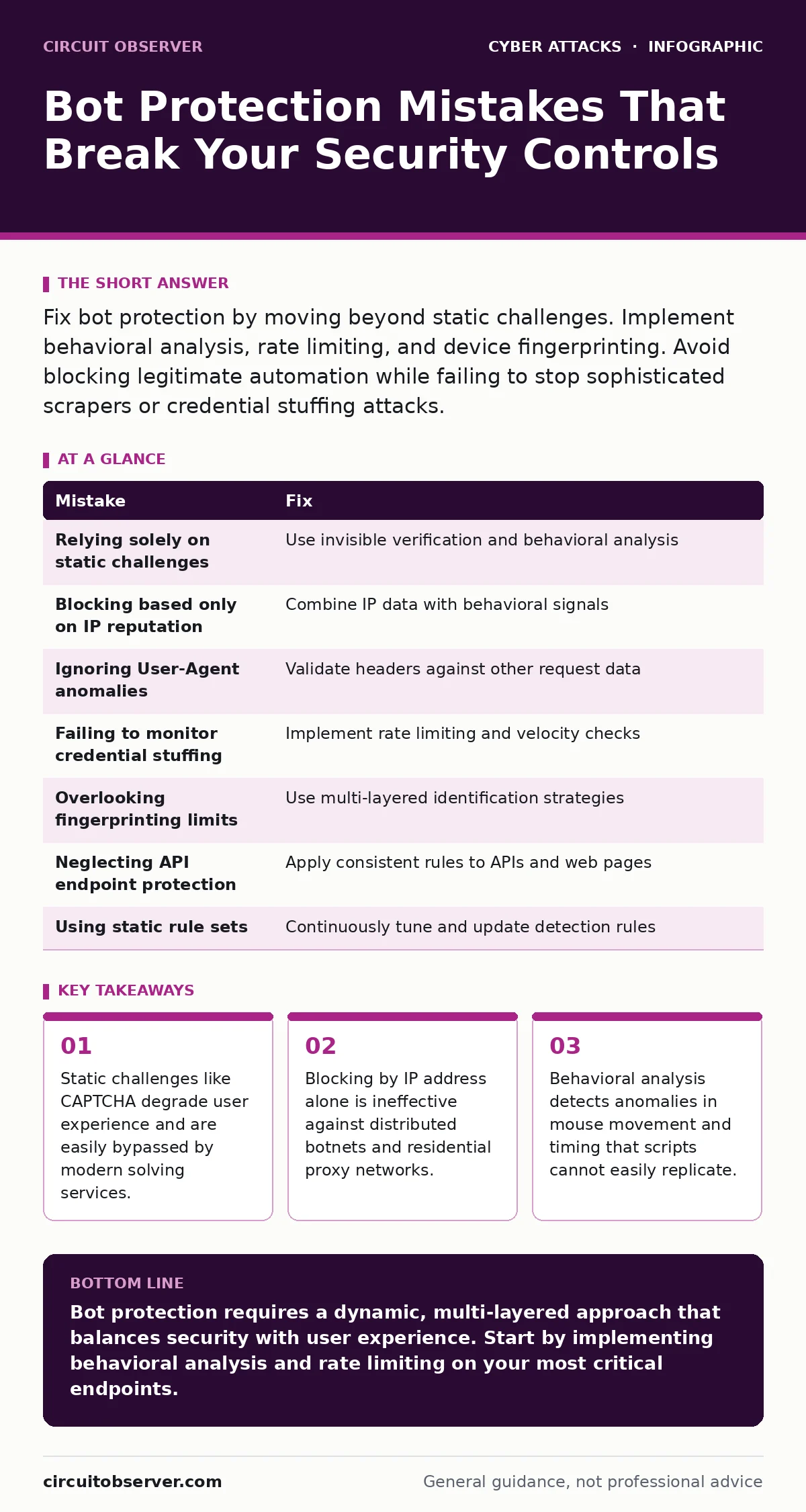
Fix bot protection by moving beyond static challenges. Implement behavioral analysis, rate limiting, and device fingerprinting. Avoid blocking legitimate automation while failing to stop sophisticated scrapers or credential stuffing attacks.
Mistake 1: Relying Solely on Static Challenges
Many teams assume that presenting a visual or logical puzzle stops automated traffic. This approach treats all non-human interaction as a single category. It ignores the difference between a simple script and a sophisticated headless browser.
Why it hurts:
Modern bot operators use solving services that employ human workers or advanced AI to bypass these puzzles. You waste server resources rendering challenges for every request. Legitimate users face friction on every login or transaction, increasing drop-off rates. The challenge becomes a ritual that bots learn to automate, providing no real security.
The fix:
Use challenges only as a fallback for high-risk actions. Implement invisible verification that runs in the background. This method analyzes client-side signals without interrupting the user flow. It reduces friction while maintaining a barrier against simple scripts. See our guide on CAPTCHA for details on why static verification is declining in effectiveness.
Mistake 2: Blocking Based Only on IP Reputation
Administrators often maintain blocklists of known malicious IP addresses. This method is easy to implement and provides a false sense of control. It assumes that bad actors operate from static, identifiable network locations.
Why it hurts:
Botnets use thousands of compromised devices and residential proxies to mask their origin. Your blocklist will never be large enough to cover the entire attack surface. You may accidentally block legitimate users who share an IP address with a bot, such as those on corporate networks or mobile carriers. This creates false positives that disrupt business operations.
The fix:
Combine IP reputation with behavioral analysis. Look at how the request is made, not just where it comes from. Analyze request headers, timing, and navigation patterns. This allows you to detect malicious intent even from clean IP addresses. It reduces the impact of residential proxy abuse.
Mistake 3: Ignoring User-Agent String Anomalies
The User-Agent string identifies the browser and operating system making a request. Many bots send default or missing User-Agent strings. Some sophisticated bots copy strings from popular browsers to blend in.
Why it hurts:
Relying on this header for identification is fragile. Bots can easily spoof valid User-Agent strings. If you block requests with missing strings, you may block legitimate tools like monitoring services or accessibility aids. If you accept all strings, you gain no visibility into the actual client software. This header provides minimal signal on its own.
The fix:
Validate the User-Agent against known browser signatures. Look for inconsistencies between the string and other request headers. For example, a mobile browser string should match mobile viewport sizes. Use this data as one signal in a broader scoring model. Do not make blocking decisions based on this header alone.
Mistake 4: Failing to Monitor for Credential Stuffing
Credential stuffing involves using stolen username and password pairs to gain unauthorized access. This attack relies on automation to test millions of combinations quickly. It targets accounts where users have reused passwords across sites.
Why it hurts:
Standard login forms do not distinguish between a user typing slowly and a script sending requests rapidly. You may see a spike in failed login attempts but attribute it to user error. This allows attackers to gain access to valid accounts. Once inside, they can perform account takeovers or financial fraud. This is a common vector for invoice fraud when attackers compromise business email accounts.
The fix:
Implement rate limiting on login endpoints. Detect rapid succession of failed logins from the same source. Require additional verification for high-velocity login attempts. Monitor for successful logins after multiple failures. This disrupts the automation loop required for credential stuffing.
Mistake 5: Overlooking Device Fingerprinting Limitations
Device fingerprinting creates a unique identifier based on browser configuration and hardware. This technique helps track users across sessions without cookies. It is often used to detect bot behavior by identifying non-standard configurations.
Why it hurts:
Privacy-focused browsers and extensions actively block or randomize fingerprinting signals. This reduces the accuracy of your identification. You may flag legitimate privacy-conscious users as bots. Conversely, advanced bots can emulate standard fingerprints, bypassing this detection. Relying solely on fingerprinting creates blind spots.
The fix:
Use fingerprinting as part of a multi-layered strategy. Combine it with behavioral analysis and risk scoring. Accept that some users will have low-confidence fingerprints. Adjust your thresholds to balance security and privacy. This approach maintains detection capability while respecting user privacy settings.
See also: Browser Isolation Checklist: Secure Remote Access Without Compromise · Web Cache Poisoning: How to Trace and Stop the Attack
Mistake 6: Neglecting API Endpoint Protection
APIs are the backbone of modern web applications. They handle data exchange between services and users. Many teams focus bot protection on the frontend website but leave API endpoints exposed.
Why it hurts:
Bots target APIs to scrape data, abuse functionality, or perform replay attacks. API endpoints often lack the visual challenges used on web pages. They may have different authentication mechanisms that are easier to automate. This creates a weak point in your security posture. Attackers can exploit these endpoints to steal data or disrupt services.
The fix:
Apply the same bot protection rules to APIs as you do to web pages. Implement strict rate limiting and authentication requirements. Validate all input parameters to prevent abuse. Monitor for unusual patterns in API usage. This ensures consistent protection across your entire application stack. See our guide on replay attacks for more on securing API interactions.
Mistake 7: Static Rule Sets Without Continuous Tuning
Bot behavior evolves as detection methods improve. Attackers adapt their scripts to mimic human behavior more closely. Static rule sets become outdated quickly.
Why it hurts:
Rules that worked last month may fail today. You may create too many false positives, blocking legitimate traffic. Or you may miss new attack vectors entirely. This leads to alert fatigue for your cyber incident response team. They struggle to distinguish between noise and real threats.
The fix:
Regularly review and update your bot protection rules. Analyze traffic logs to identify new patterns. Adjust thresholds based on observed behavior. Use machine learning models that adapt to new threats. This keeps your defenses effective against evolving tactics.
| Mistake | Fix |
|---|---|
| Relying solely on static challenges | Use invisible verification and behavioral analysis |
| Blocking based only on IP reputation | Combine IP data with behavioral signals |
| Ignoring User-Agent anomalies | Validate headers against other request data |
| Failing to monitor credential stuffing | Implement rate limiting and velocity checks |
| Overlooking fingerprinting limits | Use multi-layered identification strategies |
| Neglecting API endpoint protection | Apply consistent rules to APIs and web pages |
| Using static rule sets | Continuously tune and update detection rules |
Key takeaways
- Static challenges like CAPTCHA degrade user experience and are easily bypassed by modern solving services.
- Blocking by IP address alone is ineffective against distributed botnets and residential proxy networks.
- Behavioral analysis detects anomalies in mouse movement and timing that scripts cannot easily replicate.
Bot protection requires a dynamic, multi-layered approach that balances security with user experience. Start by implementing behavioral analysis and rate limiting on your most critical endpoints.
Frequently asked questions
How do I distinguish between a good bot and a bad bot?
Good bots, like search engine crawlers, follow standard protocols and identify themselves clearly. Bad bots often hide their identity, behave aggressively, or target sensitive endpoints. Analyze behavior and intent rather than just presence.
Does bot protection affect website performance?
Poorly implemented protection can slow down your site by adding processing overhead. Efficient solutions run lightweight checks in the background. Optimize your configuration to minimize latency for legitimate users.
Can I use free tools for bot protection?
Free tools often lack advanced behavioral analysis and real-time threat intelligence. They may provide basic rate limiting but fail against sophisticated attacks. Invest in solutions that offer deeper visibility and adaptive rules.
How do I handle false positives?
Establish a clear process for reviewing and whitelisting legitimate traffic. Monitor user feedback and error logs. Adjust your rules to reduce friction for verified users while maintaining security for unknown sources.
How this guide was produced: written by the Circuit Observer editorial team with AI assistance, checked against the public references listed below, and reviewed when the facts change. See our editorial policy or report an error.