
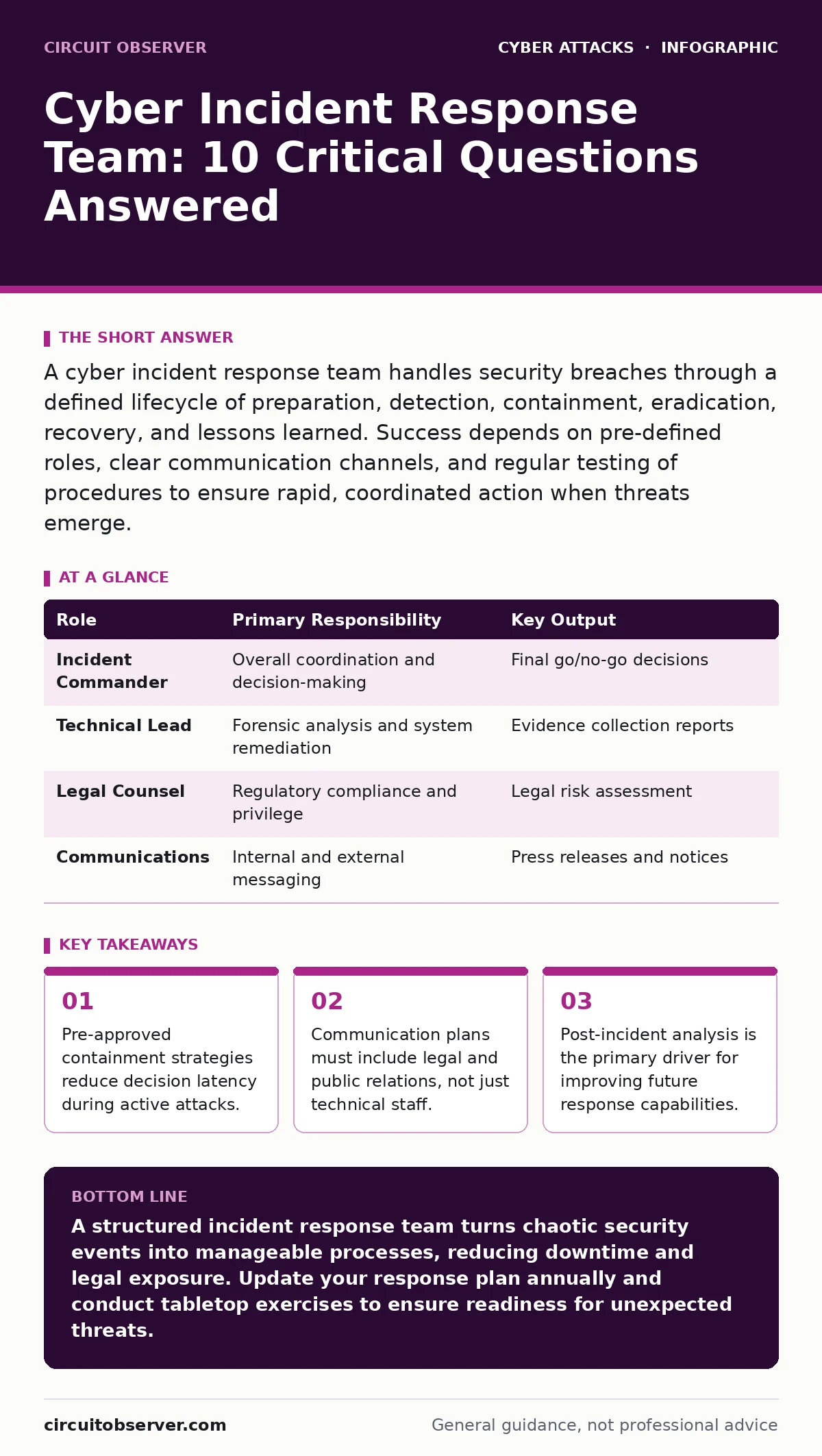
A cyber incident response team handles security breaches through a defined lifecycle of preparation, detection, containment, eradication, recovery, and lessons learned. Success depends on pre-defined roles, clear communication channels, and regular testing of procedures to ensure rapid, coordinated action when threats emerge.
What is the primary function of an incident response team?
The primary function is to minimize damage and recovery time by executing a pre-defined set of procedures during a security breach. This team does not just fix the immediate technical issue; they manage the entire lifecycle of the event from detection to final review. They act as the central nervous system for crisis management, ensuring that technical actions align with business continuity goals. Without this structure, responses become reactive and fragmented, often exacerbating the initial problem.
Who should be included in the core team?
The core team must include technical responders, legal counsel, communications specialists, and executive sponsors. Technical staff handle the forensic analysis and system isolation, while legal ensures regulatory compliance and privilege protections. Communications specialists manage internal and external messaging to control the narrative and prevent panic. Executive sponsors provide the authority to make costly decisions, such as shutting down critical production systems, without bureaucratic delay.
How does the team prepare before an incident occurs?
Preparation involves developing and maintaining an incident response plan that defines roles, responsibilities, and escalation paths. The team must establish secure communication channels that remain operational if primary networks are compromised. Regular tabletop exercises simulate various attack scenarios to identify gaps in the plan and train personnel under pressure. This phase also includes securing forensic tools and ensuring access to critical system logs is available and intact.
What are the standard phases of incident response?
The standard framework consists of preparation, identification, containment, eradication, recovery, and post-incident activity. Identification involves confirming that a security event is indeed a malicious incident and not a false positive. Containment focuses on limiting the spread of the threat, often by isolating affected networks or systems. Eradication removes the root cause, while recovery restores systems to normal operation with enhanced monitoring. Post-incident activity reviews the response to improve future performance.
How does the team verify a potential threat?
Verification requires correlating alerts from multiple sources to distinguish true threats from noise or misconfigurations. Analysts examine log entries, network traffic patterns, and system behaviors for anomalies that match known attack signatures. They must determine if the activity is authorized, such as a scheduled maintenance task, or unauthorized. This step prevents unnecessary disruption caused by responding to benign events, which can erode trust in the security monitoring systems.
See also: Malware Payloads: Small Business Defense Strategies · Breach Notification Rule: What It Is and How to Comply
What is the difference between containment and eradication?
Containment stops the immediate spread of the threat, while eradication removes the threat entirely from the environment. Containment might involve disconnecting a server from the network or blocking specific IP addresses at the firewall. Eradication requires identifying and removing all malicious artifacts, such as malware files, backdoors, and compromised user accounts. You cannot safely eradicate a threat without first containing it to prevent further lateral movement.
How does the team handle communication during a crisis?
Communication follows a strict protocol that separates technical details from public-facing messages. Internal communications use encrypted channels to discuss sensitive forensic data without exposing it to unauthorized personnel. External communications are crafted by legal and public relations teams to protect the organization’s reputation and comply with disclosure laws. Imagine a scenario where technical staff speak directly to the media; this often leads to inconsistent messaging and legal liability.
| Role | Primary Responsibility | Key Output |
|---|---|---|
| Incident Commander | Overall coordination and decision-making | Final go/no-go decisions |
| Technical Lead | Forensic analysis and system remediation | Evidence collection reports |
| Legal Counsel | Regulatory compliance and privilege | Legal risk assessment |
| Communications | Internal and external messaging | Press releases and notices |
What common mistakes do response teams make?
A frequent error is failing to preserve evidence before attempting remediation, which can destroy critical data needed for forensic analysis or legal proceedings. Another mistake is assuming that the initial point of entry is the only compromise, ignoring the possibility of lateral movement. Teams often rush to restore services before confirming that all malicious components have been removed, leading to reinfection. Poor documentation during the chaos also hinders post-incident learning and legal defensibility.
How does the team recover systems safely?
Recovery begins with the least critical systems and moves to core infrastructure only after thorough verification. Systems should be restored from known clean backups that predate the infection, not from the compromised environment. Enhanced monitoring is applied to restored systems to detect any signs of residual compromise or reinfection. This phased approach ensures that stability is regained without reintroducing the threat into the clean environment.
Why is the post-incident review critical?
The post-incident review, or lessons learned, identifies what worked, what failed, and how to improve the response plan. It transforms a negative event into a strategic opportunity to harden defenses and refine procedures. The team documents timeline discrepancies, communication breakdowns, and technical gaps to update the incident response plan. Without this step, the organization is likely to repeat the same mistakes in the next incident, wasting resources and increasing risk.
How does this relate to other security measures?
An effective response team complements preventive controls like email filtering and privileged access management by handling breaches that bypass these defenses. While preventive measures reduce the likelihood of an incident, the response team determines the impact when prevention fails. Understanding related concepts, such as how to mitigate replay attacks or the importance of bot protection, helps the team identify the attack vector more quickly. The response plan must account for scenarios where invoice fraud or gift card scams serve as the initial social engineering vector.
Key takeaways
- Pre-approved containment strategies reduce decision latency during active attacks.
- Communication plans must include legal and public relations, not just technical staff.
- Post-incident analysis is the primary driver for improving future response capabilities.
A structured incident response team turns chaotic security events into manageable processes, reducing downtime and legal exposure. Update your response plan annually and conduct tabletop exercises to ensure readiness for unexpected threats.
Frequently asked questions
How long does it take to build an incident response team?
Building a functional team requires months of planning, role definition, and training, but initial capabilities can be established within weeks by assigning existing staff to specific roles.
Do small organizations need a dedicated incident response team?
Small organizations can use a hybrid model where existing IT staff take on response roles, supplemented by external managed security service providers for specialized forensic support.
What is the first step after detecting a potential breach?
The first step is to verify the alert and determine the scope of the incident before taking any containment actions that might destroy evidence.
How often should the incident response plan be tested?
The plan should be tested at least annually through tabletop exercises, with additional tests following any significant changes to the IT infrastructure or security posture.
How this guide was produced: written by the Circuit Observer editorial team with AI assistance, checked against the public references listed below, and reviewed when the facts change. See our editorial policy or report an error.