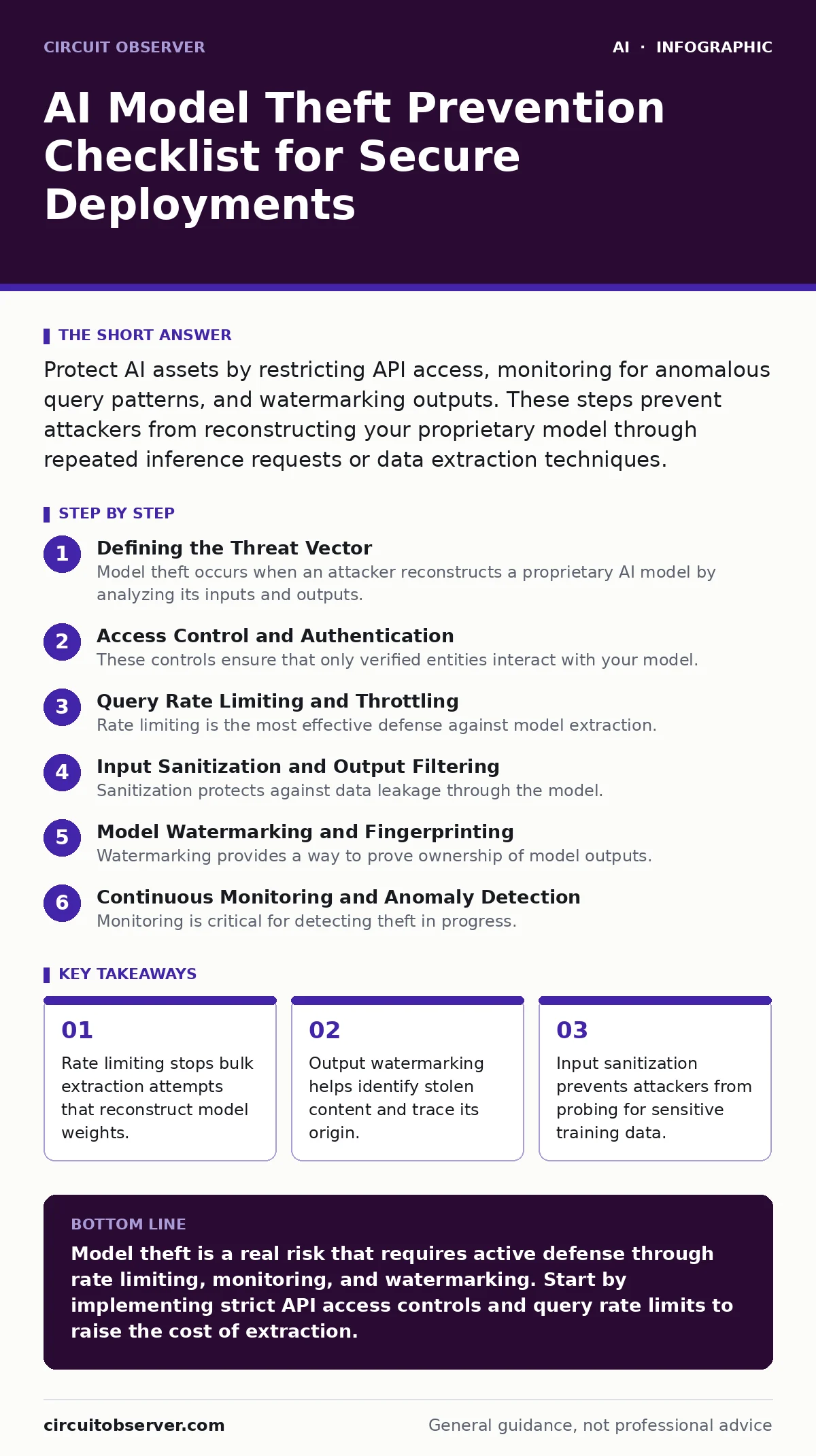
Protect AI assets by restricting API access, monitoring for anomalous query patterns, and watermarking outputs. These steps prevent attackers from reconstructing your proprietary model through repeated inference requests or data extraction techniques.
Defining the Threat Vector
Model theft occurs when an attacker reconstructs a proprietary AI model by analyzing its inputs and outputs. The attacker does not need direct access to the code or weights. They query the model repeatedly to map its decision boundaries. This process creates a surrogate model that mimics the original behavior. The stolen model can then be deployed without paying for the original training costs. You must treat the inference API as a potential leak point for intellectual property.
Access Control and Authentication
- Enforce strict API key rotation: Regular rotation limits the damage if a key is compromised.
- Implement role-based access control: Only authorized services should query the model endpoints.
- Use mutual TLS authentication: Both client and server verify identities before data exchange.
- Log all API access attempts: Detailed logs help detect unauthorized or unusual access patterns.
These controls ensure that only verified entities interact with your model. Without them, any user with the endpoint URL can begin extraction. Authentication proves identity, but it does not limit what the identity can do. You need both identity verification and action restrictions.
Query Rate Limiting and Throttling
- Set per-user rate limits: Prevents any single entity from making excessive inference requests.
- Implement global throttling: Protects the system from coordinated attacks using multiple accounts.
- Add random delays to responses: Increases the time and cost required for model extraction.
- Monitor for burst patterns: Sudden spikes in queries often indicate automated extraction scripts.
Rate limiting is the most effective defense against model extraction. Attackers rely on volume to gather enough data to train a surrogate. By slowing down requests, you make the theft process economically unviable. Random delays add uncertainty, forcing attackers to waste more resources. This does not stop determined actors, but it raises the barrier significantly.
Input Sanitization and Output Filtering
- Strip metadata from inputs: Removes hidden data that could aid in fingerprinting the model.
- Filter sensitive tokens in outputs: Prevents leakage of proprietary information or training data.
- Use input length restrictions: Limits the complexity of queries that could probe model internals.
- Validate input formats: Ensures queries conform to expected structures and prevents injection.
Sanitization protects against data leakage through the model. Attackers may craft specific inputs to trigger outputs that reveal training data. This is related to sensitive data leaks through AI chatbots, where user data inadvertently appears in responses. Filtering outputs ensures that even if the model recalls sensitive information, it does not expose it. This adds a layer of protection beyond simple access controls.
Model Watermarking and Fingerprinting
- Embed invisible watermarks in outputs: Allows tracking of stolen content back to its source.
- Use unique token sequences: Creates a signature that is difficult to remove without altering meaning.
- Monitor for watermark presence: Detects unauthorized use of your model's outputs in the wild.
- Implement dynamic watermarking: Changes watermarks over time to prevent reverse engineering.
Watermarking provides a way to prove ownership of model outputs. If a competitor uses your model to generate content, the watermark reveals the source. This is not a prevention measure, but a detection and attribution tool. It helps in legal actions and discourages theft by increasing the risk of exposure. Watermarks must be robust against common editing techniques to remain effective.
See also: Large Language Models as Optimizers: Why Your Code Changes Break · Injection attacks examples: how prompt leaks break AI systems
Continuous Monitoring and Anomaly Detection
- Track query frequency and patterns: Identifies unusual behavior that may indicate extraction attempts.
- Monitor output distribution shifts: Changes in output patterns can signal model manipulation or theft.
- Set up alerts for suspicious activity: Enables rapid response to potential security incidents.
- Regularly review access logs: Helps identify compromised accounts or unauthorized access.
Monitoring is critical for detecting theft in progress. Static defenses are not enough. Attackers adapt their methods to bypass rate limits and filters. AI model monitoring helps you see these changes in real-time. By analyzing query patterns, you can spot automated scripts that differ from human usage. This proactive approach allows you to block threats before significant damage occurs.
Integration with Broader Security Practices
- Align with AI governance frameworks: Ensures consistent security practices across all AI projects.
- Conduct regular AI security testing: Identifies vulnerabilities in the model and its infrastructure.
- Audit for shadow AI: Discovers unauthorized model deployments that bypass security controls.
- Review plugin security: Ensures that insecure AI plugins and agents do not expose model endpoints.
Model theft prevention does not exist in isolation. It must be part of a broader security strategy. This includes considerations like data poisoning attacks, where attackers corrupt training data to weaken the model. Understanding tokens in language models helps you appreciate how much information is conveyed in each output. Integrating these practices ensures a holistic defense.
Key takeaways
- Rate limiting stops bulk extraction attempts that reconstruct model weights.
- Output watermarking helps identify stolen content and trace its origin.
- Input sanitization prevents attackers from probing for sensitive training data.
Model theft is a real risk that requires active defense through rate limiting, monitoring, and watermarking. Start by implementing strict API access controls and query rate limits to raise the cost of extraction.
Frequently asked questions
Can I completely prevent AI model theft?
No, you can only raise the cost and difficulty of theft to make it unviable for attackers.
How do I detect if my model has been stolen?
Monitor for anomalous query patterns and use watermarking to trace unauthorized outputs.
Is rate limiting enough to stop model extraction?
No, rate limiting slows down extraction but must be combined with monitoring and access controls.
What is the role of watermarking in model security?
Watermarking helps identify stolen content and attribute it to your model, aiding in detection and legal action.
How this guide was produced: written by the Circuit Observer editorial team with AI assistance, checked against the public references listed below, and reviewed when the facts change. See our editorial policy or report an error.