
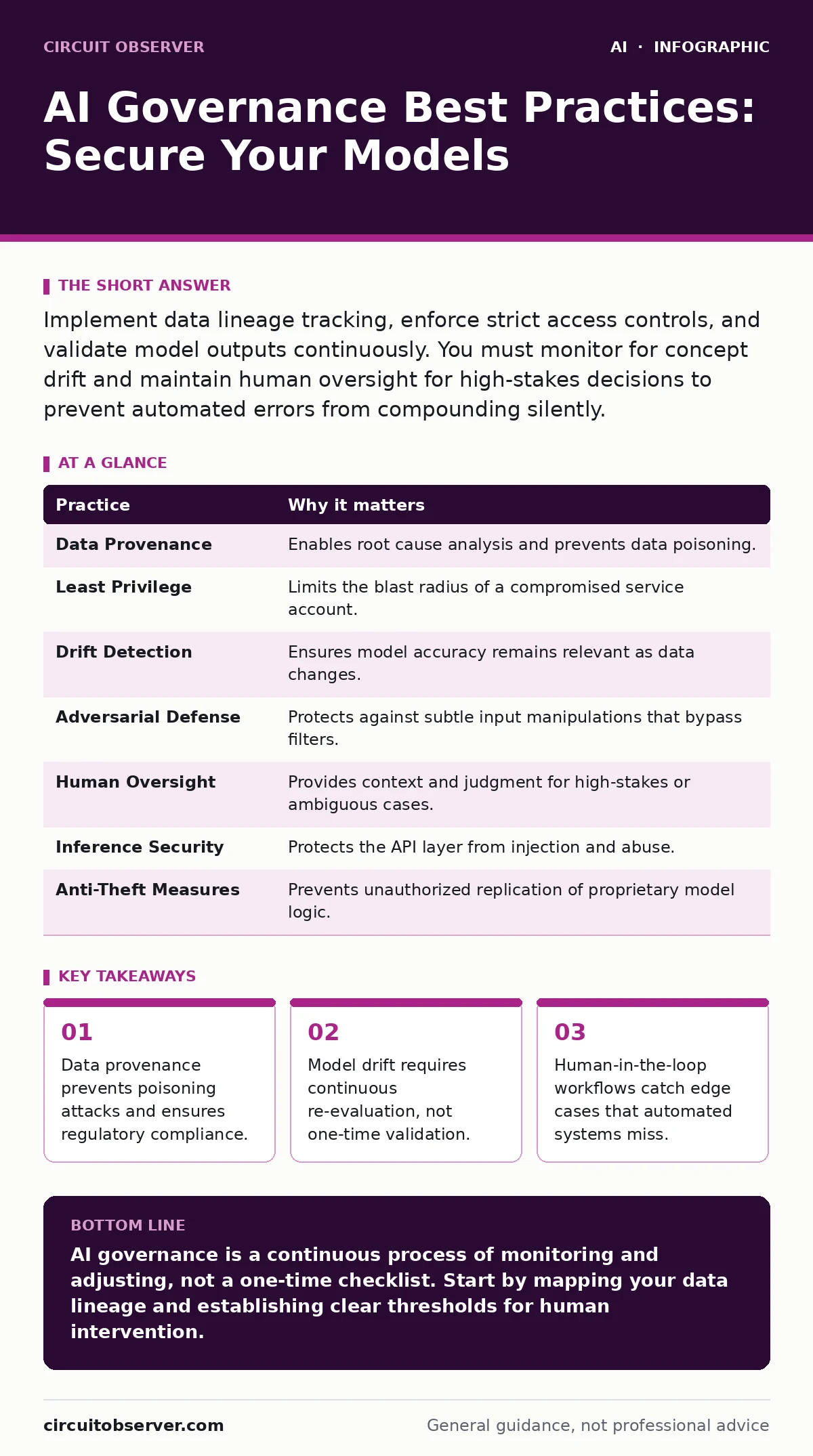
Implement data lineage tracking, enforce strict access controls, and validate model outputs continuously. You must monitor for concept drift and maintain human oversight for high-stakes decisions to prevent automated errors from compounding silently.
1. Enforce Strict Data Provenance
You cannot secure what you cannot trace. When an AI model produces an incorrect or biased output, the root cause often lies in the training data. If you do not know which dataset contributed to a specific behavior, you cannot isolate the error. This lack of visibility creates a blind spot where poisoned data can degrade performance without detection.
Data provenance tracks the origin, processing steps, and lineage of every data element used in training. It answers the question of where the data came from and how it was transformed. This is distinct from simple file storage; it requires a chain of custody.
Practical tip: Implement a data versioning system that assigns unique identifiers to each dataset snapshot. Record the hash of the data, the transformation scripts applied, and the timestamp. This allows you to reconstruct the exact training environment if an issue arises later. See our guide on sensitive data leaks through AI chatbots for related data handling risks.
2. Implement Least Privilege Access Controls
AI systems require access to vast amounts of data, but this access creates a massive attack surface. If a single service account has broad read-write permissions to the entire data lake, a compromise of that account exposes everything. The principle of least privilege restricts access to only what is necessary for a specific task.
In machine learning pipelines, this means separating data ingestion, model training, and inference environments. Each stage should have its own identity with minimal permissions. This containment prevents lateral movement if one component is breached.
Practical tip: Use role-based access control (RBAC) to define specific permissions for each stage of the AI lifecycle. Ensure that model training jobs cannot access production databases directly. Instead, they should access sanitized copies of the data through a secure intermediate storage layer.
3. Validate Models for Concept Drift
Models degrade over time because the real world changes. This phenomenon is known as concept drift. A model trained on historical data may become inaccurate as user behavior, market conditions, or language patterns evolve. Without monitoring, you deploy a system that appears to work but is making increasingly wrong decisions.
Static validation at deployment is insufficient. You must continuously compare the distribution of input data against the training data. Significant deviations indicate that the model may no longer be reliable. This is not a bug; it is a natural consequence of using static logic on dynamic data.
Practical tip: Set up automated alerts for statistical deviations in input data distributions. If the mean or variance of key features shifts beyond a defined threshold, trigger a review. Consider our guide on AI model monitoring for deeper technical implementation details.
4. Guard Against Adversarial Inputs
AI models can be tricked by subtle manipulations in their input data. These are called adversarial examples. An attacker adds small, often imperceptible noise to an image or text to cause the model to misclassify it. This is not about breaking the code; it is about exploiting the mathematical sensitivity of the model.
Standard input validation does not catch these attacks because the inputs look valid. The model processes them normally but produces incorrect outputs. This can bypass security filters or lead to dangerous misclassifications in critical systems.
Practical tip: Integrate adversarial training into your development cycle. Expose your model to generated adversarial examples during training to make it more resilient. See our guide on adversarial examples for specific generation techniques.
5. Maintain Human Oversight for Critical Decisions
Automated systems lack context and moral reasoning. While AI can process data at scale, it cannot understand the nuance of exceptional cases. Relying entirely on automation for high-stakes decisions creates a risk of catastrophic error. Human oversight provides a safety net for edge cases that the model has never seen.
This does not mean humans must review every decision. Instead, you implement a tiered approach. Low-risk decisions are automated, while high-risk or ambiguous decisions are flagged for human review. This balances efficiency with safety.
Practical tip: Define clear thresholds for human intervention. If the model’s confidence score falls below a certain level, or if the decision impacts significant financial or safety outcomes, route it to a human operator. This ensures that uncertainty triggers caution, not action.
See also: Malware Targeting AI Infrastructure Explained for Beginners
6. Secure the Inference Pipeline
The model itself is only one part of the system. The inference pipeline, which handles real-time predictions, is often a target for attackers. If an attacker can manipulate the inputs or intercept the outputs, they can subvert the system’s purpose. This is where many governance frameworks fail, focusing only on training security.
Inference endpoints must be protected against injection attacks and denial-of-service attempts. The model may be secure, but the API serving it might not. You must treat the inference layer as a critical application component.
Practical tip: Implement rate limiting and input sanitization at the API gateway before requests reach the model. Validate the format and size of all inputs. See our guide on AI security testing for methods to evaluate these endpoints.
7. Prevent Model Theft and Extraction
Models represent significant intellectual property and operational value. Attackers can extract a model’s parameters or behavior by querying it repeatedly. This is known as model extraction or model theft. They do not need access to the code; they only need access to the API.
By analyzing many inputs and outputs, an attacker can create a surrogate model that mimics your original. This allows them to bypass your defenses or replicate your capabilities. This risk exists even if your underlying infrastructure is secure.
Practical tip: Limit the number of queries allowed per user and add noise to outputs where possible. This makes it harder for attackers to accurately reconstruct the model. See our guide on AI model theft for advanced mitigation strategies.
8. Audit for Bias and Fairness
AI models can amplify existing biases present in training data. This leads to unfair outcomes for certain groups. Bias is not always intentional; it is often a statistical artifact of uneven data representation. Without active auditing, these biases remain hidden until they cause harm.
Governance requires regular testing for disparate impact. You must measure how the model performs across different demographic slices of your data. A model might have high overall accuracy but perform poorly for specific subgroups.
Practical tip: Use fairness metrics to evaluate model performance across protected attributes. If disparities are found, retrain the model with balanced data or apply post-processing adjustments. This ensures equitable outcomes for all users.
| Practice | Why it matters |
|---|---|
| Data Provenance | Enables root cause analysis and prevents data poisoning. |
| Least Privilege | Limits the blast radius of a compromised service account. |
| Drift Detection | Ensures model accuracy remains relevant as data changes. |
| Adversarial Defense | Protects against subtle input manipulations that bypass filters. |
| Human Oversight | Provides context and judgment for high-stakes or ambiguous cases. |
| Inference Security | Protects the API layer from injection and abuse. |
| Anti-Theft Measures | Prevents unauthorized replication of proprietary model logic. |
| Bias Auditing | Ensures fair and equitable outcomes across all user groups. |
Key takeaways
- Data provenance prevents poisoning attacks and ensures regulatory compliance.
- Model drift requires continuous re-evaluation, not one-time validation.
- Human-in-the-loop workflows catch edge cases that automated systems miss.
AI governance is a continuous process of monitoring and adjusting, not a one-time checklist. Start by mapping your data lineage and establishing clear thresholds for human intervention.
Frequently asked questions
How often should I retrain my AI models?
Retrain when concept drift is detected or when new data becomes available that significantly changes the problem domain. There is no fixed schedule; it depends on data volatility.
Can I use open-source models for critical systems?
Yes, but you must audit them for security vulnerabilities and bias. Open-source does not mean risk-free. You are responsible for validating their behavior in your specific context.
What is the difference between AI governance and AI security?
Governance covers the entire lifecycle, including ethics, bias, and compliance. Security focuses specifically on protecting assets from malicious actors. They overlap but have different scopes.
How do I handle AI-generated content in my organization?
Label all AI-generated content clearly to maintain transparency. Implement strict guidelines on what can be generated and who can publish it. See our guide on AI-generated phishing for related risks.
How this guide was produced: written by the Circuit Observer editorial team with AI assistance, checked against the public references listed below, and reviewed when the facts change. See our editorial policy or report an error.