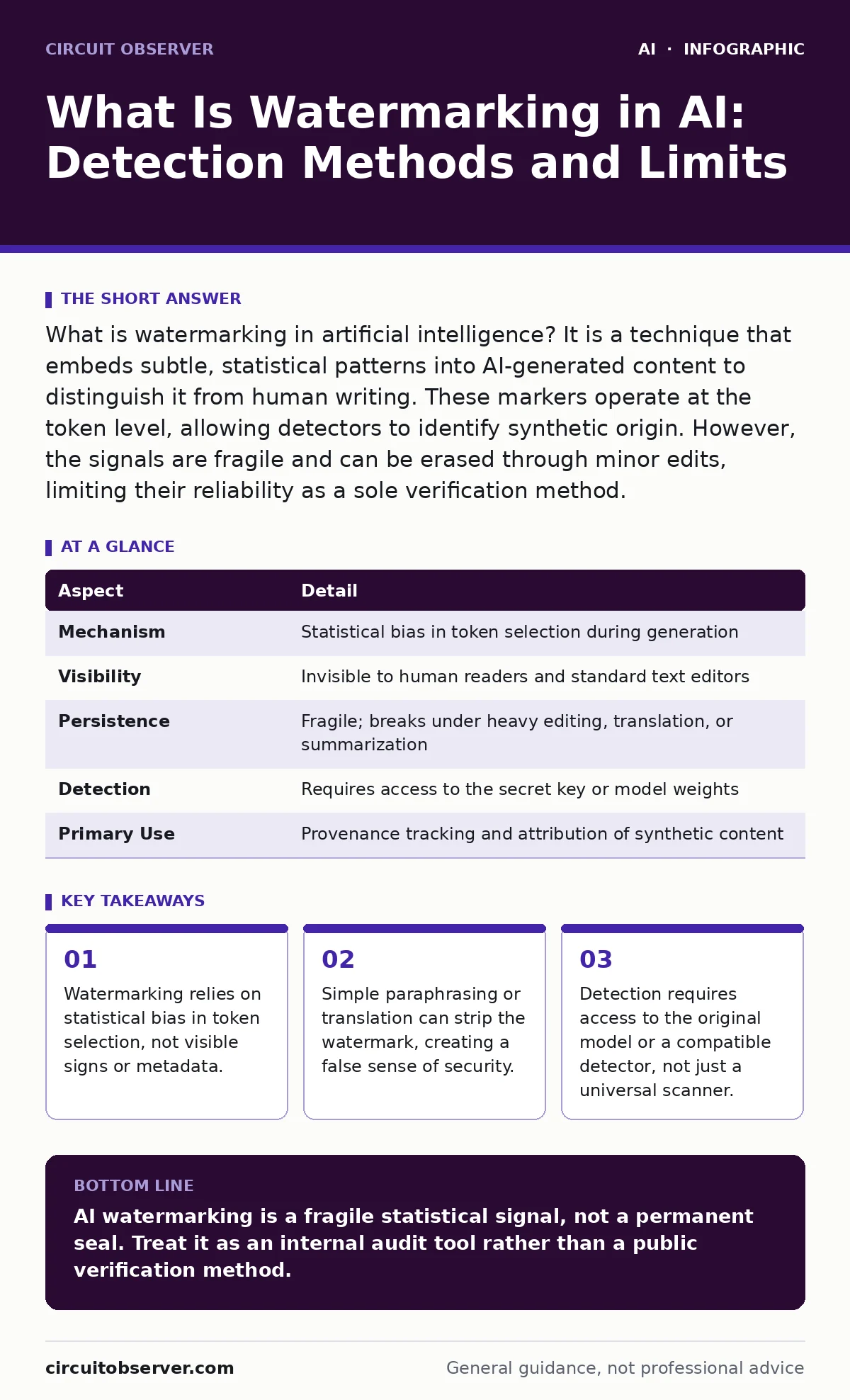
What is watermarking in artificial intelligence? It is a technique that embeds subtle, statistical patterns into AI-generated content to distinguish it from human writing. These markers operate at the token level, allowing detectors to identify synthetic origin. However, the signals are fragile and can be erased through minor edits, limiting their reliability as a sole verification method.
What Is Watermarking in AI
What is watermarking in the context of artificial intelligence? It is a method for embedding a hidden signal within the output of a generative model to prove its synthetic origin. This process does not add visible watermarks or tags to the text. Instead, it alters the probability distribution of the words the model chooses. The system favors certain valid words over others in a specific, repeating pattern that human readers cannot detect.
This technique aims to solve the provenance problem. As large language models become more prevalent, distinguishing between human-created and machine-generated content becomes difficult. Watermarking provides a cryptographic-like signature that travels with the text. It allows downstream systems to verify whether a piece of content was produced by a specific model or family of models. The goal is attribution, not necessarily quality control.
Imagine a weaver who uses a specific color thread in a fixed pattern throughout a rug. To the casual observer, the rug looks uniform. To an expert with the right key, the pattern reveals the maker. AI watermarking works similarly, but the "thread" is the statistical likelihood of each word appearing in the sequence.
| Aspect | Detail |
|---|---|
| Mechanism | Statistical bias in token selection during generation |
| Visibility | Invisible to human readers and standard text editors |
| Persistence | Fragile; breaks under heavy editing, translation, or summarization |
| Detection | Requires access to the secret key or model weights |
| Primary Use | Provenance tracking and attribution of synthetic content |
How the Technology Works
The core mechanism relies on controlling the randomness of the model. When a large language model predicts the next word, it generates a probability distribution for all possible tokens. A watermarked model modifies this distribution. It splits the vocabulary into two groups: green list and red list. The model is biased to pick words from the green list more often than the red list, following a pseudo-random sequence determined by a secret key.
This bias is subtle. It does not make the text sound unnatural or repetitive. The model still produces coherent, high-quality language. The pattern only emerges when analyzing large samples of text. Detectors look for the statistical over-representation of green-list words. If the pattern matches the secret key, the text is flagged as synthetic.
The security of this method depends on the secrecy of the key. If the key is public, anyone can generate watermarked text or remove the signal. The key is usually embedded in the model weights or managed by the provider. This creates a dependency between the generator and the detector. You cannot verify the watermark without the corresponding verification tool.
Who Is Affected by This Shift
Content creators and publishers face new verification challenges. They must integrate detection tools into their workflows to filter out synthetic spam or unauthorized AI content. This adds computational overhead and complexity to content management systems. Editors can no longer rely on intuition to spot AI writing. They need automated checks that may produce false positives.
Developers of generative models bear the responsibility for implementation. They must balance the strength of the watermark with the quality of the output. Stronger watermarks can degrade text quality or make the pattern easier to detect and remove. Weaker watermarks are easier to strip. This trade-off forces developers to choose between security and usability.
End users of AI tools may find their outputs restricted. Some platforms may refuse to generate content without the watermark, or they may block the use of watermarked text in certain contexts. This limits the utility of AI for tasks that require seamless integration with human workflows. The friction between automated generation and human verification is a growing operational cost.
What People Usually Get Wrong
Many assume that watermarks are permanent and unbreakable. This is incorrect. Watermarks in text are not like digital rights management in media files. They are statistical properties of the sequence. Any change to the sequence can disrupt the pattern. Deleting a single sentence, changing a few words, or summarizing the text can destroy the watermark. The signal is fragile by design, as it must remain invisible to humans.
Another common mistake is believing that all AI detectors use the same method. They do not. Some detectors look for stylistic features, such as perplexity or burstiness. These are not watermarks. They are heuristic checks that guess whether text looks human. Watermarking is a specific, cryptographic-like technique that requires a shared secret. Confusing these methods leads to overconfidence in detection capabilities.
The Hidden Costs of Implementation
Implementing watermarking introduces latency and complexity. The model must calculate the green and red lists for every token it generates. This adds computational cost to every request. For high-volume applications, this overhead is significant. It slows down response times and increases infrastructure expenses. Organizations must weigh the benefit of attribution against the cost of slower service.
There is also a risk of false positives. If the detector is too sensitive, it may flag human text as synthetic. This happens when human writing coincidentally matches the statistical pattern. False positives can damage reputations and create legal liabilities. Publishers may accidentally accuse legitimate authors of using AI. The threshold for detection must be tuned carefully, but tuning is difficult without large datasets of known watermarked and human text.
See also: AI Agent Hijacking Response: Containment and Recovery Steps · Malware Targeting AI Infrastructure Prevention Checklist
Strategies for Mitigation and Verification
You cannot stop people from removing watermarks. The only effective strategy is to assume the signal can be lost. Treat watermarking as one layer of a broader security posture. Combine it with other methods, such as metadata signing or behavioral analysis. Use it for auditing and internal tracking, not for real-time blocking.
For detection, maintain a close relationship with your model provider. You need access to their specific detector and key. Do not rely on third-party tools that claim to detect all AI watermarks. They cannot. Only the provider of the model can verify its own watermark with high accuracy. Build your verification pipeline around this constraint.
Consider the lifecycle of your content. If you expect the text to be edited, translated, or summarized, do not rely on the watermark for final verification. Use it only for the initial output. Once the text enters the wild, the watermark is likely gone. Shift to content-based verification methods that analyze the substance, not the signature.
The Future of Synthetic Attribution
Watermarking is an evolving field. Researchers are developing more robust methods, such as steganography that hides data in the structure of the text rather than the token probabilities. These methods may be more resistant to editing. However, they also face the same fundamental challenge: the tension between invisibility and durability.
As models become more advanced, the statistical patterns may become harder to detect. The gap between human and machine text is narrowing. Watermarks may need to become more subtle, making them even easier to remove. This creates an arms race between watermarking techniques and removal methods.
Stay informed about developments in this area. The standards for AI security testing and the use of tokens in language models will influence how watermarking is implemented. Do not assume current methods will last. Build flexible systems that can adapt to new detection techniques as they emerge.
Key takeaways
- Watermarking relies on statistical bias in token selection, not visible signs or metadata.
- Simple paraphrasing or translation can strip the watermark, creating a false sense of security.
- Detection requires access to the original model or a compatible detector, not just a universal scanner.
AI watermarking is a fragile statistical signal, not a permanent seal. Treat it as an internal audit tool rather than a public verification method.
Frequently asked questions
Can I remove AI watermarking from text?
Yes, simple editing, paraphrasing, or translation can disrupt the statistical pattern and remove the watermark.
Is watermarking the same as a digital signature?
No, digital signatures are cryptographic and tamper-evident. Watermarks are statistical and can be removed without detection by the system.
How this guide was produced: written by the Circuit Observer editorial team with AI assistance, checked against the public references listed below, and reviewed when the facts change. See our editorial policy or report an error.