
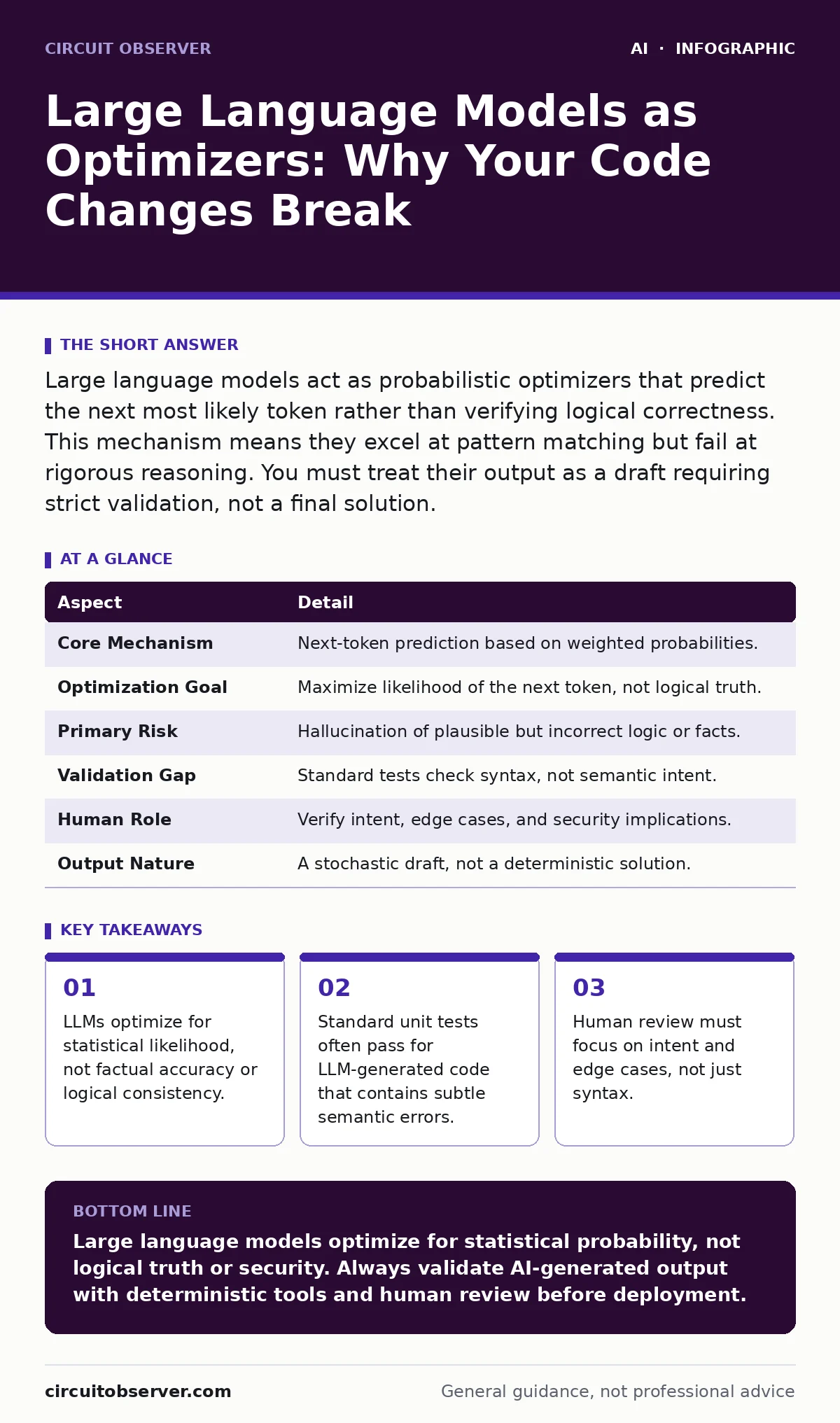
Large language models act as probabilistic optimizers that predict the next most likely token rather than verifying logical correctness. This mechanism means they excel at pattern matching but fail at rigorous reasoning. You must treat their output as a draft requiring strict validation, not a final solution.
The Autocomplete Trap
Imagine a spell checker that suggests words based on how often they appear together in books, not on whether they make sense in your specific sentence. That is how large language models operate. They do not "know" facts. They calculate the statistical probability of the next word in a sequence based on their training data. This mechanism turns them into powerful optimizers for pattern completion, but terrible optimizers for truth.
You cannot trust the output because it is designed to be plausible, not correct. The model seeks the path of least resistance in its probability space. This creates a hidden cost: code that runs without errors but does not what you intended. The silence of a passing compiler is not proof of success. It is only proof of syntax.
At a Glance: How LLM Optimization Works
| Aspect | Detail |
|---|---|
| Core Mechanism | Next-token prediction based on weighted probabilities. |
| Optimization Goal | Maximize likelihood of the next token, not logical truth. |
| Primary Risk | Hallucination of plausible but incorrect logic or facts. |
| Validation Gap | Standard tests check syntax, not semantic intent. |
| Human Role | Verify intent, edge cases, and security implications. |
| Output Nature | A stochastic draft, not a deterministic solution. |
Large Language Models as Optimizers
When you ask an AI to write code, it acts as a large language model optimizer. It searches its internal parameter space for the sequence of tokens that best matches your prompt. It does not execute the code in a sandbox. It does not check if the logic holds. It only checks if the words look like code. This distinction is critical for your security posture.
The optimizer favors common patterns. If a vulnerable coding pattern is frequent in its training data, the model will likely reproduce it. It optimizes for familiarity. This means it will suggest insecure defaults if those defaults are statistically common. You must recognize that the model is optimizing for your prompt, not for security best practices. The output is a mirror of the data, not a guardian of safety.
The Illusion of Competence
The model’s fluency masks its lack of understanding. It can explain a concept it has never truly learned. This is known as the fluency trap. You feel confident because the language is natural. The code looks professional. But the underlying logic may be inverted. A function might return the wrong value under specific conditions. The optimizer chose words that looked right, not values that were right.
This affects every user who integrates AI into their workflow. Developers, writers, and analysts all face this risk. The model provides a high-confidence wrong answer. You must assume every output is a draft. Treat it like a junior employee who reads fast but checks nothing. Verify the work. Do not assume the format implies the substance.
What People Usually Get Wrong
Most teams make 3 errors when using AI as an optimizer. First, they trust the confidence of the tone. The model speaks with authority, but it has no concept of truth. Second, they rely on standard testing. Unit tests check if code runs, not if it is safe. They miss logic errors that do not crash the system. Third, they ignore the context window. The model forgets earlier instructions as new tokens are added. Long prompts degrade quality.
You must change your validation strategy. Do not just run the code. Read the logic. Check for side effects. Verify permissions. Look for data leakage. The optimizer does not care about your constraints unless you enforce them repeatedly. It will drift from your requirements if you do not pin it down with strict prompts and immediate verification.
See also: AI Agent Hijacking Response: Containment and Recovery Steps · Malware Targeting AI Infrastructure Prevention Checklist
Mitigation Strategies
You can reduce risk by treating the model as a generator, not a solver. Use it to create drafts. Then use deterministic tools to validate those drafts. Combine the generative power with static analysis tools. These tools check for known vulnerabilities. They do not guess. They rule. This combination catches errors the optimizer misses.
Implement strict prompt engineering. Define constraints clearly. Specify what the code must not do. Limit the scope of the request. Ask for one function at a time. Complex requests increase the chance of logical drift. Break problems down. Verify each part before moving to the next. This modular approach contains errors. It prevents a single mistake from cascading through your system.
Beyond Basic Guardrails
Basic safety filters are not enough. You need deeper controls. Understand how LLM guardrails work. They filter input and output based on predefined rules. They block obvious threats. But they miss subtle logic errors. You must add semantic validation. Check the meaning, not just the words. Use automated tests that check for specific behaviors. Not just syntax.
Be aware of AI agent hijacking. If you use autonomous agents, an attacker can manipulate the optimizer to perform unwanted actions. The agent follows the most likely path. If the prompt is poisoned, the agent follows the poison. Secure your prompts. Validate the agent’s actions before execution. Treat the agent as untrusted code. It is, in effect, remote code execution with a language interface.
The Hidden Cost of Speed
Speed is the bait. The model gives you an answer in seconds. This feels efficient. But the time you spend correcting errors can exceed the time to write the code manually. This is the hidden cost. You trade upfront effort for downstream risk. The optimizer speeds up generation, not verification. You must budget time for review. Do not let the speed of generation dictate the speed of deployment.
This affects your team’s culture. Developers may become lazy reviewers. They trust the AI. They skip deep checks. This creates technical debt. The codebase fills with subtle errors. These errors are hard to find. They break in production. You must enforce a culture of skepticism. Question the AI. Verify the output. Make review a mandatory step, not an optional one.
Key takeaways
- LLMs optimize for statistical likelihood, not factual accuracy or logical consistency.
- Standard unit tests often pass for LLM-generated code that contains subtle semantic errors.
- Human review must focus on intent and edge cases, not just syntax.
Large language models optimize for statistical probability, not logical truth or security. Always validate AI-generated output with deterministic tools and human review before deployment.
Frequently asked questions
Do large language models understand the code they generate?
No, they predict the next likely token based on patterns in training data. They lack semantic understanding and cannot verify logical correctness or security implications on their own.
How can I test LLM-generated code for security flaws?
Use static analysis tools to check for known vulnerabilities. Combine this with manual review of logic and intent. Standard unit tests are insufficient because they only verify syntax, not security posture.
Is AI model theft a risk when using public LLMs?
Yes, attackers can extract weights or fine-tune models from public APIs. Protect your proprietary data by avoiding sensitive inputs. Monitor for unauthorized usage and secure your access keys.
Can jailbreaking AI chatbots bypass safety filters?
Yes, adversarial prompts can manipulate the model to ignore safety guidelines. This is a known risk. Implement robust LLM guardrails and monitor for prompt injection attempts to mitigate this threat.
How this guide was produced: written by the Circuit Observer editorial team with AI assistance, checked against the public references listed below, and reviewed when the facts change. See our editorial policy or report an error.