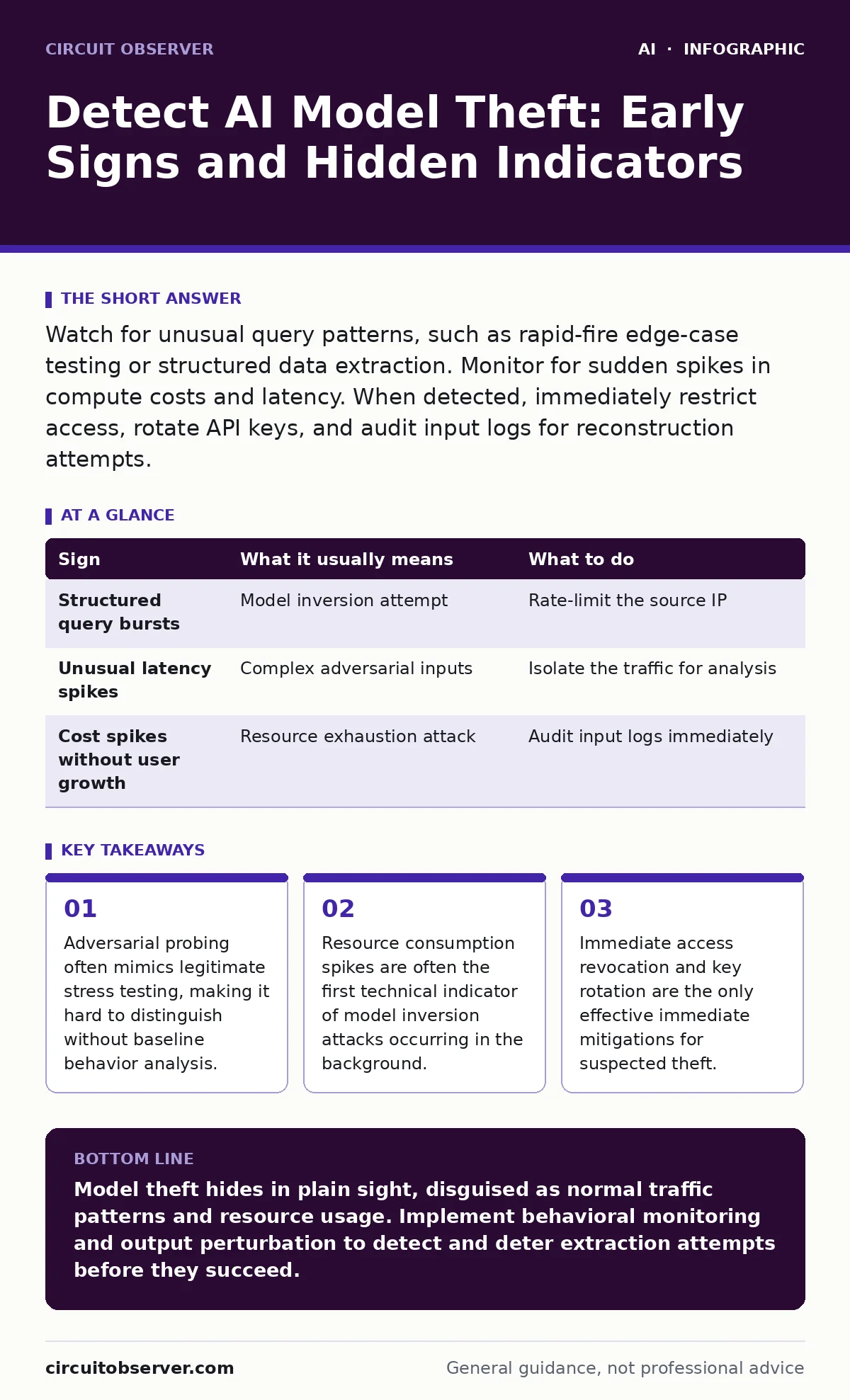
Watch for unusual query patterns, such as rapid-fire edge-case testing or structured data extraction. Monitor for sudden spikes in compute costs and latency. When detected, immediately restrict access, rotate API keys, and audit input logs for reconstruction attempts.
The Illusion of Normal Traffic
Model theft rarely looks like a brute-force hack. It looks like a user. An attacker sends requests that appear valid, but the intent is not to use the model, but to map its internal weights. This process is called model inversion. The goal is to reconstruct the proprietary logic or training data by observing the outputs.
You must distinguish between high-volume usage and high-intent extraction. High volume is noise. High intent is structure. If your model is processing thousands of requests per minute, that is scale. If those requests follow a specific mathematical progression, that is theft. The difference lies in the pattern, not the count.
Obvious Signals of Extraction
The first signs are often visible in your application logs. You will see a distinct change in the types of inputs your model receives. Normal users ask natural questions. Attackers send engineered inputs designed to provoke specific boundary responses. These are called adversarial examples.
Latency will also shift. If your model suddenly takes longer to respond to certain queries, it may be processing complex reconstruction attempts. These attempts require more computational power than standard inference. You will see this as a spike in average response time for a subset of users.
Compute costs will rise disproportionately to user growth. If your user base is flat but your cloud bill is climbing, something is wrong. The attacker is forcing the model to work harder than intended. This is a financial leak that mirrors the data leak.
| Sign | What it usually means | What to do |
|---|---|---|
| Structured query bursts | Model inversion attempt | Rate-limit the source IP |
| Unusual latency spikes | Complex adversarial inputs | Isolate the traffic for analysis |
| Cost spikes without user growth | Resource exhaustion attack | Audit input logs immediately |
Hidden Indicators in Metadata
The harder signs to miss are in the metadata, not the payload. You need to look at the timing of requests. Humans type at irregular intervals. Scripts send requests at regular, millisecond-precise intervals. If you see a steady stream of requests with zero variance in timing, it is automated.
Another hidden sign is the distribution of output tokens. If your model is a language model, it usually generates text of varying lengths. If an attacker is extracting weights, they may force the model to output single tokens or specific probability distributions. This creates a flat, unnatural distribution in your logs.
You must also monitor for "shadow" requests. These are requests that return errors or empty responses but still consume compute cycles. Attackers use these to probe the model’s error handling, which can reveal information about the model’s architecture.
The Cost of False Positives
Blocking suspicious traffic carries a risk. If you block too aggressively, you will disrupt legitimate users. This is the trade-off between security and availability. You must define what "normal" looks for your specific use case.
Imagine a research team using your model for rapid prototyping. Their usage patterns will look like an attack. They send many queries in quick succession. If you block them, you lose a customer. If you let them pass, you risk theft. The solution is not a block, but a tiered access system.
Tiered access allows you to give high-trust users more bandwidth while restricting unknown or new sources. This reduces the attack surface without killing legitimate high-volume use. You must update these tiers regularly as your user base evolves.
Immediate Containment Steps
When you suspect theft, speed matters. Do not try to analyze the full log stream in real-time. That takes too long. First, isolate the threat. Rotate your API keys. This immediately cuts off the attacker’s access if they are using stolen credentials.
Next, enable detailed logging for all incoming requests. You need every byte of data to reconstruct the attack later. Do not delete logs, even if they seem noisy. The pattern is in the noise. Archive the current state of your model and freeze updates. This preserves the evidence.
Finally, notify your security team and legal counsel. Model theft is intellectual property theft. You need to document the incident for potential legal action. Do not announce the breach publicly until you have contained the leak.
See also: Large Language Models as Optimizers: Why Your Code Changes Break · Injection attacks examples: how prompt leaks break AI systems
Long-Term Defensive Posture
Prevention requires architectural changes. You cannot stop all model theft, but you can make it expensive. Implement rate limiting that adapts to behavior, not just volume. If a user sends too many similar queries, slow them down.
Add noise to your outputs. If your model returns probabilities, add small, random variations. This makes it harder for an attacker to reconstruct the exact weights. This is called output perturbation. It degrades the quality of the stolen model, making it less useful.
Regularly audit your access controls. Ensure that only necessary personnel have access to the model’s training data and weights. Insider threats are often more damaging than external attacks. Limit access based on the principle of least privilege.
Monitoring for Data Leakage
Model theft often goes hand-in-hand with data leakage. If an attacker can extract the model, they can also extract the training data. This is called membership inference. They try to determine if a specific data point was in the training set.
Monitor for queries that target sensitive or unique data. If users ask about specific individuals or private records, flag these requests. These are often probes for data leakage. You must ensure your model does not memorize or regurgitate sensitive training data.
Use differential privacy techniques during training. This adds noise to the training process, making it harder to extract individual data points. It reduces the risk of both model theft and data leakage. It is a fundamental defense against reconstruction attacks.
Key takeaways
- Adversarial probing often mimics legitimate stress testing, making it hard to distinguish without baseline behavior analysis.
- Resource consumption spikes are often the first technical indicator of model inversion attacks occurring in the background.
- Immediate access revocation and key rotation are the only effective immediate mitigations for suspected theft.
Model theft hides in plain sight, disguised as normal traffic patterns and resource usage. Implement behavioral monitoring and output perturbation to detect and deter extraction attempts before they succeed.
Frequently asked questions
Can I stop model theft with a firewall?
No. Firewalls block network traffic, but model theft happens over legitimate API connections. You need application-level monitoring to detect the specific query patterns used in extraction attacks.
How do I know if my model has been stolen?
Look for unauthorized copies of your model’s behavior in the wild. If a competitor launches a model with identical quirks or errors, it is likely a reconstruction. Also, monitor for unusual resource consumption.
Is output perturbation safe for production?
Yes, if calibrated correctly. Small amounts of noise do not significantly impact model performance for most users. The trade-off is a slight reduction in precision for a major increase in security against reconstruction.
Should I block all automated traffic?
No. Many legitimate services use automation. Instead, use behavioral analysis to distinguish between benign automation and malicious probing. Block only the traffic that exhibits adversarial patterns.
How this guide was produced: written by the Circuit Observer editorial team with AI assistance, checked against the public references listed below, and reviewed when the facts change. See our editorial policy or report an error.