
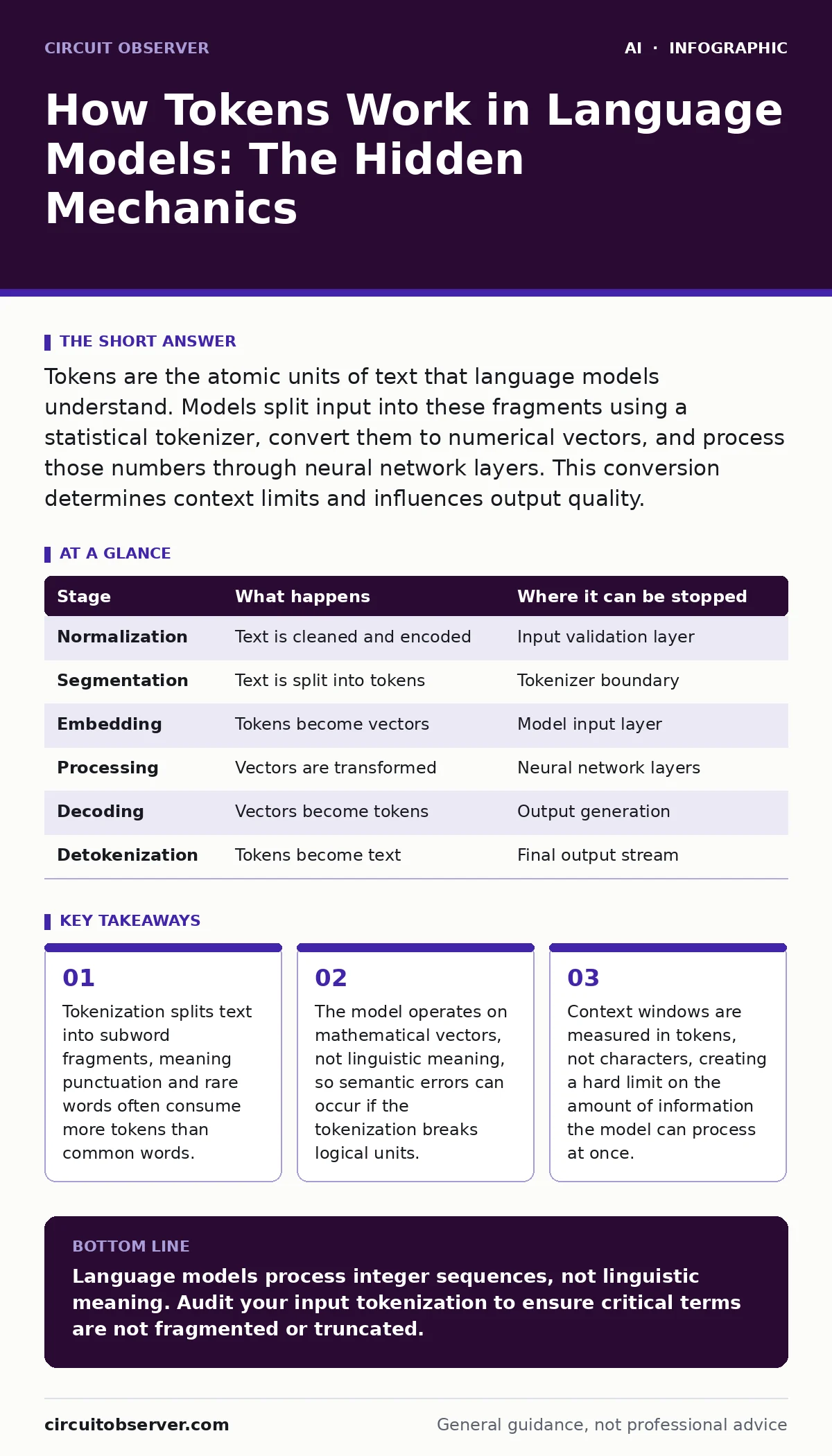
Tokens are the atomic units of text that language models understand. Models split input into these fragments using a statistical tokenizer, convert them to numerical vectors, and process those numbers through neural network layers. This conversion determines context limits and influences output quality.
The Illusion of Word Processing
You interact with a language model by typing words. The model does not see words. It sees a stream of integers. This conversion happens before the neural network processes any data. The system breaks your text into smaller units called tokens. Each token maps to a specific number in the model's vocabulary. This mapping is the first step in translating human intent into machine-readable data.
The tokenizer uses a predefined dictionary. This dictionary contains millions of possible tokens. When you type a sentence, the tokenizer scans it from left to right. It matches the longest possible sequence of characters that exists in the dictionary. If it finds a match, it assigns the corresponding integer ID. If it cannot find a match, it splits the sequence into smaller parts. This process is known as greedy matching. It is fast but can sometimes break words in unexpected places.
Stage 1: Text Normalization
Before splitting begins, the system cleans the input. This stage removes invisible formatting and standardizes character encoding. The tokenizer converts all characters to a consistent format, such as UTF-8. It may also expand contractions or remove whitespace depending on the specific implementation. This normalization ensures that "Hello" and "hello " are treated consistently. Without this step, the model would treat identical words as different tokens if their spacing varied.
This stage is often invisible to you. You assume the model understands your exact input. In reality, the model sees a sanitized version of your text. Imagine typing a special character that the tokenizer does not recognize. The system might drop it or replace it with a placeholder. This loss of fidelity happens before the model attempts to understand the meaning.
| Stage | What happens | Where it can be stopped |
|---|---|---|
| Normalization | Text is cleaned and encoded | Input validation layer |
| Segmentation | Text is split into tokens | Tokenizer boundary |
| Embedding | Tokens become vectors | Model input layer |
| Processing | Vectors are transformed | Neural network layers |
| Decoding | Vectors become tokens | Output generation |
| Detokenization | Tokens become text | Final output stream |
Stage 2: Subword Segmentation
The tokenizer now splits the normalized text into tokens. It does not split on spaces. It splits on statistical frequency. Common words like "the" or "is" usually become single tokens. Rare words or technical terms often break into multiple tokens. For example, a complex compound word might split into its root and suffix. This approach allows the model to handle millions of words without needing a vocabulary for every possible combination.
This method has a hidden cost. Meaningful units can be fragmented. If a word carries specific legal or technical weight, splitting it may dilute that precision. The model processes the parts separately. It relies on the neural network to reassemble the meaning. This reassembly is not guaranteed to be perfect. You must assume that the model understands the components, not necessarily the composite whole.
Stage 3: Vector Embedding
Each token ID converts to a high-dimensional vector. This vector is a list of floating-point numbers. The position of a token in the vocabulary determines its initial vector. This vector represents the token's semantic properties. Similar words have vectors that are close together in this mathematical space. The model uses these distances to determine relationships between concepts.
This step is where language becomes geometry. The model does not know what "king" means. It knows that the vector for "king" is a certain distance from "queen" and "man". This geometric relationship allows the model to perform analogies and reason about context. However, this representation is static at this stage. It does not yet account for the specific sentence structure.
Stage 4: Contextual Processing
The vectors enter the neural network. The model applies attention mechanisms to weigh the importance of each token relative to others. This allows the model to understand that "bank" means something different in "river bank" versus "savings bank". The attention heads look at the entire sequence of tokens. They adjust the vectors based on their neighbors. This creates a dynamic representation of the input.
This stage is computationally expensive. The complexity grows quadratically with the number of tokens. If you double the input length, the processing time increases by four times. This is why context windows have hard limits. The model cannot process infinite text because the memory required to track relationships between all tokens becomes prohibitive. You must manage your input length carefully to avoid performance degradation.
See also: How Tokenization Works: Mapping Data to Unbreakable Tokens
Stage 5: Token Generation
The model predicts the next token. It calculates the probability of every token in its vocabulary being the next one. It selects the token with the highest probability, or samples from the top candidates. This new token is then added to the sequence. The model repeats this process until it reaches a stop token or the maximum length. This autoregressive nature means each token depends on all previous tokens.
This mechanism creates a dependency chain. An error in early tokenization can propagate through the entire output. If the model misinterprets a token early on, it may generate a coherent but incorrect response. This is why precision in the initial prompt matters. The model does not have a global view of the final answer. It builds it one step at a time.
Stage 6: Detokenization
The sequence of integer IDs converts back to text. The system joins the tokens together. It may add spaces or remove artifacts introduced during tokenization. This final string is what you see. The process is not always reversible. Some tokenization schemes lose information about spacing or capitalization. You receive text that looks correct but may have subtle formatting differences from your input.
Understanding this flow reveals the limits of AI systems. The model is a statistical engine, not a reasoning agent. It manipulates numbers that represent text. This distinction matters when you evaluate outputs. For deeper analysis of how these outputs can be manipulated, see AI security testing. To understand the risks of these systems being misused, review AI-generated phishing. For monitoring the behavior of these models over time, consider AI model monitoring.
Key takeaways
- Tokenization splits text into subword fragments, meaning punctuation and rare words often consume more tokens than common words.
- The model operates on mathematical vectors, not linguistic meaning, so semantic errors can occur if the tokenization breaks logical units.
- Context windows are measured in tokens, not characters, creating a hard limit on the amount of information the model can process at once.
Language models process integer sequences, not linguistic meaning. Audit your input tokenization to ensure critical terms are not fragmented or truncated.
Frequently asked questions
How many tokens are in a word?
One word usually equals one to four tokens. Common words are one token. Rare or complex words split into multiple tokens.
Why does the model make spelling errors?
The model predicts the next token, not the next character. If the correct word is rare, the model may predict a similar but incorrect token sequence.
Can I change how tokenization works?
No. The tokenizer is fixed within the model architecture. You can only influence the input text to align with the existing vocabulary.
Does tokenization affect speed?
Yes. More tokens mean more computation. Shortening prompts by using concise language reduces token count and improves response time.
How this guide was produced: written by the Circuit Observer editorial team with AI assistance, checked against the public references listed below, and reviewed when the facts change. See our editorial policy or report an error.