
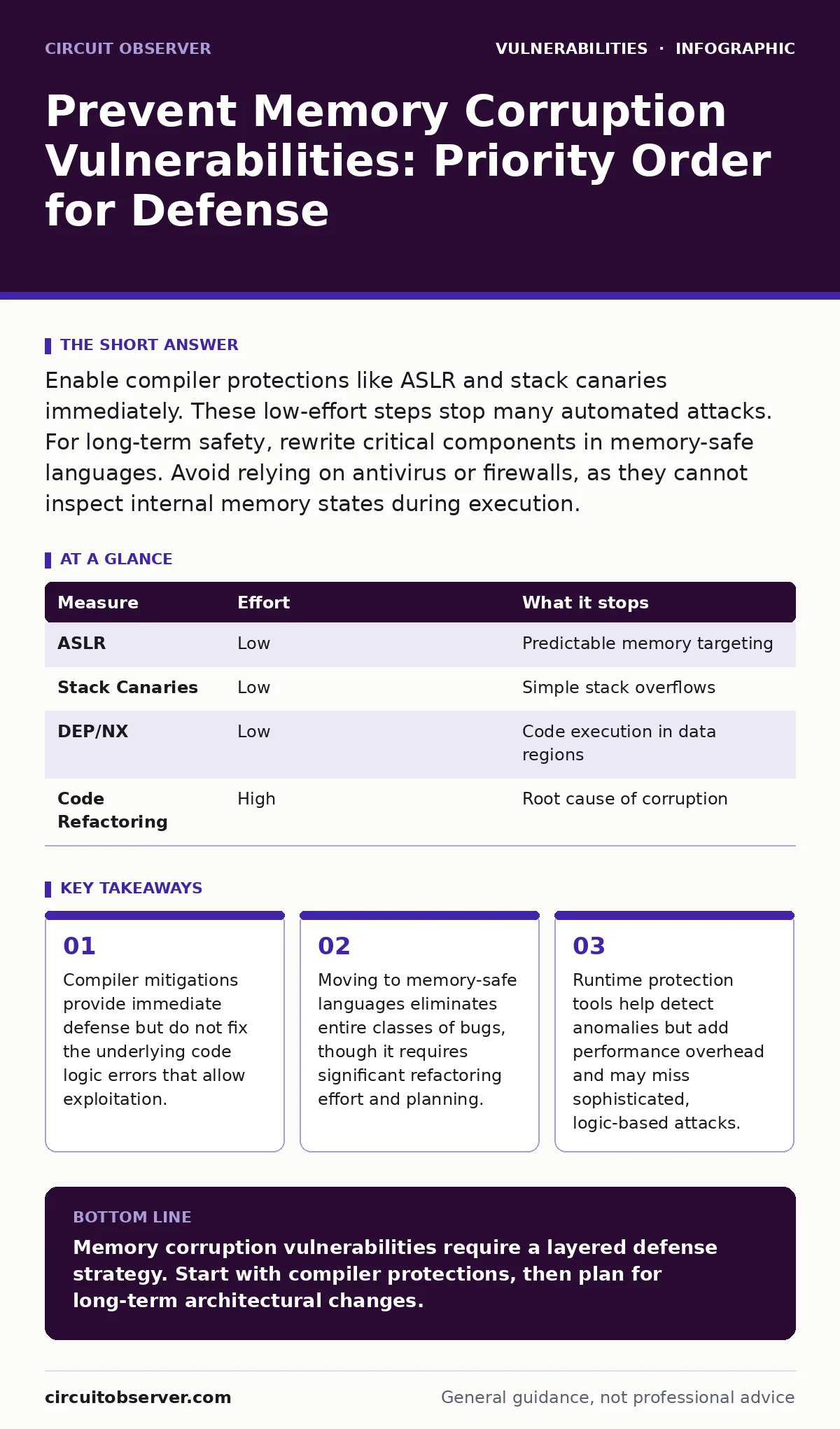
Enable compiler protections like ASLR and stack canaries immediately. These low-effort steps stop many automated attacks. For long-term safety, rewrite critical components in memory-safe languages. Avoid relying on antivirus or firewalls, as they cannot inspect internal memory states during execution.
Compiler Protections Offer Immediate Risk Reduction
Enabling compiler hardening flags is the fastest way to reduce exposure. Most modern compilers support Address Space Layout Randomization (ASLR), which randomizes the memory locations of process components. This prevents attackers from predicting where to inject code. Stack canaries place a known value before the return address on the stack.
If an overflow overwrites this value, the program terminates before executing malicious code. These measures stop simple, automated exploits that rely on predictable memory layouts. They do not prevent the overflow from occurring, but they make successful exploitation significantly harder. You should enable these flags for all production builds. This requires no code changes, only build configuration updates.
| Measure | Effort | What it stops |
|---|---|---|
| ASLR | Low | Predictable memory targeting |
| Stack Canaries | Low | Simple stack overflows |
| DEP/NX | Low | Code execution in data regions |
| Code Refactoring | High | Root cause of corruption |
Memory-Safe Languages Eliminate The Root Cause
The most effective long-term strategy is using languages that manage memory automatically. Languages like Rust or Go prevent buffer overflows by design. The compiler enforces strict ownership rules, ensuring that memory is accessed only when valid. This removes the possibility of use-after-free or double-free errors. These are common vectors for advanced persistent threats.
Migrating to such languages requires rewriting legacy code, which is costly and time-consuming. However, it removes the need for complex mitigation layers. You gain confidence that new code cannot contain these specific classes of defects. This shift changes the security posture from reactive detection to proactive prevention.
Runtime Detection Adds A Safety Net
Runtime Application Self-Protection (RASP) and similar tools monitor the application while it runs. They can detect suspicious memory access patterns and terminate the process. This provides visibility into attacks that bypass static protections. These tools are useful for detecting novel exploits that have not been seen before. They do not prevent the vulnerability from existing. They only react after the malicious behavior has started. The trade-off is performance. Constant monitoring consumes CPU and memory resources. You must balance security visibility with application responsiveness. Use these tools for high-value assets where the cost of downtime is lower than the cost of a breach.
Input Validation Must Be Strict And Complete
Even with safe languages, input validation remains a critical layer. Untrusted data can cause logic errors that lead to resource exhaustion or unexpected behavior. Validate all inputs against a whitelist of allowed values. Reject anything that does not match the expected format. This includes length, type, and range. Do not rely on client-side validation, as attackers can bypass it. Server-side validation is the final gate. Combine this with least privilege access principles. If an application component is compromised, limiting its permissions reduces the impact. It cannot access sensitive data or escalate privileges if it lacks the necessary rights.
Code Reviews Focus On Logic, Not Just Syntax
Manual code reviews should look for complex logic errors, not just syntax mistakes. Automated tools miss context. A human reviewer can spot a race condition that leads to a use-after-free error. These errors occur when two threads access memory simultaneously, and one frees it while the other still uses it. This is difficult to detect with static analysis. Reviewers should focus on data structures that manage dynamic memory. Check for proper initialization and cleanup. Look for assumptions about object lifetime. Document these checks in your review checklist. This process is slow but catches high-impact bugs that automated tools miss.
Legacy Systems Require Containment Strategies
You cannot rewrite all legacy code. For these systems, containment is the primary defense. Isolate them from the network. Use virtualization or containers to limit their access to host resources. If the application is compromised, the attacker cannot move laterally. Monitor network traffic from these systems for anomalies. Block outbound connections unless explicitly required. This reduces the value of the system to an attacker. It also limits the damage if a memory corruption vulnerability is exploited. Combine this with regular patching. Vendors often release patches for known vulnerabilities. Apply them promptly.
What Does Not Work Against Memory Corruption
Many common security measures are ineffective against memory corruption. Web application firewalls (WAFs) filter HTTP traffic, but they cannot inspect binary memory operations. Intrusion Detection Systems (IDS) look for known signatures in network traffic. Memory corruption exploits often use novel techniques that do not match known signatures. Penetration testing is valuable, but it only finds what the tester knows to look for. It cannot guarantee that all vulnerabilities are found. Do not rely on these tools as your primary defense. They are supplementary. Use them to detect attacks that bypass your primary controls.
Closing Checklist For Today
Start with the lowest effort, highest impact actions. Enable compiler protections for all new builds. Audit your build scripts to ensure ASLR and stack canaries are active. Identify the most critical legacy systems. Isolate them from the rest of the network. Begin planning a migration path for critical components to memory-safe languages. Do not wait for a breach to act.
- Enable ASLR and stack canaries in build configurations.
- Isolate legacy systems from the internal network.
- Schedule a review of critical memory management code.
Key takeaways
- Compiler mitigations provide immediate defense but do not fix the underlying code logic errors that allow exploitation.
- Moving to memory-safe languages eliminates entire classes of bugs, though it requires significant refactoring effort and planning.
- Runtime protection tools help detect anomalies but add performance overhead and may miss sophisticated, logic-based attacks.
Memory corruption vulnerabilities require a layered defense strategy. Start with compiler protections, then plan for long-term architectural changes.
Frequently asked questions
Does using a secure language guarantee no memory errors?
No. Secure languages prevent memory safety errors, but logic errors and configuration mistakes can still occur. You must still validate inputs and follow secure coding practices.
Can I patch memory corruption vulnerabilities after they are found?
Yes. Patches fix the specific code error. However, new vulnerabilities may be discovered later. Continuous monitoring and secure development practices are necessary to stay protected.
How do I know if my compiler supports these protections?
Check your compiler documentation. Most modern compilers support ASLR, stack canaries, and DEP/NX. Look for flags like -fstack-protector or -z relro in your build settings.
Is static analysis enough to find all memory bugs?
No. Static analysis misses complex logic errors and race conditions. Combine it with manual code reviews and dynamic testing to catch a broader range of issues.
How this guide was produced: written by the Circuit Observer editorial team with AI assistance, checked against the public references listed below, and reviewed when the facts change. See our editorial policy or report an error.