
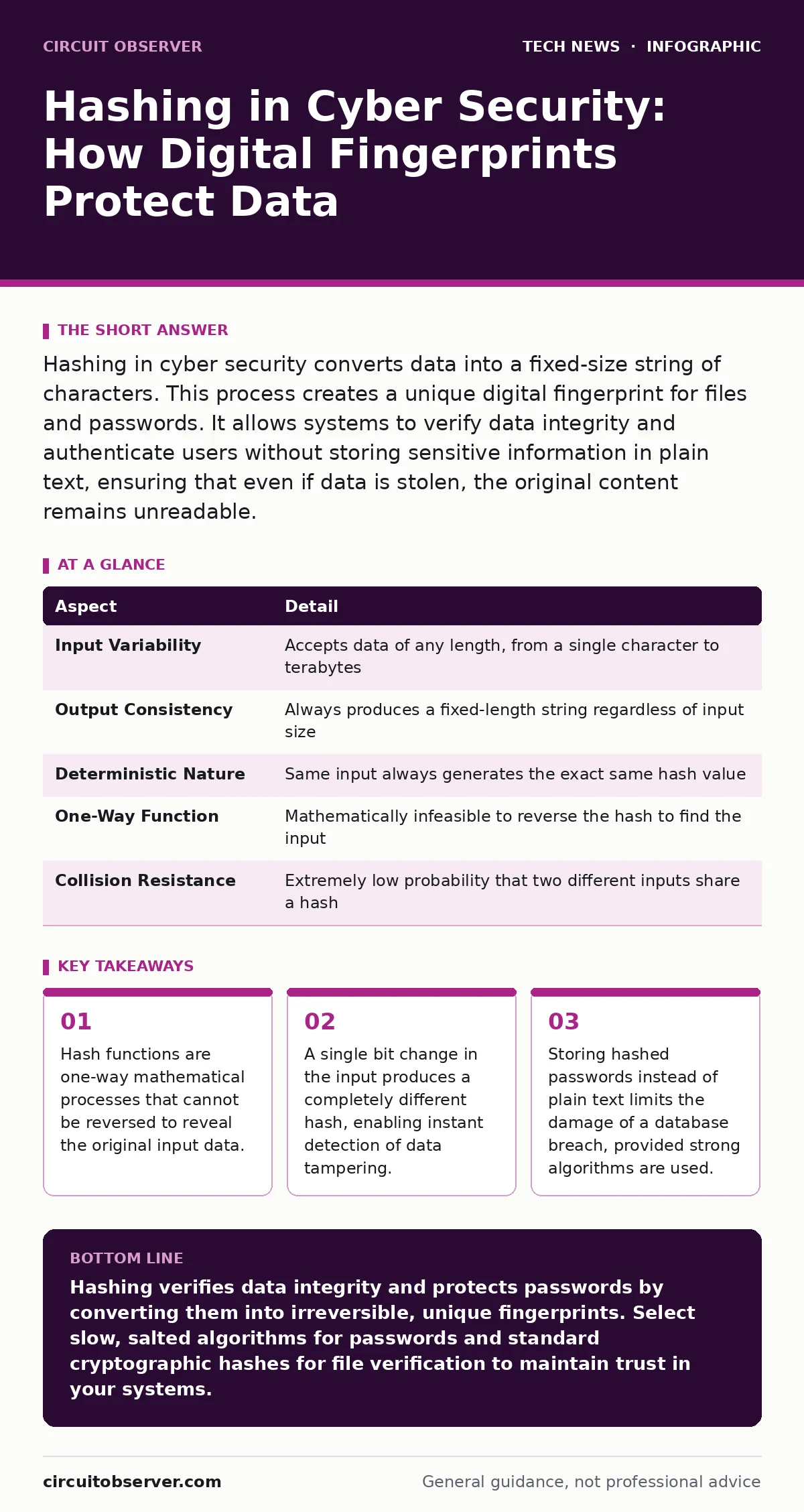
Hashing in cyber security converts data into a fixed-size string of characters. This process creates a unique digital fingerprint for files and passwords. It allows systems to verify data integrity and authenticate users without storing sensitive information in plain text, ensuring that even if data is stolen, the original content remains unreadable.
How Hashing Works in Practice
Imagine you have a secret recipe for a cake. Instead of writing down the ingredients, you bake the cake and give someone a small sample. They can taste the sample to confirm it is your specific recipe, but they cannot reverse-engineer the exact measurements or ingredients from that single bite. Hashing operates on this same principle. It takes input data of any size and produces a fixed-length output called a hash.
The mechanism relies on a cryptographic hash function. This algorithm processes the input bits through complex mathematical operations. The result is a unique string of hexadecimal characters. If you change even one letter in the original input, the resulting hash changes completely. This property is known as the avalanche effect. It ensures that similar inputs do not produce similar outputs, making it impossible to guess the original data by comparing hash patterns.
| Aspect | Detail |
|---|---|
| Input Variability | Accepts data of any length, from a single character to terabytes |
| Output Consistency | Always produces a fixed-length string regardless of input size |
| Deterministic Nature | Same input always generates the exact same hash value |
| One-Way Function | Mathematically infeasible to reverse the hash to find the input |
| Collision Resistance | Extremely low probability that two different inputs share a hash |
Why Hashing in Cyber Security Matters
Hashing protects data integrity and confidentiality simultaneously. When you download a software update, the provider publishes the hash of the file. You run a hash check on the downloaded file. If your calculated hash matches the published one, you know the file has not been altered during transit. This prevents attackers from injecting malware into legitimate software distributions.
For user authentication, systems store hashed passwords rather than the passwords themselves. When you log in, the system hashes your entered password and compares it to the stored hash. The system never sees or stores your actual password. This means that if an attacker breaches the database, they only obtain the hashes. Without the original passwords, these hashes are difficult to use directly. This approach significantly reduces the risk of credential theft.
Who Is Affected by Weak Hashing
Every organization that stores user credentials or sensitive files is affected by hashing choices. System administrators must select appropriate algorithms. Older algorithms like MD5 or SHA-1 are now considered broken. Attackers can find collisions for these algorithms, meaning they can create two different files with the same hash. This undermines the trust model of digital signatures and certificate validation.
Users are affected when they reuse passwords across multiple services. If one service uses weak hashing and suffers a breach, attackers can use rainbow tables to reverse the hashes. These tables contain precomputed hashes for common passwords. Once an attacker identifies your password, they can attempt to log in to your email, bank, or other accounts. This cascading effect makes weak hashing a systemic risk for individuals and enterprises alike.
Common Misconceptions About Hashing
Many people believe hashing is encryption. This is incorrect. Encryption is reversible with a key. Hashing is not. You cannot decrypt a hash to get the original data. Another common mistake is assuming that a longer hash is always more secure. Security depends on the algorithm's resistance to collision and preimage attacks, not just the output length.
Suppose an administrator uses a fast hashing algorithm for password storage. Speed is good for file verification but bad for passwords. Attackers can compute billions of hashes per second using modern hardware. This allows them to brute-force weak passwords quickly. Slow algorithms are preferred for passwords because they increase the computational cost for attackers. This trade-off is often overlooked in system design.
Choosing the Right Algorithm
Not all hash functions serve the same purpose. For data integrity, such as verifying file downloads, SHA-256 is a standard choice. It offers a good balance of speed and security. For password storage, you need algorithms designed to be slow. These algorithms incorporate a salt, which is random data added to the password before hashing. The salt ensures that even identical passwords produce different hashes.
Salts prevent rainbow table attacks. Without a salt, an attacker can use a single precomputed table to crack many passwords at once. With unique salts for each user, the attacker must compute a new table for every single password. This drastically increases the time and resources required. Modern password hashing functions like bcrypt, scrypt, or Argon2 include salting and key stretching by default. They are specifically engineered to resist hardware-accelerated attacks.
See also: AI Governance Best Practices: Secure Your Models
Implementing Hashing Safely
Implementing hashing correctly requires attention to detail. Always use a cryptographically secure random number generator for salts. The salt does not need to be secret, but it must be unique for each entry. Store the salt alongside the hash in your database. When verifying a password, retrieve the salt, apply it to the input, and hash the result. Then compare the new hash to the stored one.
Consider the context of your data. If you are securing data at rest on endpoints, BitLocker provides full disk encryption, which is different from hashing. Hashing verifies integrity; encryption hides content. For mobile device security, ensure that sensitive data is hashed before being cached locally. This prevents local extraction of usable credentials if the device is lost. Similarly, in data center security, hashing is used to verify the integrity of virtual machine images and configuration files.
Integrating with Broader Security Frameworks
Hashing does not exist in isolation. It works alongside other security mechanisms. When implementing SAML for single sign-on, digital signatures use hashing to ensure the integrity of the authentication assertions. If the hash of the assertion changes, the receiving system rejects it. This prevents tampering with identity tokens in transit.
For legacy systems, end-of-life hardware may lack support for modern cryptographic instructions. This forces administrators to rely on software-based hashing, which is slower and more resource-intensive. Upgrading hardware can improve performance, but the algorithm choice remains the primary security factor. Even on powerful systems, using outdated algorithms like SHA-1 leaves gaps. Regularly audit your hashing implementations. Ensure that you are using current standards and that salts are properly managed.
Key takeaways
- Hash functions are one-way mathematical processes that cannot be reversed to reveal the original input data.
- A single bit change in the input produces a completely different hash, enabling instant detection of data tampering.
- Storing hashed passwords instead of plain text limits the damage of a database breach, provided strong algorithms are used.
Hashing verifies data integrity and protects passwords by converting them into irreversible, unique fingerprints. Select slow, salted algorithms for passwords and standard cryptographic hashes for file verification to maintain trust in your systems.
Frequently asked questions
Can I reverse a hash to get the original password?
No, hashing is a one-way function. You cannot reverse it. You can only guess inputs and hash them to see if they match the target hash.
What is the difference between encryption and hashing?
Encryption hides data and can be reversed with a key. Hashing creates a fixed-size fingerprint and cannot be reversed to reveal the original data.
Why do I need a salt for password hashing?
Salts add random data to each password before hashing. This ensures that identical passwords produce different hashes, preventing attackers from using precomputed rainbow tables.
Is SHA-256 safe for storing passwords?
SHA-256 is fast, which makes it vulnerable to brute-force attacks on passwords. Use dedicated password hashing algorithms like bcrypt or Argon2 instead.
How this guide was produced: written by the Circuit Observer editorial team with AI assistance, checked against the public references listed below, and reviewed when the facts change. See our editorial policy or report an error.