
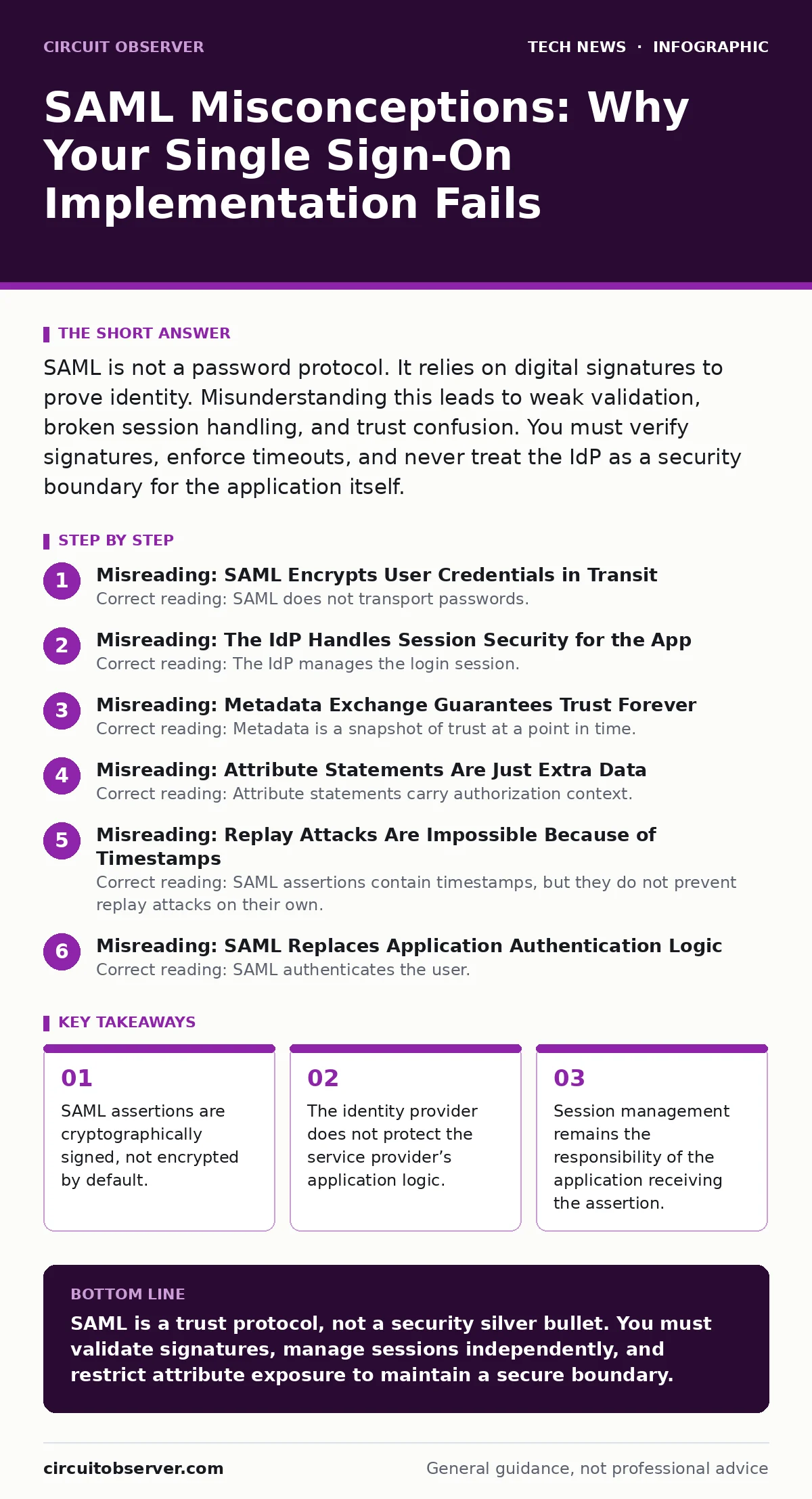
SAML is not a password protocol. It relies on digital signatures to prove identity. Misunderstanding this leads to weak validation, broken session handling, and trust confusion. You must verify signatures, enforce timeouts, and never treat the IdP as a security boundary for the application itself.
Misreading: SAML Encrypts User Credentials in Transit
Correct reading: SAML does not transport passwords. It transports an XML document called an assertion that states a user has already authenticated. The protocol relies on HTTPS for transport security, not on encrypting the payload itself.
Many assume the SAML response is a sealed envelope containing secrets. It is not. The assertion contains statements about the user, such as their email or group membership. If you rely on SAML to hide credentials from network sniffers, you are relying on TLS, not SAML.
The assertion is signed by the Identity Provider (IdP). This signature proves the document came from the trusted source and was not altered. It does not hide the contents. If an attacker intercepts the SAML response, they can read the attributes unless you explicitly configure XML encryption, which is complex and rarely implemented correctly.
This distinction matters for compliance. You cannot claim SAML provides data-at-rest or data-in-transit confidentiality for the attributes themselves. You must treat the SAML response as cleartext XML that is protected only by the transport layer.
Misreading: The IdP Handles Session Security for the App
Correct reading: The IdP manages the login session. The Service Provider (SP) manages the application session. These are two separate lifecycles that rarely sync automatically.
Imagine a user logs into their corporate IdP. They click a link to an internal tool. The tool creates its own session cookie for that browser tab. If the user logs out of the IdP, the tool may still keep them logged in.
This happens because SAML has no mechanism to remotely destroy the SP session. The SP must implement its own session timeout and logout logic. Relying on the IdP to "log everyone out" is a common failure mode.
You must configure the SP to check for session validity independently. Some protocols support back-channel logout, where the IdP notifies the SP to kill the session. This is optional and often broken in complex networks. Do not assume it works. Treat the SP session as an independent security boundary.
Misreading: Metadata Exchange Guarantees Trust Forever
Correct reading: Metadata is a snapshot of trust at a point in time. It contains endpoints, certificates, and entity IDs. If you cache it too long, you trust revoked certificates. If you fetch it too often, you risk interception during updates.
Administrators often download the IdP metadata file once and never update it. This creates a window where expired signing keys are still accepted. An attacker who obtains an old private key can forge valid assertions during this window.
Conversely, fetching metadata on every request introduces latency and potential for man-in-the-middle attacks if the update channel is not strictly verified. The metadata itself should be signed or served over a highly secure channel.
You need a balanced refresh strategy. Cache the metadata for a reasonable period, but implement a mechanism to force refresh when certificate expiration is near. Validate the signature of the metadata file itself if the IdP supports it. This prevents an attacker from injecting a malicious endpoint into your trust chain.
Misreading: Attribute Statements Are Just Extra Data
Correct reading: Attribute statements carry authorization context. They can include sensitive data like security clearance levels or internal role IDs. Leaking these attributes to an untrusted SP is a data breach.
Suppose you connect a public-facing partner application to your IdP. You authenticate the user successfully. The SAML response includes an attribute for "Department." If that attribute contains sensitive internal codes, you have just leaked it to the partner.
The IdP must enforce strict attribute release policies. These policies define which attributes go to which SP based on the SP’s entity ID. Do not use a single policy for all applications.
You must audit these policies regularly. Attributes often expand as new applications are added. A policy that was safe for an internal tool may be too broad for an external partner. Treat attributes as data, not just as tokens for login.
Misreading: Replay Attacks Are Impossible Because of Timestamps
Correct reading: SAML assertions contain timestamps, but they do not prevent replay attacks on their own. They require strict clock synchronization and short validity windows.
An attacker can capture a valid SAML assertion and resend it. If the SP does not check the NotBefore and NotOnOrAfter conditions strictly, the assertion is accepted. Even with timestamps, a small clock skew between the IdP and SP can cause valid assertions to be rejected or invalid ones to be accepted.
You must configure a tolerance window, often called clock skew tolerance. This allows for minor differences in system time. However, a large tolerance increases the window for replay attacks.
The assertion ID must also be unique. The SP should track recently seen assertion IDs to prevent immediate replays. This requires state storage on the SP, which adds complexity. Do not assume the timestamp alone is sufficient protection.
See also: How Remote Work Security Works: The Zero Trust Mechanism · User Access Provisioning: Secure Identity Without Friction
Misreading: SAML Replaces Application Authentication Logic
Correct reading: SAML authenticates the user. It does not authorize actions within the application. The SP must still enforce its own access controls.
Imagine a user authenticates via SAML. The SP receives an assertion saying the user is "Alice." The SP logs her in. If the application does not check what Alice is allowed to do, she can access any resource.
SAML does not carry permission tokens for specific API calls or database rows. It carries identity. The application must map the SAML attributes to its internal role model.
This mapping is where many security gaps appear. If the application trusts the SAML attributes blindly, and an attacker modifies the attribute in the assertion (bypassing signature checks), they gain elevated privileges. You must validate the signature before using any attribute for authorization.
Key takeaways
- SAML assertions are cryptographically signed, not encrypted by default.
- The identity provider does not protect the service provider’s application logic.
- Session management remains the responsibility of the application receiving the assertion.
- Attribute release policies define data exposure, not just authentication success.
SAML is a trust protocol, not a security silver bullet. You must validate signatures, manage sessions independently, and restrict attribute exposure to maintain a secure boundary.
Frequently asked questions
Does SAML work with mobile apps?
Yes, but mobile apps often use OAuth2 with SAML backends. Direct SAML in mobile browsers can be fragile due to session handling differences.
Can I use SAML without HTTPS?
No. SAML relies on TLS to protect the transport. Without HTTPS, assertions are exposed to interception and tampering.
How do I handle IdP certificate rotation?
Update your SP metadata configuration before the old certificate expires. Test with the new certificate in a staging environment first.
Is SAML better than OIDC?
SAML is better for enterprise legacy systems and complex attribute exchange. OIDC is simpler for web and mobile apps and provides a standard ID token format.
How this guide was produced: written by the Circuit Observer editorial team with AI assistance, checked against the public references listed below, and reviewed when the facts change. See our editorial policy or report an error.